



Brief Answer
Feeling dread about seeing clients because of a note backlog is very common and can be part of burnout, but it can also be a strong signal that your documentation system is unsustainable. Burnout usually shows up across multiple domains (emotional exhaustion, cynicism, feeling ineffective), not just in notes.
Practically, you can:
- Do a one-time backlog triage and choose a "good-enough" standard for older notes (brief, compliant, not perfectionistic).
- Put guardrails on new notes (e.g., 3–7 minutes per progress note, same day only).
- Use templated structures plus an AI scribe to turn short summaries or recordings into usable drafts so you're editing instead of writing from scratch.
- If dread, hopelessness, or emotional numbness toward clients keeps growing despite workflow changes, that's a sign to treat this as potential burnout and seek support (peer consults, supervision, therapy, medical care as needed).
The Longer Answer
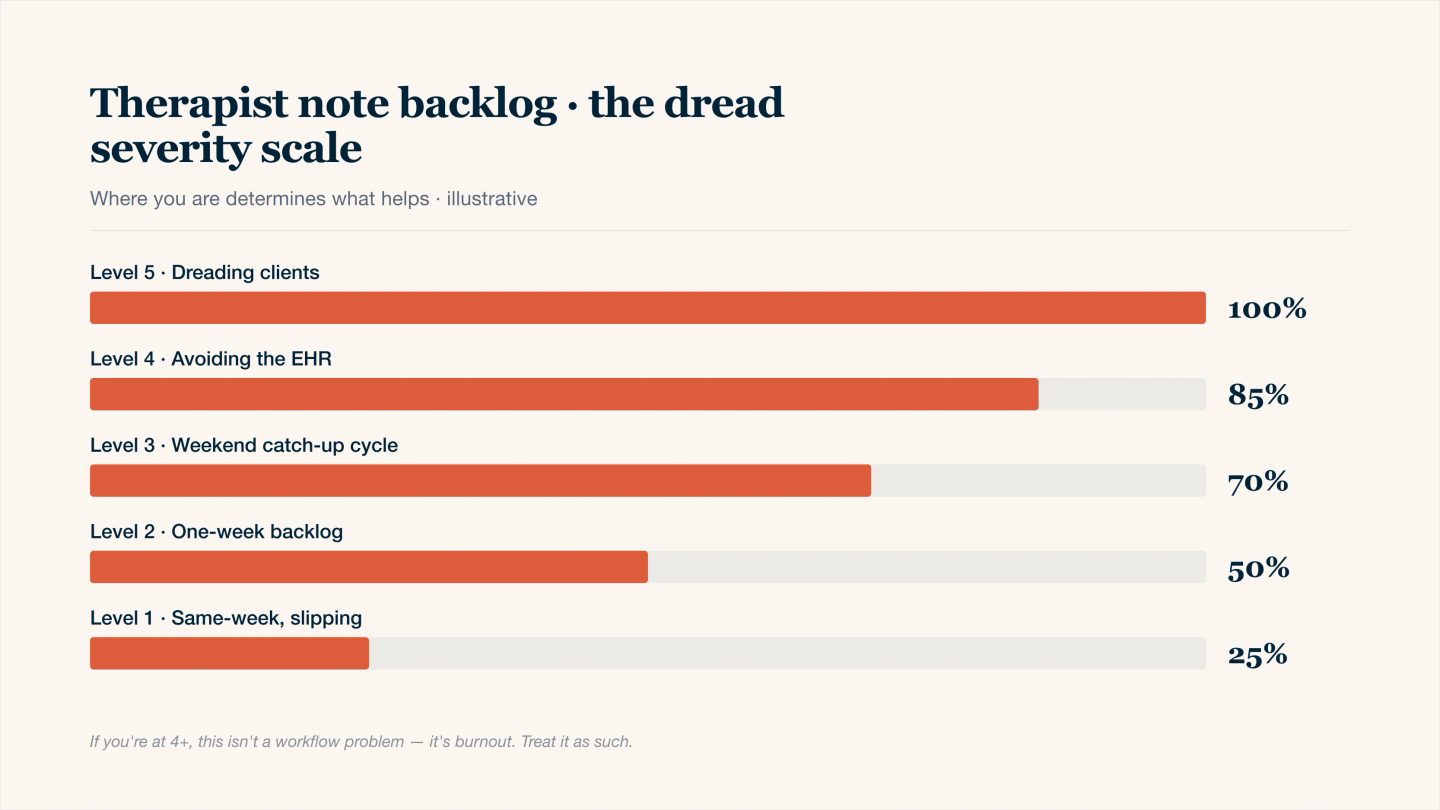
Therapist note backlog severity — where you are determines what actually helps.
1. Is this burnout or "just" documentation overload?
You don't have to self‑diagnose, but it's useful to separate symptoms of burnout from symptoms of a broken documentation system.
More about notes / workflow | More suggestive of broader burnout |
|---|---|
Dread peaks when you think about charting | Dread is present even when notes are done |
You still feel engaged during sessions but crash after | You feel numb or disconnected during sessions |
Relief when cancellations = "fewer notes to write" | Relief is more about "not having to be a therapist" today |
Anxiety is focused on audits, deadlines, admin | Global hopelessness, feeling like nothing you do matters |
Both columns can coexist. If most of your distress is clustered around documentation, then fixing the workflow can make a big dent in how you feel. If you're also feeling persistent emotional exhaustion, detachment, or significant changes in sleep/appetite/mood, it's worth treating it as possible burnout or depression and getting professional support.
2. A quick self-check: how bad is the backlog?
Two clarifying questions:
- Scope: How many notes are unfinished, and how old are they?
- Impact: How often are you staying late / working weekends because of them?
You can loosely categorize it like this:
Situation | Typical experience | Main goal |
|---|---|---|
< 1 week behind | Annoying but recoverable | Adjust workflow now so this doesn't recur |
1–3 weeks behind | Daily dread and guilt; weekends invaded | One-time "backlog sprint" + new system |
| Avoidance, shame, maybe panic about audits | Get safe, minimal, compliant notes documented and reconsider caseload/system |
If your body tenses just seeing this table, you're not alone. Many clinicians only realize how big the problem is when they write it down.
3. Short-term: getting out from under the backlog
Think of this as a one-time project, not your new normal.
Step 1: Decide a "good-enough" standard for old notes
Older notes generally don't need literary quality. Aim for:
- Date, session type, CPT code if relevant
- Brief symptoms/functional status
- 1–2 key interventions or themes
- Risk assessment (especially SI/HI, self-harm, safety plan if applicable)
- Progress toward goals
- Plan / homework / next steps
You're documenting what happened and why it was clinically reasonable, not capturing every minute.
Step 2: Block time specifically for backlog
- Protect 2–3 blocks per week (e.g., 60–90 minutes) solely for backlog notes.
- During that time, don't see clients, check email, or do billing. Backlog only.
- Start with the most recent notes (you remember them better and they're more likely to be reviewed).
Step 3: Use tools + templates to speed up
- Pick a single template (SOAP, DAP, BIRP, or Progress) and stick with it for the backlog.
- For each client, jot a 2–3 line summary or dictate a quick recap and let AI help shape it into that template.
- Avoid perfectionism: if the note is accurate, complete enough, and readable, move on.
Your aim: get back to same‑week documentation, then same‑day.
4. Medium-term: designing a week that doesn't create backlog
Once the backlog is shrinking, you want a system that keeps it from coming back.
Consider these anchors:
- Same-day rule: No session goes to the next day without at least a skeleton note.
- Time budget: 3–7 minutes per standard progress note, 10–20 minutes for intakes/treatment plans.
- Micro-blocks for notes:
- 3–5 minutes right after each session or
- Two documentation blocks per day (midday + end-of-day).
- One main format: Use one "default" note style for most clients so your brain runs the same script every time.
- Reduce cognitive load:
- Pre-fill diagnosis and long-term goals.
- Use standard phrasing for your common interventions (CBT, EMDR, ACT, psychodynamic, etc.).
- Have a few standard ways to phrase progress or lack of progress.
The emotional shift often comes when your brain trusts: "Notes get done inside work hours. Weekends are not for charting."
5. When to treat this as burnout and seek more support
Even with a better system, it's important to pay attention to your overall wellbeing. Consider reaching out for professional support (supervisor, peer consult, therapist, primary care/psychiatry) if you notice:
- Persistent emotional exhaustion that doesn't ease with rest.
- Growing cynicism or detachment from clients.
- Feeling ineffective or like nothing you do matters.
- Significant changes in sleep, appetite, or mood.
- Thoughts of self-harm or that your clients would be "better off without you."
This page can't diagnose you. It's meant to help you differentiate a solvable documentation problem from a broader mental health issue and to encourage you to get help sooner rather than later if you're worried about burnout or depression.