


A play therapy progress note translates how a child used play to communicate and regulate into clinical language. It doesn't need to list every toy the child touched. Many clinicians find it challenging to convert symbolic play into language that satisfies payers, informs parents, and preserves the integrity of the child's inner world. This guide provides a complete sample note, breaks down the core components of a progress note, and shows how to document both child‑centered and directive sessions.
A Complete Play Therapy Progress Note
Below is a sample progress note:
Session Context and the Presenting Concern
- Client: J.S.
- Session Type: Individual play therapy (child-centered).
- Duration: 45 minutes.
- Presenting Concern: Difficulty expressing worries verbally; separation anxiety; frequent reassurance-seeking at school drop-off.
- Treatment Goal Addressed: J.S. will identify and express at least one feeling related to separation and use a coping strategy when distressed, in 4 or 5 sessions.
Observed Play Themes and Symbolic Content
- Play Materials Chosen: Sand tray, miniature family figures, a small fence, and a toy dog.
- Play Narrative: J.S. buried the "child" figure under sand, then placed the "mother" figure far away. The dog circled the buried figure repeatedly. After several minutes, J.S. dug the child figure out of the sand and placed it next to the dog.
- Clinical Observation: The play sequence suggested themes of separation, vulnerability, and a search for protection. The shift from burial to reunion marked a move toward mastery.
Clinician Interventions and Child's Response
- Interventions Used:
- Reflective listening ("I see you've buried him deep, and the dog is watching over him").
- Tracking ("You're moving the mother farther away").
- Emotion labelling ("That feels lonely").
- Response to Intervention: J.S. nodded, maintained eye contact, and began narrating the dog's actions ("He's looking for him"). When the therapist reflected, "The dog keeps looking until he finds him", J.S. smiled and said, "He's brave." This represents an emerging capacity to articulate protective quality.
Progress Toward Goals and Plan
- Progress Noted: J.S. initiated the symbolic expression of separation without prompting and shifted the narrative toward resolution. This aligns with the internal growth objective of increased emotional expression through play.
- Plan: Continue child-centered sessions; introduce a predictable "hello/goodbye" ritual with the miniature figures to reinforce mastery; consult with caregiver about a consistent drop-off routine.
- Risk/Safety: No risk concerns observed or reported.
- Caregiver Involvement: Caregiver will be updated with themes (not specific play content) and invited to practice a brief transition ritual at home.

How to Turn Playroom Observations into a Defensible Note
Best practices for play therapy progress notes.
Document Play Themes
The note should capture what the play was doing rather than listing every material used.
What to Record:
- Repetition: Did a scene repeat?
- Affect Shift: Did the child's emotional tone shift?
- Relational Position: Where was the child in the play?
- What to Omit: Verbatim dialogue that does not serve the treatment plan.
State the Intervention with Clinical Precision
Payers and supervisors need to see what the therapist did and why it was a therapeutic choice.
Examples:
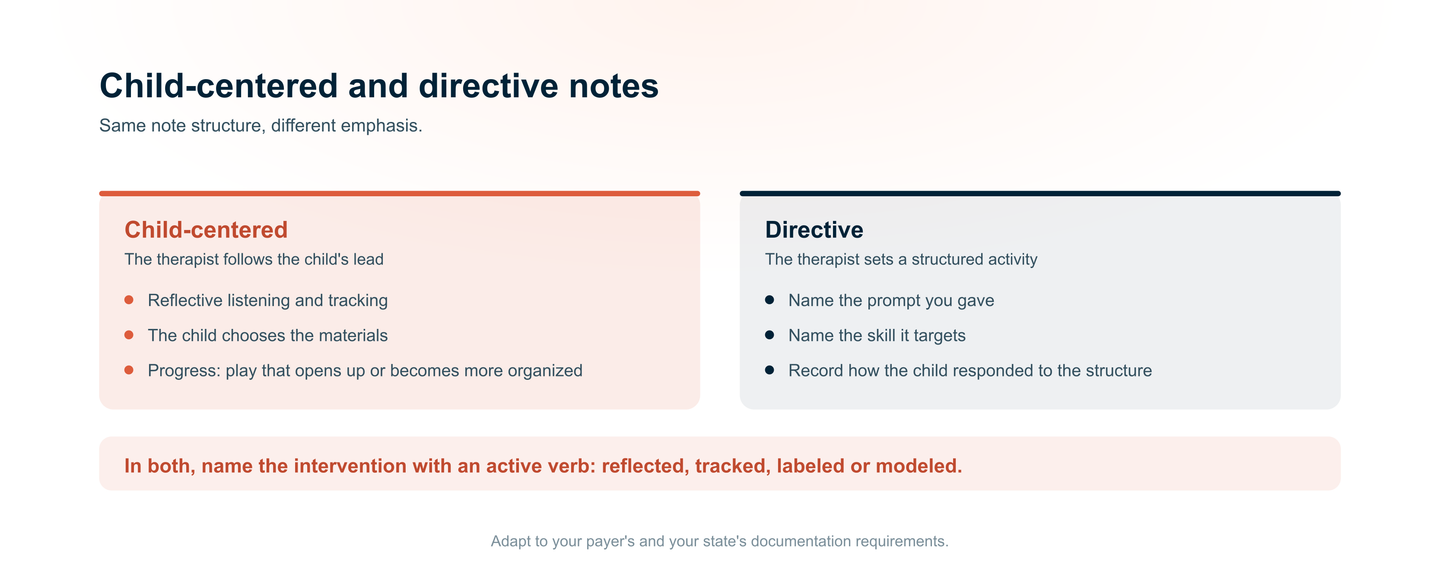
- Child-centered: "Therapist used reflective listening and tracking to follow the child's lead and communicate unconditional acceptance."
- Directive: "Therapist introduced a structured sand tray prompt: 'Show me a place where you feel safe'"
- Tip: Use an active verb (reflected, labeled, modeled) to anchor the intervention in observable behavior.
Link the Child's Response to Progress Toward Goals
A progress note must answer: Did anything move? Even a "no progress" session can be documented as "child remained in repetitive play with no observable shift".
Template Sentence:
- "Child [response] when therapist [intervention], which [supports/does not yet support] the goal of [goal language]."
Child-Centered Session Note Example
What makes this note Child‑Centered?
- Therapist Stance: Follows the child's lead; uses reflective statements, tracking, and limit setting only when necessary.
- Play Content: Child chooses materials; themes then emerge spontaneously.
- Progress Marker: A shift from constricted to expansive play or from disorganized to organized narrative.
Sample Note
C.W. entered the playroom and immediately moved to the dollhouse. She placed the 'baby' in a corner and covered it with a blanket. Therapist tracked: 'You're hiding the baby'. C.W. replied, 'She's sleeping'. Over 15 minutes, C.W. returned repeatedly to the covered baby, occasionally peeking underneath the blanket. Therapist reflected the repetition: 'You keep checking on her.' C.W. eventually removed the blanket and placed the baby in the mother figure's arms. Therapist labeled: 'She's safe now.' C.W. nodded and began feeding the baby.
Assessment: C.W. used repetitive hiding and checking play to explore themes of presence and safety, then initiated a resolution sequence independently. This represents progress toward the goal of increased symbolic expression of separation‑related affect.
Directive Session Note Example
- Therapist Role: Introduces a specific activity with a therapeutic purpose (e.g., psychoeducation, trauma narrative)
- Structure: The note should name the directive prompt and the skill targeted.
Sample Note
"Therapist introduced a 'feelings volcano experiment' (baking soda, vinegar, food coloring) to externalize anger. Therapist prompted: 'Show me what happens when the volcano erupts; what does your body feel like?' Client (age 9) added vinegar slowly, narrating: 'It's bubbling but it's not exploding.' Therapist modeled a breathing strategy: 'Let's see if we can make it fizz without overflowing.' Client practiced three slow breaths before adding more vinegar.
Assessment: Client demonstrated the capacity to pause and use a breathing technique before a potentially activating task, directly aligned with the treatment goal of increasing coping‑skill use when frustrated."
What to Share with Parents (and What to Protect)
- One Observation: A jargon-free description of what the child did.
- One Meaning: A respectful interpretation tied to a capacity.
- One Invitation: A simple way the parent can reinforce the same capacity at home.
Sample Parent Update Language
"Today J.S. played a scene where a dog kept looking for a buried figure until he found him. That kind of play often reflects a child working on trust and reunion. At home, you might try a short goodbye ritual: one hug and 'I'll always come back', to give him a predictable anchor."
Conclusion
Effective play therapy progress notes translate the language of play into the language of outcomes, without stripping the playroom of its therapeutic power. Use a structured template as a starting point, but review every note through the dual lens of clinical integrity and readability. For a faster starting point, explore our play therapy note generator (which handles the formatting so you can focus on the clinical translation) and see our broader guides on documenting better in pediatrics and progress notes for complementary workflows.