


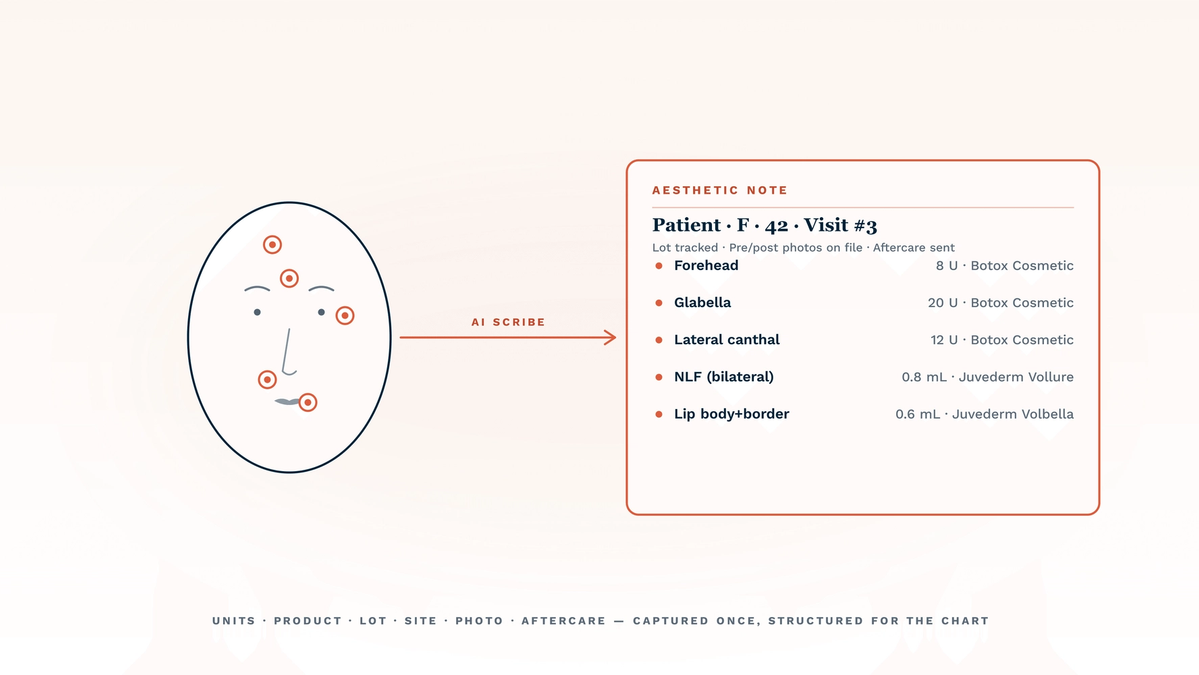
For most medspas in 2026, Twofold Health is the strongest overall AI scribe. It pairs customizable injectable, filler, and laser templates with structured fields for units, product, lot number, and anatomic site, an EHR‑agnostic workflow that travels across PatientNow, Aesthetic Record, Symplast, Nextech, Mangomint, and Zenoti, same‑day setup with no procurement, and a single transparent plan at $49/mo annual per clinician. That combination matches how independent medspas actually buy.
Medspa documentation is genuinely different from primary care. Every neuromodulator visit has units per anatomic site. Every filler visit has product, lot, and volume per site. Every laser visit has device‑specific settings. Every visit has photo capture and aftercare. The right AI scribe captures that structure as fields, not as a narrative paragraph that gets lost on review.
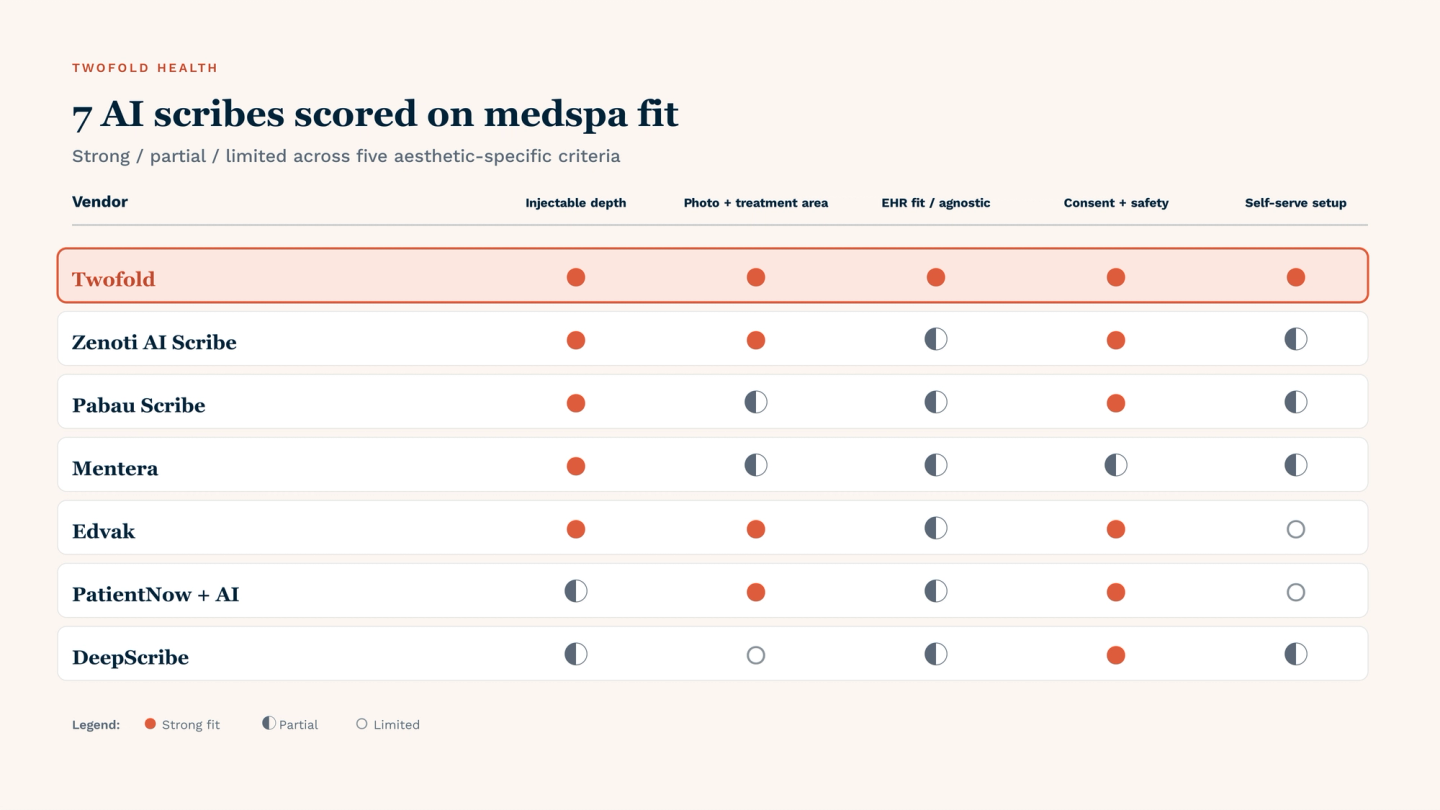
This is an opinionated, first‑person listicle. From my work with medspa clinicians — solo injectors, multi‑room aesthetic practices, derm‑adjacent cosmetic clinics — I've ranked seven AI scribes on five criteria that matter specifically for aesthetic medicine. Each vendor gets honest credit for its actual strengths, and an honest call‑out on where it isn't the structural best fit.
What makes an AI scribe good for medspas specifically
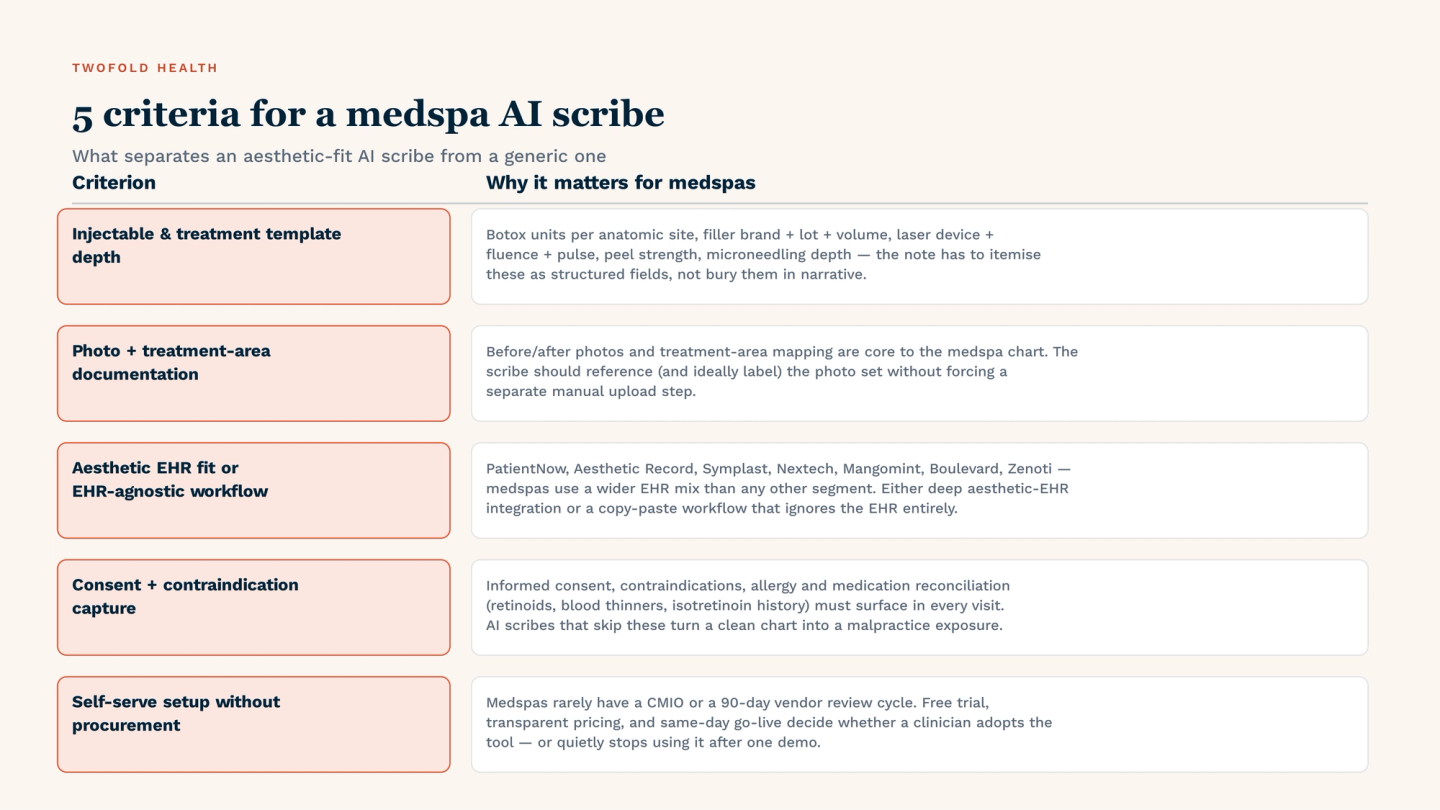
Five criteria separate a medspa‑fit scribe from a generic SOAP tool. The first is injectable and treatment template depth — Botox units per site, filler brand and lot and volume, laser device and fluence and pulse, peel strength, microneedling depth. The chart needs these as structured fields, not buried in prose.
The second is photo and treatment‑area documentation. Before/after photos and treatment‑area mapping are core to the medspa chart; the scribe should reference (and ideally label) the photo set without a separate manual upload step. The third is aesthetic EHR fit or an EHR‑agnostic workflow — medspas use a wider EHR mix than any other healthcare segment (PatientNow, Aesthetic Record, Symplast, Nextech, Mangomint, Boulevard, Zenoti), so either deep aesthetic‑EHR integration or a paste‑in workflow that ignores the EHR entirely.
The fourth is consent and contraindication capture. Informed consent, contraindications, and medication reconciliation (retinoids, blood thinners, isotretinoin history) have to surface in every visit — AI scribes that skip these turn a clean chart into malpractice exposure. The fifth is self‑serve setup without procurement. Medspas rarely have a CMIO or a 90‑day vendor review. A free trial, transparent pricing, and same‑day go‑live decide whether the clinician adopts the tool or quietly drops it after the demo.
Best AI scribes for medspas in 2026: ranked
1. Twofold Health — best overall for medspas
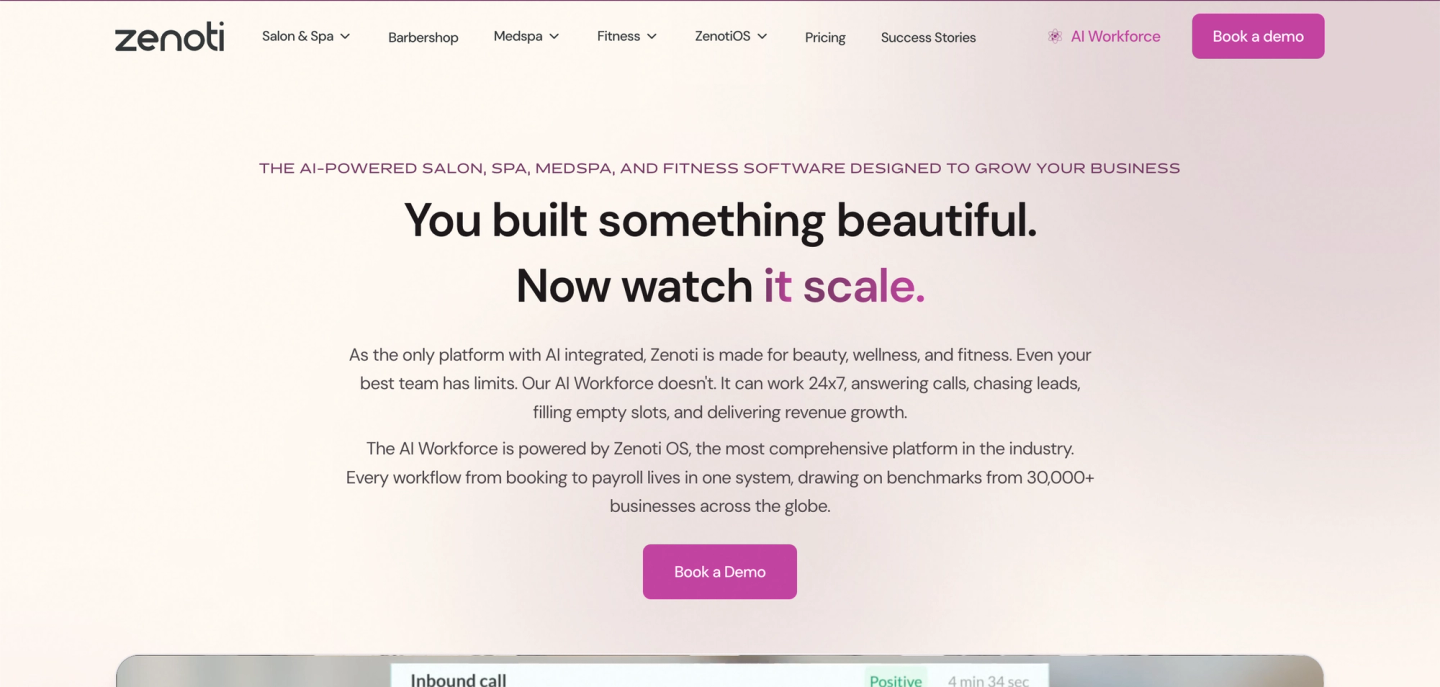
Twofold is the strongest overall AI scribe for medspas in 2026. Its template library ships with customizable formats that can be tuned to a medspa's specific workflow — Botox units per anatomic site with structured product + lot fields, filler volume per site with cannula/needle marker, laser device parameters with fluence and pulse, and aftercare blocks per treatment type. The same template surface handles consultation visits, follow‑ups, and combination treatments. The Twofold AI scribe for medical spas solution page walks through the typical injectable + laser workflow in detail.
Pricing is a single Personal plan at $49/mo annual per clinician (or $69/mo monthly), full features, no tier gates. The EHR‑agnostic paste‑in workflow travels across PatientNow, Aesthetic Record, Symplast, Nextech, Mangomint, Boulevard, and Zenoti without requiring a particular EHR architecture — and stays useful if the practice switches platforms later. Same‑day setup with no procurement matches the independent‑medspa buying motion.
Compliance posture is conservative: audio is deleted by default after the note is drafted, the BAA covers the full subprocessor chain, and the training‑data policy does not use patient audio to train the model. Based on each vendor's published policy at the time of writing, that's a tighter default set than most alternatives in this list.
Honest fit limitation: Twofold is not an aesthetic‑EHR‑native product the way Edvak or PatientNow + AI are. For a medspa already locked into one aesthetic EHR and wanting the scribe to live entirely inside that EHR's UI, the native option will have tighter platform integration than a paste‑in workflow. For everyone else — multi‑EHR medspas, EHR‑curious medspas, medspas still using scheduling‑tool‑as‑EHR — Twofold is the structural fit.
2. Zenoti AI Scribe — best if you're on Zenoti
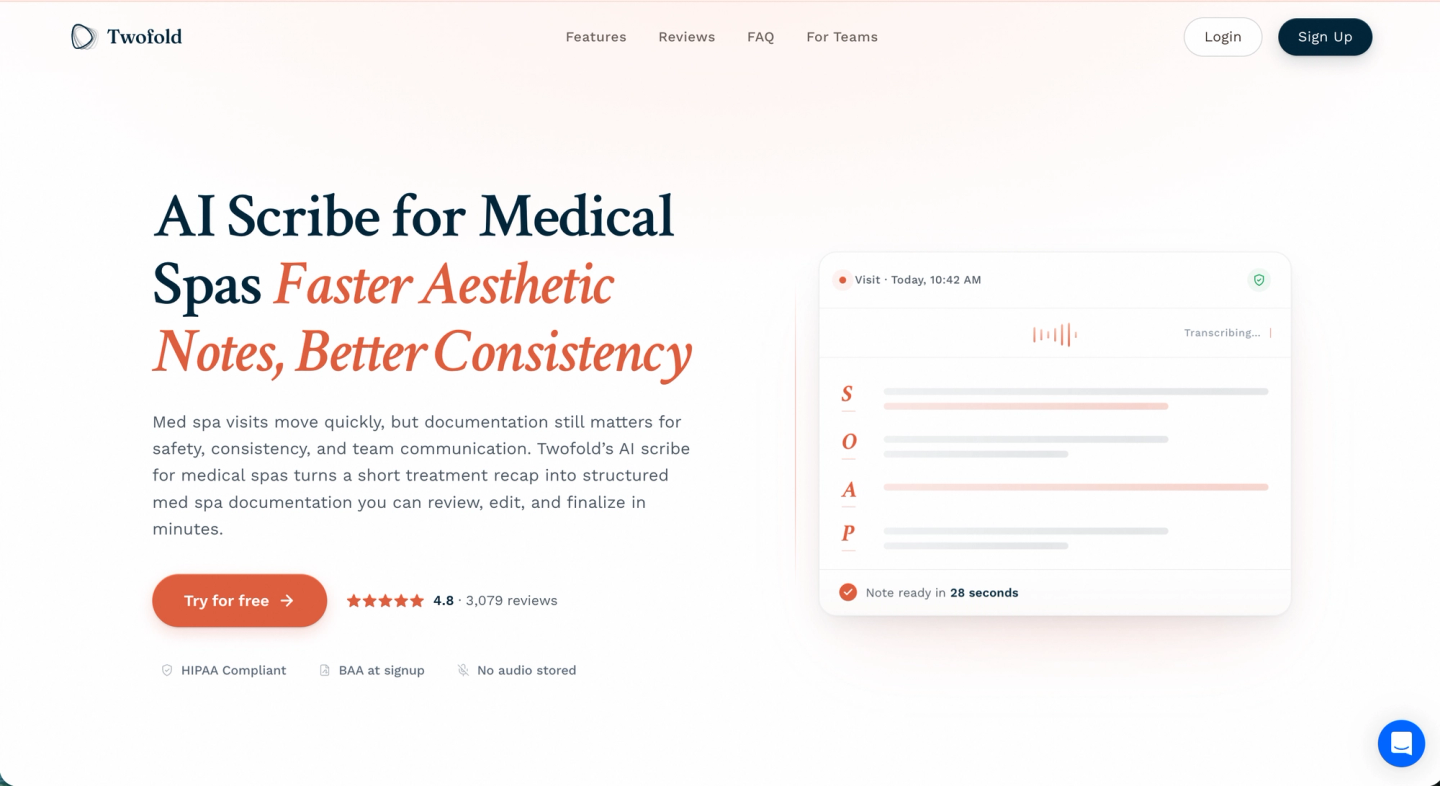
Zenoti AI Scribe is the strongest pick for medspas already running on Zenoti's all‑in‑one aesthetic platform. It's optimized for aesthetic visits (injectables, consults, laser treatments, facials, combination services), transcribes in real time, populates Zenoti's custom charts directly, and turns captured treatment data into marketing audiences within the same platform.
The trade‑off is platform lock‑in. Zenoti AI Scribe is most useful for practices that have already committed to Zenoti as the operational platform. For medspas using Zenoti alongside another EHR or scheduling tool — or for medspas not on Zenoti at all — the integration benefit doesn't carry over, and the value proposition drops to that of a general aesthetic scribe.
Best fit: medspas already on Zenoti who want a deeply integrated scribe + CRM + marketing motion. Less ideal: practices using a mix of platforms or evaluating before committing to Zenoti.
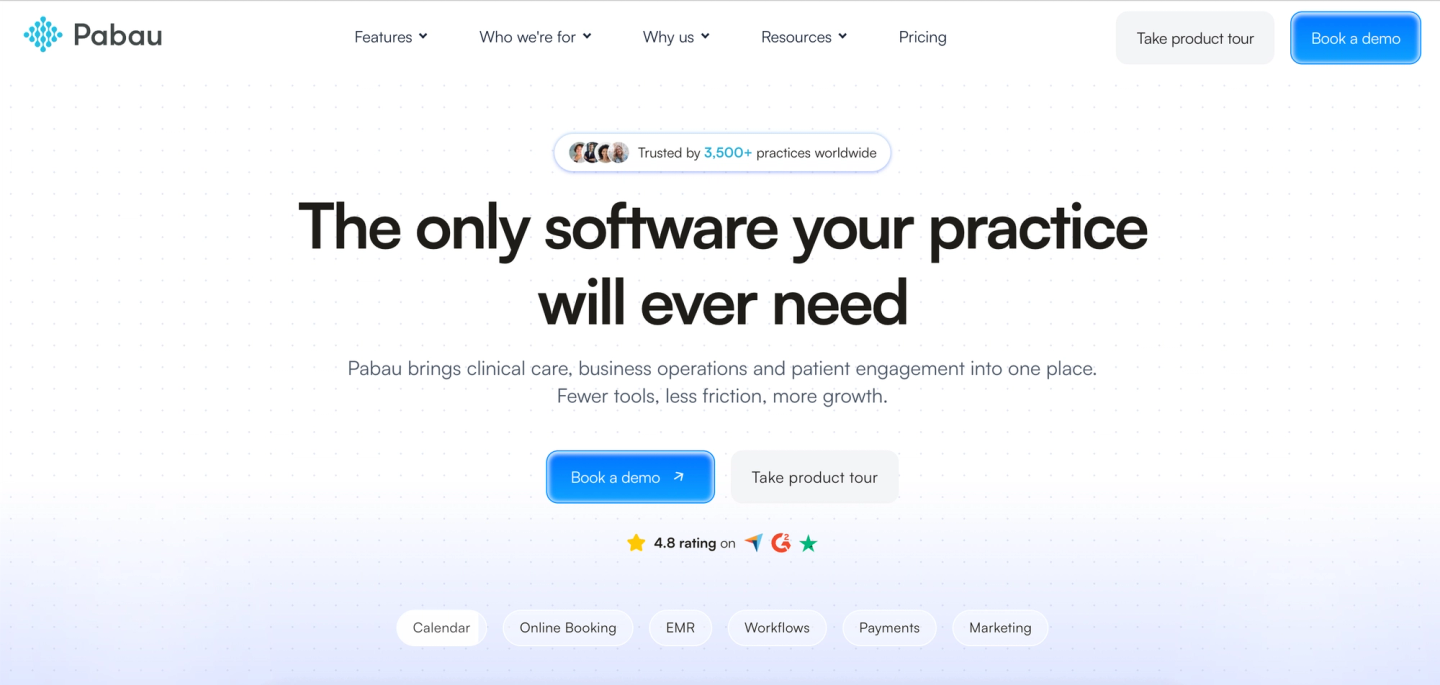
3. Pabau Scribe — best on Pabau (UK / EU strength)
Pabau is one of the most widely‑adopted practice management platforms in UK and EU aesthetic medicine, and Pabau Scribe is its in‑platform AI scribe. For practices already on Pabau, the integration is meaningfully deeper than any bolted‑on alternative — charts, treatments, products, and inventory all live in one system, and the scribe writes directly into the structured fields the platform already uses.
Outside the Pabau ecosystem, Pabau Scribe doesn't travel — it's not a standalone product. The honest positioning is platform‑dependent: extremely good if you're a Pabau practice (especially in the UK/EU markets where Pabau is dominant), structurally non‑applicable if you're not.
Best fit: UK/EU medspas and aesthetic practices on Pabau. Less ideal: US medspas not on Pabau, or any practice unwilling to migrate platforms for the scribe.
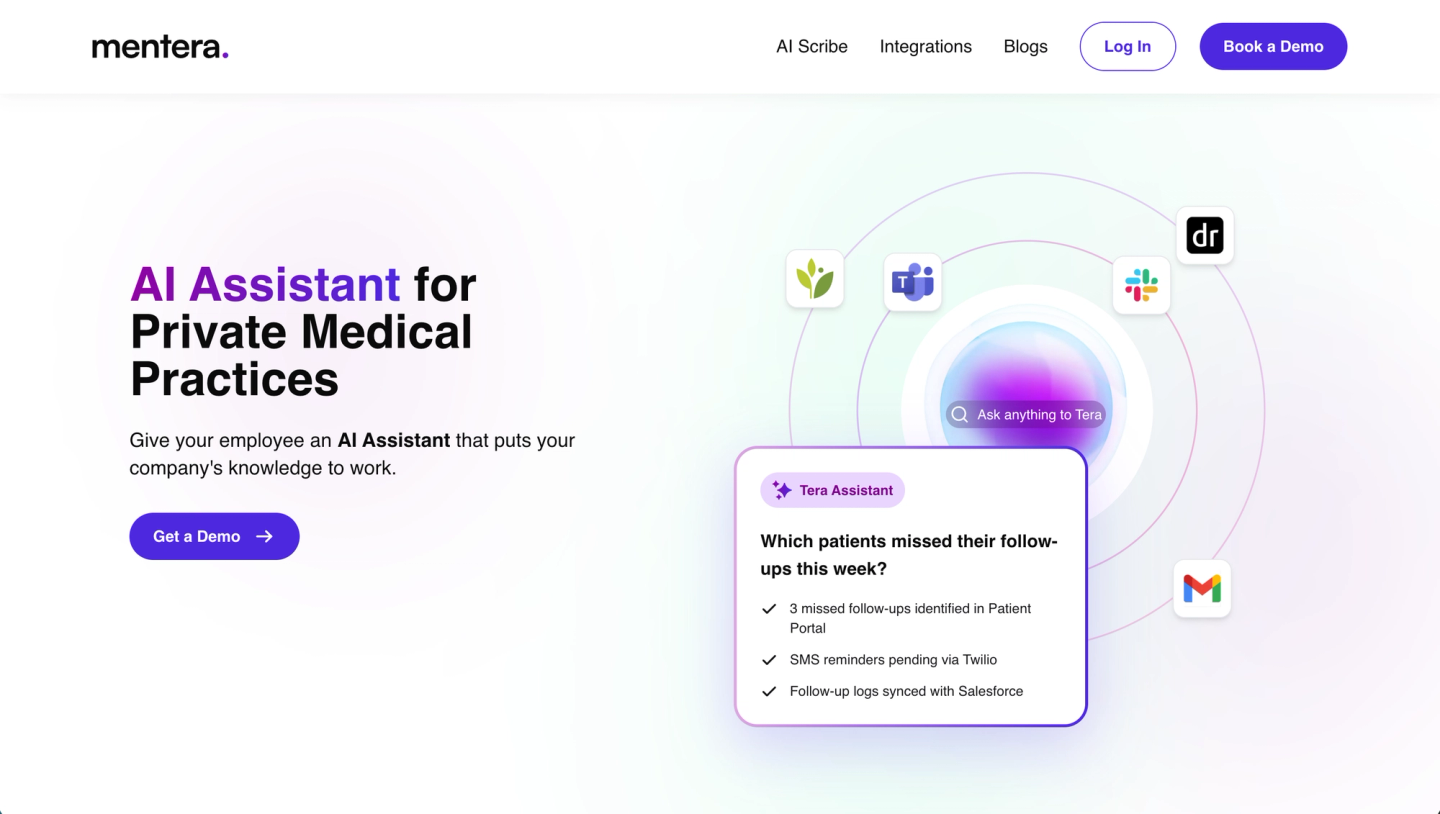
4. Mentera — aesthetics-specific terminology depth
Mentera positions itself explicitly as an aesthetics‑first AI tool, with terminology depth that covers neuromodulator dosing patterns, filler placement vocabulary, laser parameter language, and the cannula‑vs‑needle distinction that generic medical scribes routinely miss. For solo or small‑team aesthetic practices that want a tool that already speaks the language, Mentera is credible.
It's a newer and narrower product than the more mature general‑purpose scribes. EHR integrations are more limited, the compliance default disclosures are less detailed than the established vendors, and self‑serve evaluation is less polished. The terminology fit is the strongest card.
Best fit: aesthetic practices where terminology depth is the gating concern and the team is willing to evaluate a newer, narrower product. Less ideal: practices that want a mature, broad‑EHR‑integration scribe with a long compliance track record.
5. Edvak — AI-native EHR purpose-built for US medspas
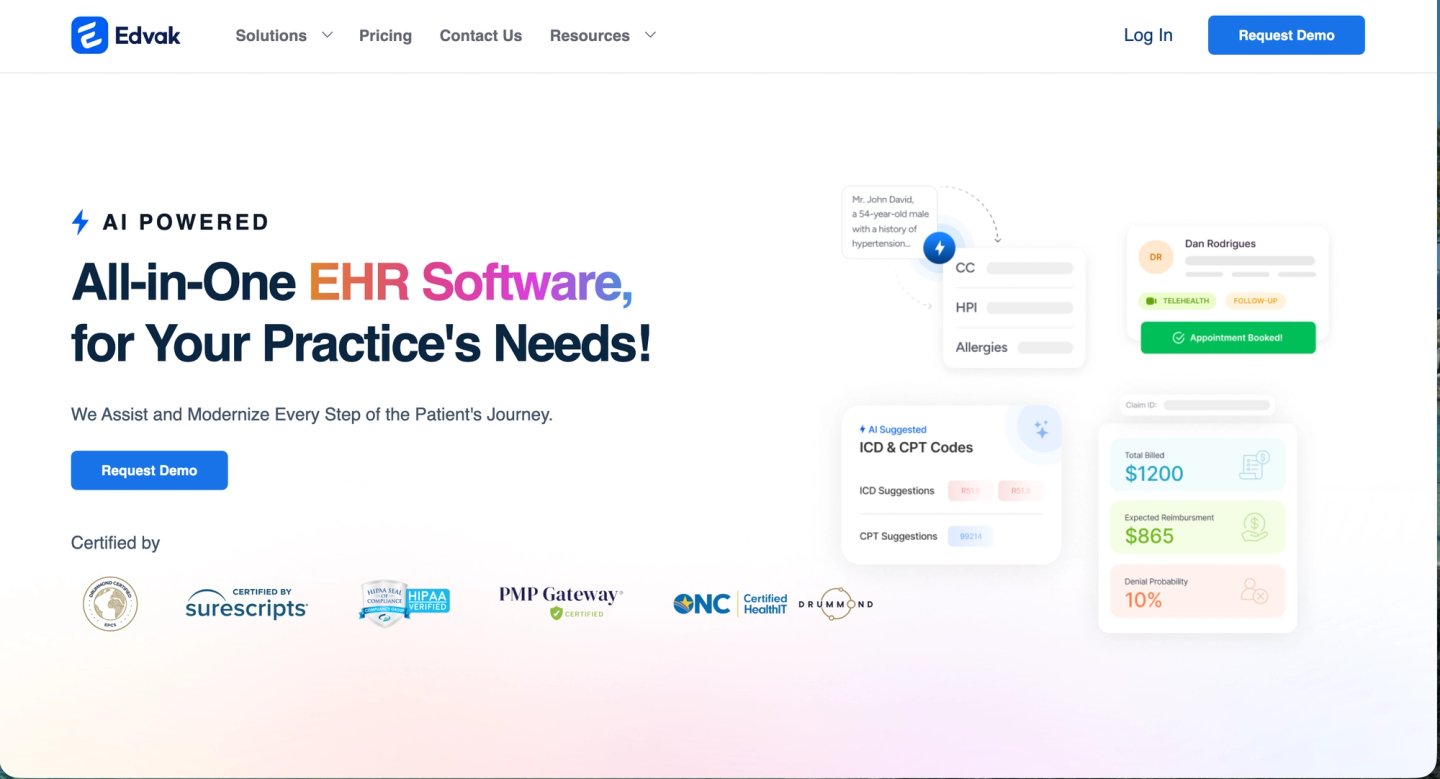
Edvak is positioned as an AI‑native EHR built specifically for US medspa and aesthetic clinics, with the AI scribe wired directly into billing, inventory, patient communication, and analytics inside a single platform. For practices ready to commit to a single all‑in‑one system from the ground up, Edvak's architecture is genuinely ambitious — the scribe doesn't just write a note, it logs lot numbers, decrements inventory, and structures follow‑up scheduling in the same step.
The trade‑off is platform commitment. Edvak is most useful when adopted as the medspa's primary EHR, not as a scribe layer over an existing system. For practices already on PatientNow, Aesthetic Record, or another established aesthetic EHR, the value of Edvak's all‑in‑one design depends on a platform migration, which is a bigger decision than choosing a scribe.
Best fit: newer medspas or growth‑stage practices ready to standardise on a single AI‑native EHR. Less ideal: established practices already deeply on PatientNow, Aesthetic Record, or similar.
6. PatientNow + AI — best inside the dominant aesthetic EHR
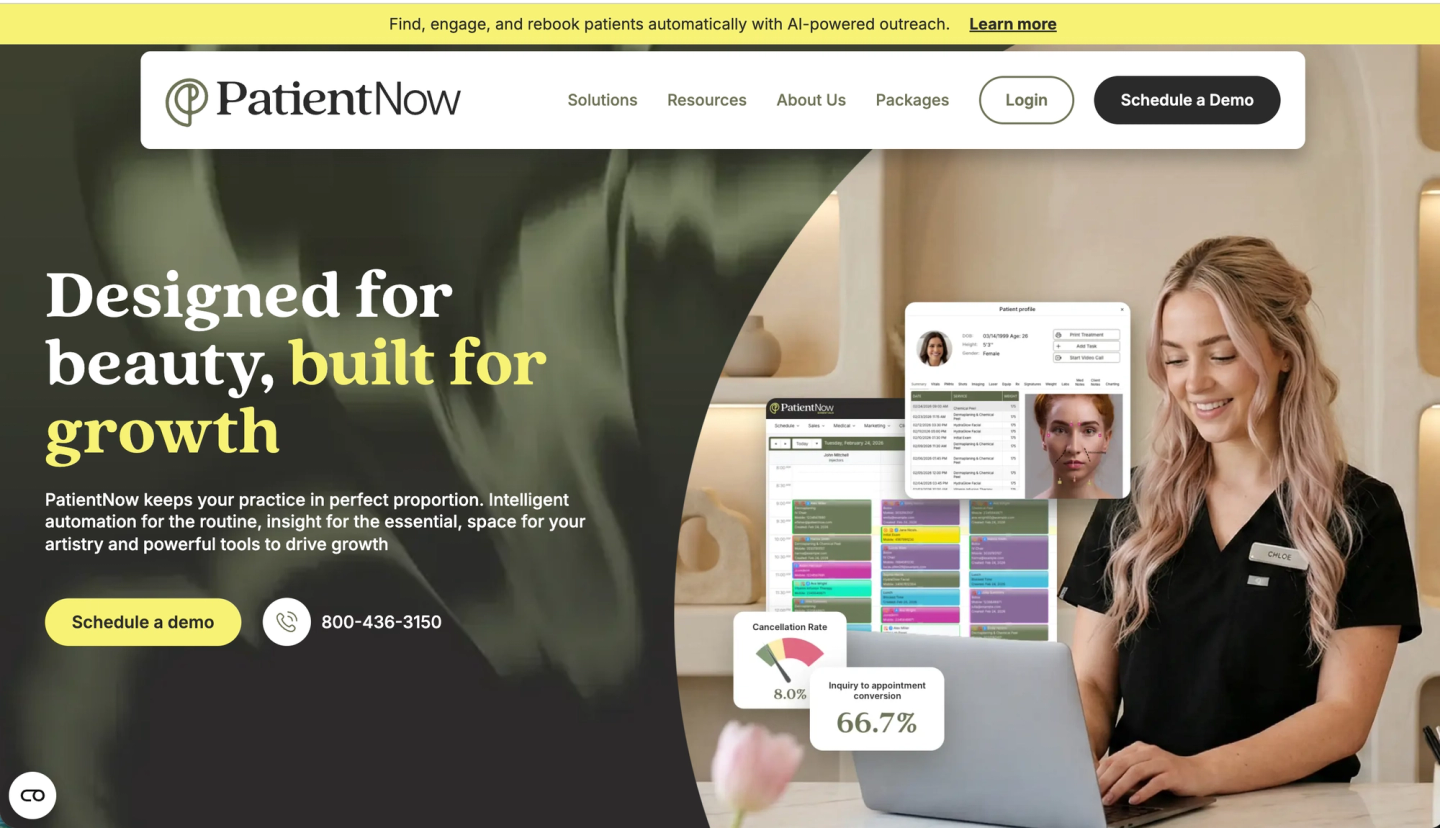
PatientNow is the most widely‑adopted aesthetic‑specific EHR in the US market, with 20+ years focused on medical aesthetics and plastic surgery. Its AI documentation features are integrated directly into the platform that many medspas already use as their system of record — charts, photos, scheduling, and revenue all live there.
For PatientNow practices, the in‑platform AI features are the natural first option to evaluate. Outside the PatientNow ecosystem, the AI capabilities don't extend, so the comparison reduces to whether the practice is committed to PatientNow as its EHR or evaluating alternatives. PatientNow's AI feature set is still maturing relative to dedicated scribe vendors, and the practice should compare directly on injectable / filler / laser template depth before deciding.
Best fit: established medspas already on PatientNow as their EHR. Less ideal: practices not on PatientNow, or practices on PatientNow but evaluating whether to switch.
7. DeepScribe — general-purpose with derm-adjacent depth
DeepScribe is one of the more mature general‑purpose AI scribes, with the strongest specialty‑template depth among the broad‑market vendors — including dermatology, which is the closest specialty to aesthetic medicine. For dermatology‑adjacent aesthetic practices (cosmetic dermatology, medspas attached to dermatology clinics), DeepScribe's specialty depth carries over more usefully than its lack of explicit medspa positioning suggests.
It's not an aesthetics‑first product. Injectable and laser templates exist but aren't the primary workflow DeepScribe is calibrated for, and pricing is sales‑led rather than self‑serve — which adds procurement weight compared with the medspa‑typical buying motion. For a pure cosmetic medspa, the structural fit is weaker than the aesthetics‑first vendors above.
Best fit: cosmetic dermatology practices and medspas attached to dermatology clinics where general specialty depth matters as much as aesthetic‑specific workflows. Less ideal: pure cosmetic medspas where injectable / filler / laser template depth is the gating concern.
Quick‑reference comparison across pricing, setup, EHR workflow, and strongest medspa fit. Platform‑tied rows (Zenoti, Pabau, Edvak, PatientNow) ride on the EHR or platform contract; sales‑led rows (DeepScribe) require a conversation to scope; same‑day rows reflect self‑serve onboarding paths.
Vendor | Starting price | Plan structure | Setup time | EHR workflow | Strongest medspa fit |
|---|---|---|---|---|---|
Twofold | $49/mo (annual) | Single plan, full features | Same-day | EHR-agnostic paste-in (PatientNow, Aesthetic Record, Symplast, Nextech, Mangomint, Zenoti) | Independent + multi-EHR medspas (recommended default) |
Zenoti AI Scribe | Platform-tied | Bundled with Zenoti subscription | Days (inside Zenoti) | Native to Zenoti charts + CRM | Medspas already on Zenoti |
Pabau Scribe | Platform-tied | Bundled with Pabau subscription | Days (inside Pabau) | Native to Pabau | UK/EU medspas on Pabau |
Mentera | Aesthetics-first pricing | Subscription, evolving tiers | Days | Limited integrations, mostly paste-in | Aesthetics-terminology-heavy practices |
Edvak | AI-EHR pricing | All-in-one EHR + scribe + inventory | Weeks (platform migration) | Native (Edvak is the EHR) | Newer medspas adopting an AI-native EHR |
PatientNow + AI | PatientNow contract | Bundled with EHR contract | Days–weeks (inside PatientNow) | Native to PatientNow | Established medspas on PatientNow |
DeepScribe | Sales-led | Custom by practice | Weeks (sales onboarding) | Specialty EHR partnerships, derm depth | Cosmetic dermatology + derm-adjacent medspas |
How to choose the right AI scribe for your medspa
The framework I use with medspa buyers starts with a single question: are you committing to one platform, or are you keeping options open? If you've already standardised on Zenoti, Pabau, Edvak, or PatientNow, the in‑platform AI scribe is the natural first option — deep integration is the whole point of those products. If you're on a mix of tools, or you're early enough that platform migration is still on the table, an EHR‑agnostic scribe like Twofold preserves optionality.
Then look at your treatment mix. If injectables (Botox, fillers) and lasers dominate, prioritise template depth and structured‑field capture for units, product, lot, and site — Twofold, Zenoti, Pabau, and Mentera all score well here. If your practice is dermatology‑adjacent with more medical‑cosmetic mix, DeepScribe's derm depth becomes more relevant. If your medspa is high‑volume membership‑driven with package consumption tracking, Zenoti's CRM tie‑in or Edvak's inventory wiring become differentiators.
Finally, decide on procurement style. Twofold, Mentera, and DeepScribe (limited) support self‑serve evaluation; Zenoti, Pabau, Edvak, and PatientNow are platform‑decision‑led — the AI scribe rides on top of the platform choice. For an even broader vendor scan across all medical specialties (not medspa‑specific), our broader AI medical scribe roundup covers the same dynamics across primary care, behavioral, and specialty settings.
Final verdict: best AI scribe for medspas in 2026
Twofold Health is the strongest overall AI scribe for medspas in 2026 — because it's the most directly aligned with the buyer profile that actually defines the segment: independent or small‑team practices, a mixed or EHR‑flexible technology stack, no enterprise procurement, and a treatment mix that needs structured‑field capture for injectables, fillers, and lasers. Honest credit to Zenoti AI Scribe for in‑platform medspas, Pabau Scribe for Pabau practices, Mentera for aesthetic terminology depth, Edvak for newer practices wanting an AI‑native EHR, PatientNow + AI for the established aesthetic‑EHR base, and DeepScribe for derm‑adjacent cosmetic dermatology.
The recommendation is not that Twofold is the best at every single criterion — it isn't. Zenoti's integration with its own platform is deeper, Pabau's UK/EU footprint is broader, Mentera's terminology depth is sharper, Edvak's all‑in‑one architecture is more ambitious, and PatientNow's installed base is larger. The recommendation is that Twofold combines the five criteria — injectable template depth, photo + treatment‑area documentation, EHR‑agnostic flexibility, consent + contraindication capture, and self‑serve setup — in a packaging that doesn't require a platform migration, a sales call, or a 90‑day procurement review to evaluate.