


An AI scribe for psychiatry is a HIPAA-compliant tool that listens to a psychiatric session — an intake, a medication follow-up, or therapy — and drafts the clinical note for the prescriber to review and sign. The catch: most AI scribes were trained on general medical visits, and psychiatry doesn't document like general medicine. This guide covers what psychiatric documentation actually requires from an AI scribe — the mental status exam, medication management, risk documentation, coding, and confidentiality rules — so you can evaluate any tool against the real bar.
What Is an AI Scribe for Psychiatry?
An ambient AI scribe captures the session conversation (in person or telehealth), transcribes it, and generates a structured draft note in the clinician's format. The psychiatrist or PMHNP reviews, edits, and signs — the clinician remains the author of record; the scribe removes the typing, not the judgment.
What separates a psychiatry‑ready scribe from a general medical one is not the recording or the transcription — it's whether the output matches how psychiatry documents. A tool that writes an excellent knee‑exam note can still produce a mental status exam flattened into a single vague paragraph.
What "Psychiatry-Ready" Actually Means
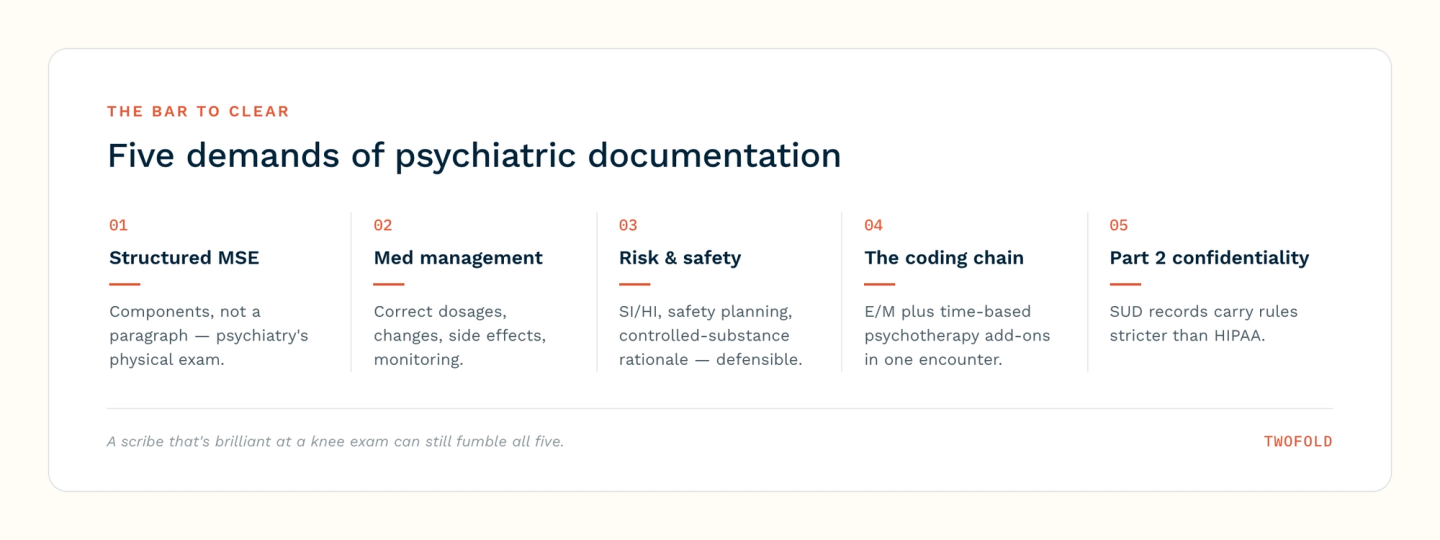
Five documentation demands are specific to psychiatric practice. Judge any AI scribe on these — not on its demo.
1. A Structured Mental Status Exam
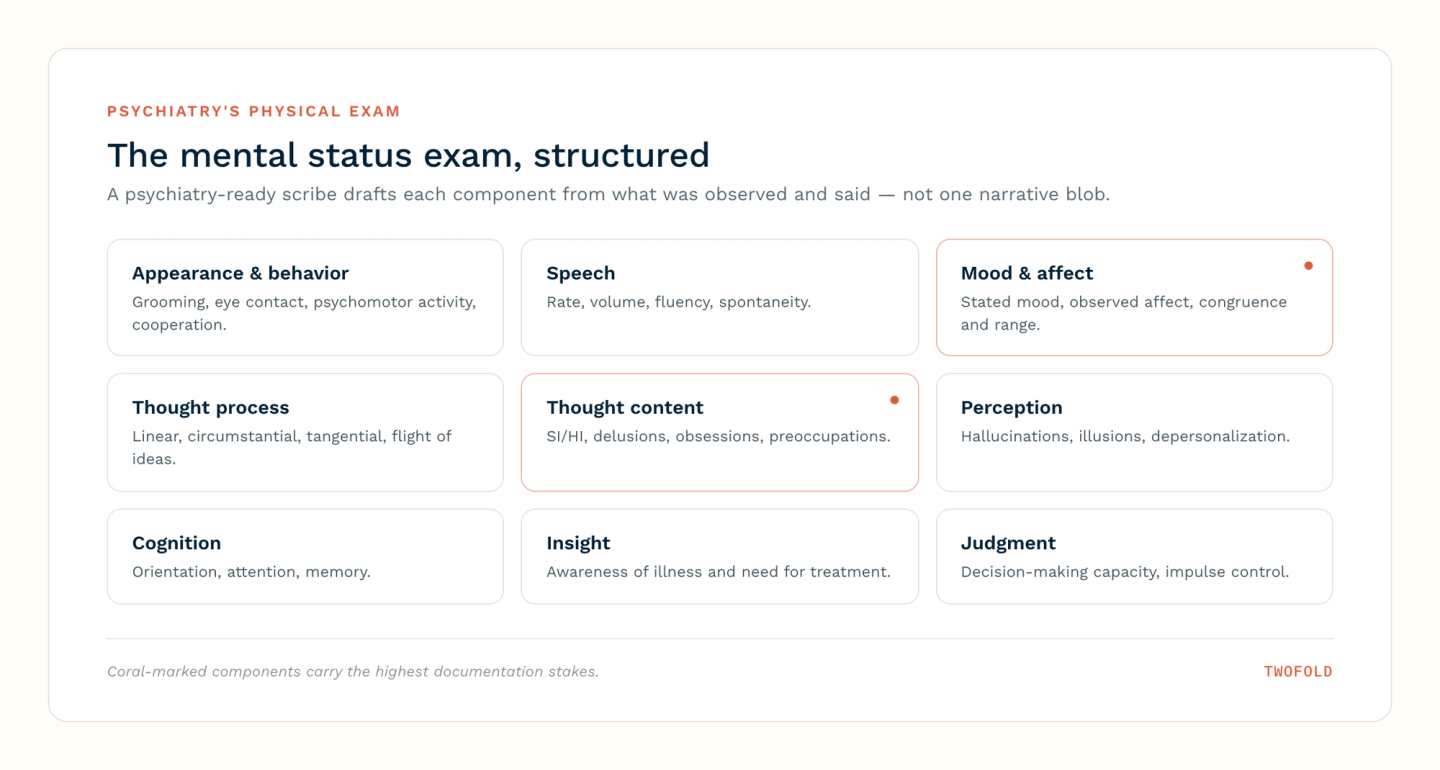
The MSE is psychiatry's physical exam. A psychiatry‑ready scribe produces it as structured components — appearance and behavior, speech, mood and affect, thought process, thought content, perception, cognition, insight, and judgment — drawn from what was actually observed and said in the session. If the draft renders the MSE as one narrative blob, every downstream reader (including auditors) loses the clinical signal.
2. Medication Management Documentation
Most outpatient psychiatry runs on med‑management visits: short, dense, high‑volume. The note must capture the current medication list with correct dosages, what changed and why, side effects discussed, adherence, and monitoring plans (labs, AIMS, metabolic screening). Numbers are where AI transcription fails most — a psychiatry‑ready tool gets dosages right, and the clinician's review verifies every one.
3. Risk and Safety Documentation
Suicidal and homicidal ideation, safety planning, and the rationale around controlled substances have to be documented cleanly enough to defend. The scribe's draft should reflect the risk assessment that actually happened — screening, findings, plan — without inventing reassurance that wasn't said or flattening a nuanced conversation into a checkbox phrase.
4. Coding: E/M Plus Psychotherapy Add-Ons
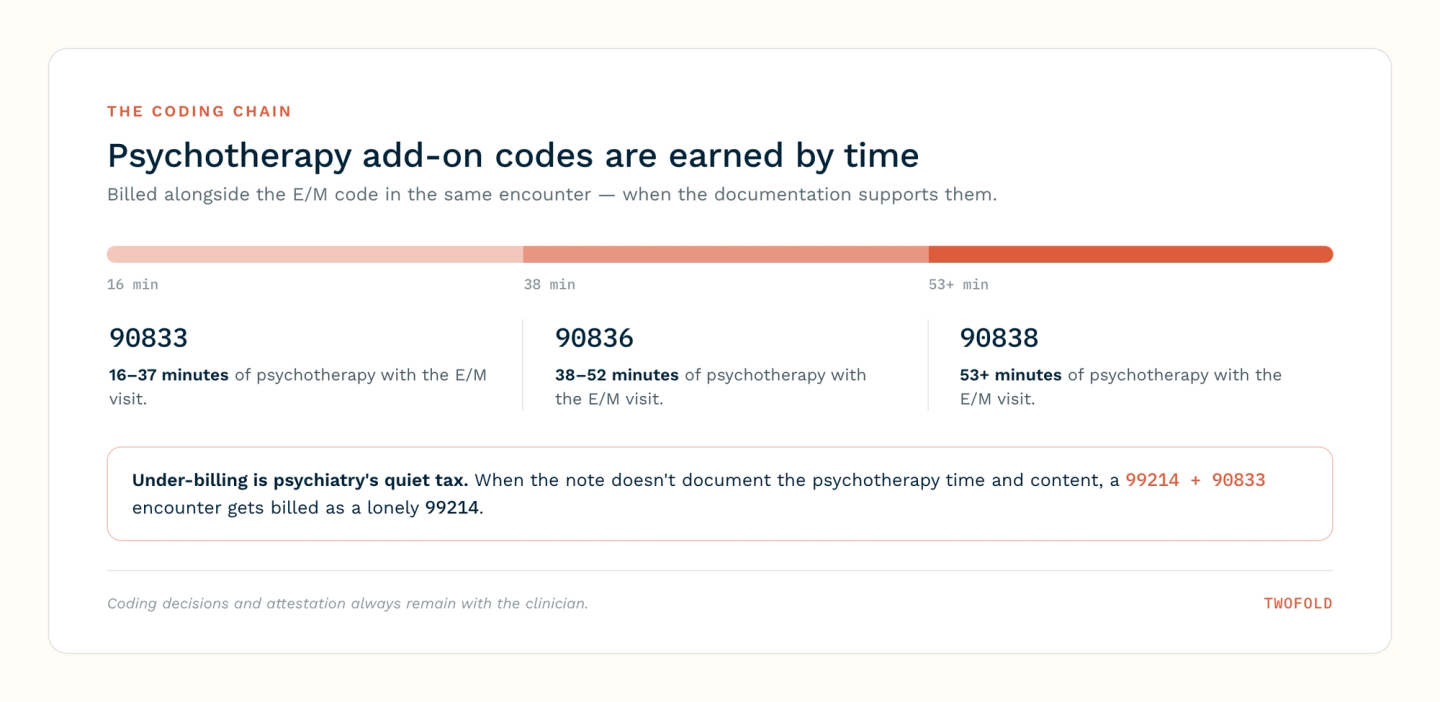
Psychiatry bills evaluation‑and‑management (E/M) codes and, in the same encounter, time‑based psychotherapy add‑on codes — 90833 (16–37 minutes), 90836 (38–52), and 90838 (53+). Under‑billing is the specialty's quiet tax: when the documentation doesn't support the add‑on, a 99214 + 90833 encounter becomes a lonely 99214. A useful scribe produces documentation complete enough to support the codes the visit earned; coding responsibility stays with the clinician who attests.
5. 42 CFR Part 2 and Substance Use Confidentiality
Substance use disorder records carry federal confidentiality protections stricter than HIPAA (42 CFR Part 2). When an ambient scribe captures an SUD disclosure, it creates a record subject to those rules. Practices treating SUD need to know how their scribe vendor handles Part 2 exposure — and prescribers should prefer tools that minimize what's retained in the first place.
The Evaluation Criteria That Matter
- Structured MSE output — components, not a paragraph.
- Med-list fidelity — dosages and changes captured correctly, every time.
- Visit-type range — handles a 60-minute intake and a 15-minute med check with equal grace.
- Documentation that supports your coding — E/M complexity plus time-based add-ons.
- Privacy you can defend — signed BAA, no model training on patient data, and ideally zero audio retention so no session recording persists.
- Economics you can plan — flat monthly pricing beats per-minute meters in a specialty with long intakes.
How the Options Compare, by Capability
Rather than naming vendors — the market shifts monthly — evaluate tools by which tier they belong to:
Capability tier | What it does well | What it misses for psychiatry |
|---|---|---|
General medical AI scribes | Fast ambient capture, broad specialty coverage, strong EHR integrations | MSE comes out unstructured; psychotherapy add-on documentation and psychiatric risk language need heavy template work |
Therapy-only note tools | DAP/BIRP formats, therapy-session flow | Weak on medication management, E/M coding support, and prescriber workflows |
Dictation software | Fast for clinicians who narrate well | You're still composing the note yourself — it saves typing, not thinking time |
Human scribes | Judgment and context | Cost ($30,000+/year), scheduling, and a third person in a psychiatric session |
Mental-health-trained AI scribes | Structured MSE, med-management notes, therapy formats, psychiatric risk documentation | Verify EHR fit and audio-retention policy vendor by vendor |
How Twofold Handles a Psychiatric Session
Twofold is a mental‑health‑trained AI scribe built for individual and small‑group practices — the setting where most outpatient psychiatry happens. A session flows like this:
Three design decisions matter specifically for psychiatry:
- Zero audio retention — the recording is discarded once the note is drafted. No session audio sits on a server, which simplifies both HIPAA posture and 42 CFR Part 2 exposure.
- No model training on patient data, with a signed BAA on every plan. The platform is HIPAA compliant and HITRUST CSF aligned.
- Flat pricing, unlimited notes — $69/month billed annually, with a 7-day free trial (no credit card). No per-minute meter running through a long intake.
Twofold is used by more than 20,000 clinicians who have generated over 20 million notes, holding a 4.8‑star rating across 3,000+ public reviews — see the adoption milestone for the numbers behind that.
Where to Go Deeper
- Want a ranked, multi-vendor comparison? See what psychiatrists on Reddit actually recommend in our best AI scribe for psychiatrists roundup.
- Deciding between a focused scribe and an all-in-one platform? Read standalone AI scribe vs. all-in-one therapy platform.
- See how Twofold works for your setting on the psychiatry specialty page, or start the free trial and test it on your own notes.