


A few years ago, "AI scribe for therapy" meant one thing: a standalone tool that listened to your session and wrote the note. You pasted it into whatever EHR you already used, and that was that.
In 2026, that's no longer what every tool on those "best AI scribe" lists actually is. Several of the best‑known names have quietly grown out of the scribe category entirely — they've become all‑in‑one platforms, or full EHRs, that run your whole practice. That's a legitimate and even impressive strategy. But it means the question "what's the best AI scribe for therapy?" now has two very different kinds of answers, and confusing them is an expensive mistake.
Two categories that used to be one
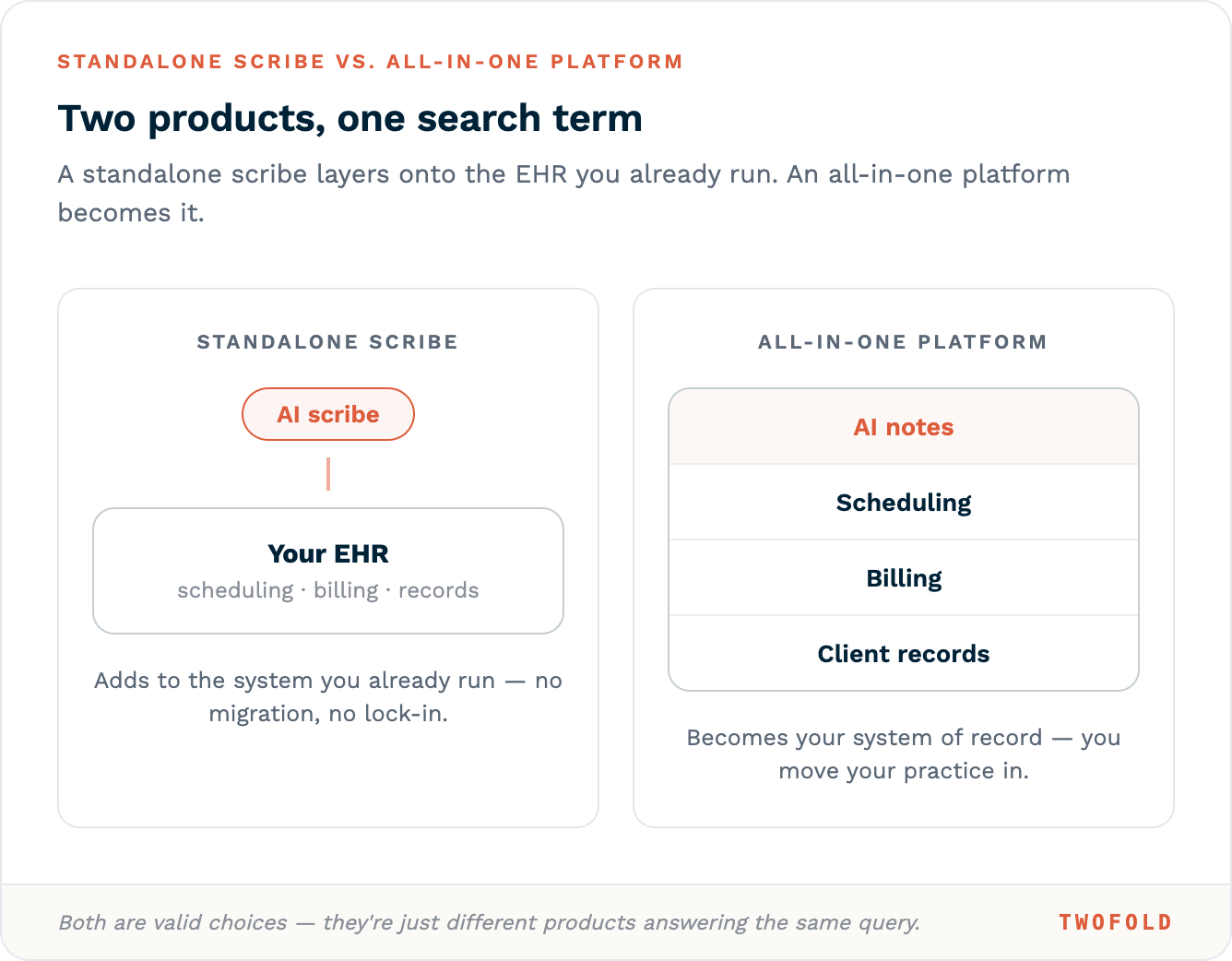
Standalone AI scribe. Its job is the note. It captures the session, drafts the documentation in your format, and hands it back. You keep your existing system of record — your EHR, your scheduling, your billing — and the scribe layers on top of it. Twofold is built this way: it works with any EHR by copy‑paste, so you don't change anything else about how you practice.
All-in-one platform / AI-assisted EHR. Here, the tool is your system of record. It holds your client records, your calendar, your billing, your forms — and the AI notes are one feature inside the larger system. You don't bolt it onto your practice; you move your practice into it.
Both are good products. They are not the same purchase.
Standalone AI scribe | All-in-one platform / EHR | |
|---|---|---|
System of record | Stays your existing EHR | Becomes the platform itself |
Setup | Layers on — no migration | Migrate your practice in |
Lock-in | Low — swap anytime | Higher — your data lives in it |
Works with your current EHR | Yes — any EHR | No — it replaces it |
What it runs | Documentation only | Notes + scheduling + billing + records |
Examples | Twofold | Upheal, Blueprint |
Best for | Keep your workflow, lose the charting | Consolidate onto one system |
The shift is real — and the vendors say so themselves
This isn't speculation. Two of the most‑recommended "AI therapy note" tools now describe themselves as EHRs:
- Upheal brands itself as an "EHR for Therapists," with AI notes, scheduling, a client portal, telehealth, and billing in one platform (insurance billing is rolling out in 2026). It even publishes guides on choosing the best EHR for private practice.
- Blueprint launched what it calls "the AI-Assisted EHR" — "everything a practice needs to run: scheduling, billing, forms, insurance, and documentation." The EHR is free; the AI assistant is the paid layer.
So when a roundup ranks Upheal or Blueprint as a "best AI scribe," it's increasingly comparing an EHR to a note‑taker — apples to oranges. They may still write excellent notes. But you're no longer evaluating a scribe; you're evaluating a system of record.
Why the distinction matters before you buy
Choosing an all-in-one platform means adopting a system. The upside is real — one system for notes, scheduling, billing, and records, with less app‑switching and tight internal integration.
- The cost: you migrate your practice into it. Your client records, calendar, and billing now live with that vendor. Switching later means a data migration, and your documentation is tied to the platform you chose — you're betting your system of record on one company's roadmap and pricing.
Choosing a standalone scribe means keeping your system. It layers onto the EHR you already use — SimplePractice, TherapyNotes, or anything else — so there's no migration and no lock‑in. Your records stay where they are, and you can swap the scribe out anytime.
- The cost: by design, it doesn't run your practice. If you want one vendor for everything, a standalone scribe isn't that.
How to choose: one question
It comes down to a single question about what you're actually trying to replace.
- Just the notes. You like your EHR and your workflow; you only want documentation off your plate. That's a standalone AI scribe that works with your existing EHR — Twofold's lane: capture the session, get a note in your voice in under 60 seconds, and paste it into the system you already run. No migration, no lock-in, and your audio is never stored.
- The whole system. You're starting fresh or want to consolidate scheduling, billing, records, and notes into one tool, and you're willing to migrate and commit. That's an all-in-one platform / AI-assisted EHR like Upheal or Blueprint.
There's no universally "best" answer — but there is a right answer for you, and it depends entirely on which category you're actually shopping in. For a related distinction — a scribe versus a thin AI layer that sits on top of your existing EHR — see our guide on AI scribe vs. EHR overlay.