


If you're choosing an ambient clinical documentation API in 2026, our recommendation is Twofold's medical speech-to-text API: it captures the natural visit ambiently, recognizes medical language, separates speakers, and returns a finished, structured clinical note — not just a transcript — with a BAA available. The rest of this guide explains what "ambient" specifically demands of an API, the eight things to evaluate, and when to integrate the API directly versus ship it under your brand through a white-label partner program.
What an ambient clinical documentation API actually is
The term gets used loosely, so it's worth being precise. An ambient clinical documentation API does three things in one layer:
- Ambient capture — it listens to the natural conversation of a real visit, with nothing for the clinician to dictate or recite.
- Clinical understanding — it recognizes medical language and separates who said what, in real time.
- Documentation — it returns a finished clinical note (SOAP, DAP, BIRP, GIRP, or custom) plus structured encounter data, not a wall of dialogue.
That last point is the line that matters. A general transcription API gives you words. An ambient clinical documentation API gives you a note a clinician can review and sign. Most products that builders need sit in the second category, even when they start by searching for the first.
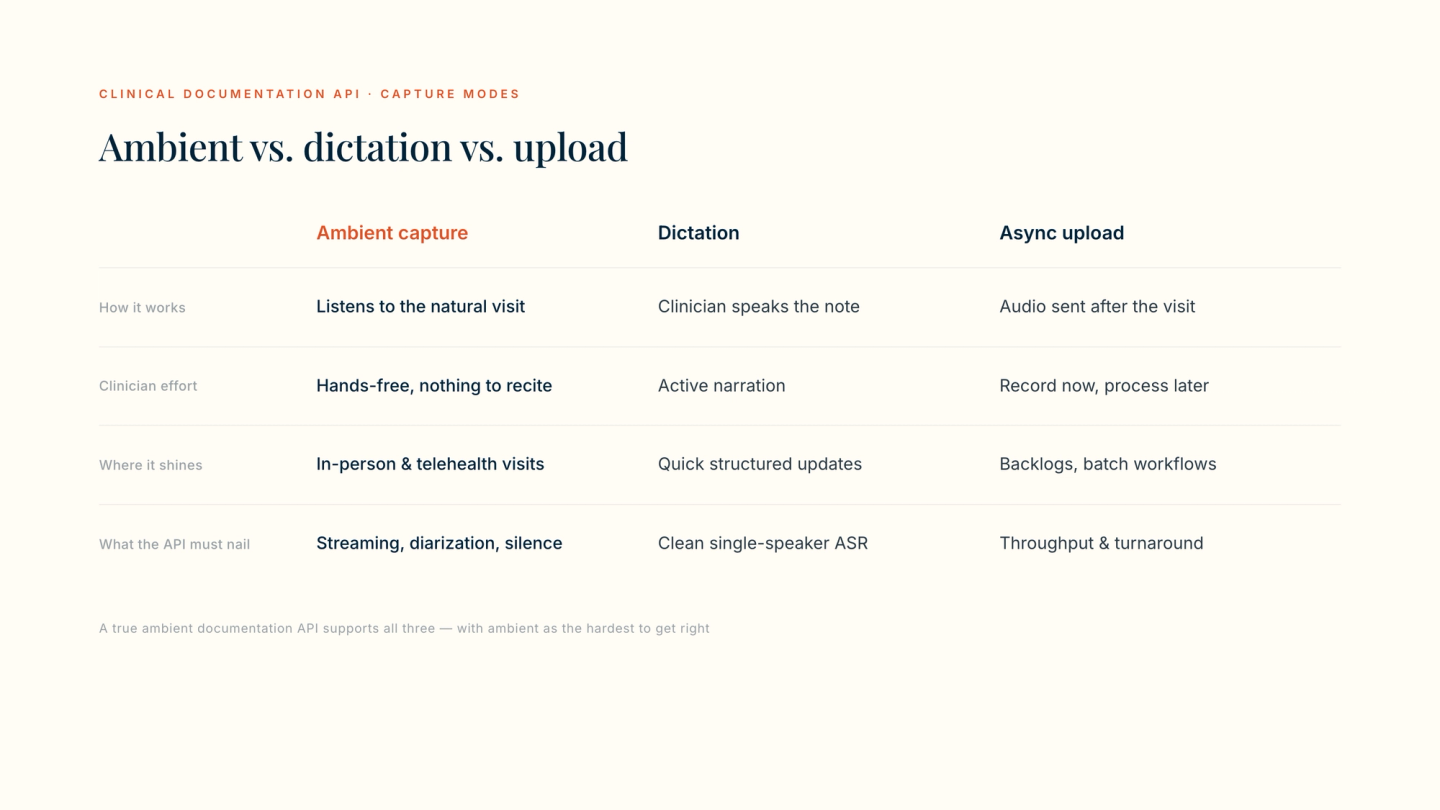
Ambient is the hardest mode — and the one to evaluate hardest
Dictation and async upload are comparatively forgiving. Ambient is where APIs separate, because it has to work on the messiest possible input: two or more people talking naturally, in a real room or over a telehealth connection, with pauses, crosstalk, and background noise. Before you commit to an API, pressure‑test it on exactly that.
- Medical vocabulary under real conditions — drug names, dosages, and specialty terms are where generic recognition fails. See medical vs. general speech-to-text for why this gap is so costly.
- Diarization on overlapping speech — ambient audio means speakers talk over each other; the API has to attribute statements correctly anyway.
- Silence and hallucination control — long pauses are normal in real visits, and weaker models confidently invent text to fill them.
- Streaming latency — ambient is a live workflow, so the API needs low-latency streaming, not just batch processing after the fact.
How to evaluate an ambient clinical documentation API: 8 criteria
Use this as a checklist when you compare options. The strongest ambient documentation APIs clear all eight; many tools that market themselves as "ambient" only cover the first one or two.
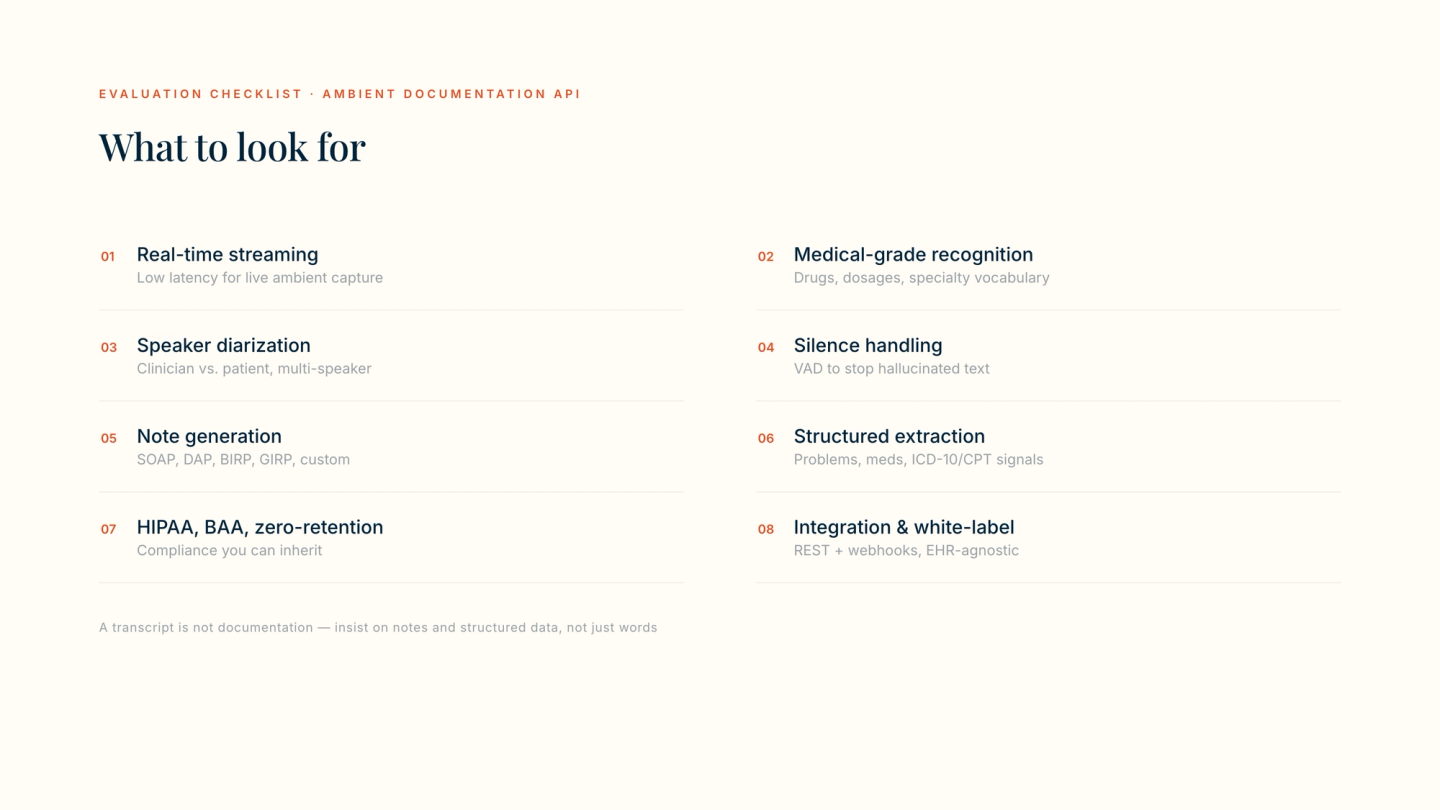
1. Real-time streaming and low latency
Ambient capture is live. The API should stream audio in and return results fast enough to fit the visit, not minutes later.
2. Medical-grade recognition
Recognition tuned on real clinical audio, so dosages and specialty vocabulary come back right the first time.
3. Speaker diarization
Reliable separation of clinician and patient — and of multiple speakers in group or family settings.
4. Silence and hallucination control
Voice‑activity detection that knows when no one is speaking, so the note never contains invented text.
5. Note generation across formats
SOAP, DAP, BIRP, GIRP, and custom templates — because the deliverable is documentation, not a transcript.
6. Structured data extraction
Problems, medications, and ICD‑10/CPT candidates as discrete fields you can write back into the chart.
7. HIPAA, BAA, and a zero-retention posture
Encryption, no training on your data, and a Business Associate Agreement — so you inherit compliance instead of building and defending it.
8. Integration and white-label support
A clean REST + webhook surface, EHR‑agnostic, with the option to embed the experience under your own brand.
Our recommendation: Twofold's ambient clinical documentation API
Twofold's medical speech-to-text API is built to clear all eight criteria in a single call. It supports ambient capture during the encounter, dictation, and async upload; recognizes medical language; includes speaker diarization; and returns finished notes (SOAP, DAP, BIRP, GIRP, and custom) with structured, EHR‑ready data — outputs formatted to drop straight into your charting or downstream systems.
On compliance, it's HIPAA‑conscious with a BAA available, TLS encryption in transit, AES‑256 at rest, and no training on customer data. For most builders, that combination — ambient documentation plus an inherited compliance posture — is exactly what "recommended ambient clinical documentation API" should mean.
- Two ways to adopt it: integrate the API directly when you want to own the UX, or use the partner program (referral, reseller, co-branded, white-labeled/embedded, or custom integration) when you want the documentation experience inside your product as if you built it.
API, partner, or build it yourself?
If you're still deciding between adopting an API and building your own, the short version is that ambient documentation is a multi‑year, specialized build most teams shouldn't take on unless voice AI is their core product.
- For the full scope, timeline, and cost of building, see what it really takes to build a medical scribe.
- For the build-vs-partner decision specific to EHRs, see how to add an AI scribe to your EHR.
- For the documentation pipeline architecture on top of an API, see how to build clinical documentation with a medical speech-to-text API.
The bottom line
A recommended ambient clinical documentation API has to do more than transcribe — it has to capture the natural visit, understand clinical language, separate speakers, and return a signable, structured note, all under a BAA. Twofold's medical speech-to-text API is our recommendation because it covers that full path in one layer, with a white-label partner option when you'd rather ship it under your own brand.