
AI medical scribes are transforming physician workflows as a relief for burnout. Yet in critical healthcare systems, no task truly disappears; it simply shifts. When a doctor stops typing, that documentation burden often relocates downstream, landing on nursing staff. This creates a sequence of "second‑order" consequences: nurses spend more time translating AI‑generated summaries, reconciling data, and clarifying physician intent. This article uncovers these shifts and explores why healthcare leaders must address the entire care team when implementing AI.
The Promise of AI Scribes vs. The Reality of Workflow
Ambient AI medical scribes, digital tools that passively listen to clinical conversations and automatically generate draft clinical notes, have emerged as one of the fastest-adopted technologies in healthcare. The value proposition is compelling: eliminate the keyboard from the patient encounter, restore eye contact between physician and patient, and reclaim time from after‑hours documentation.
The Reality: The Workflow Shift to Nurses
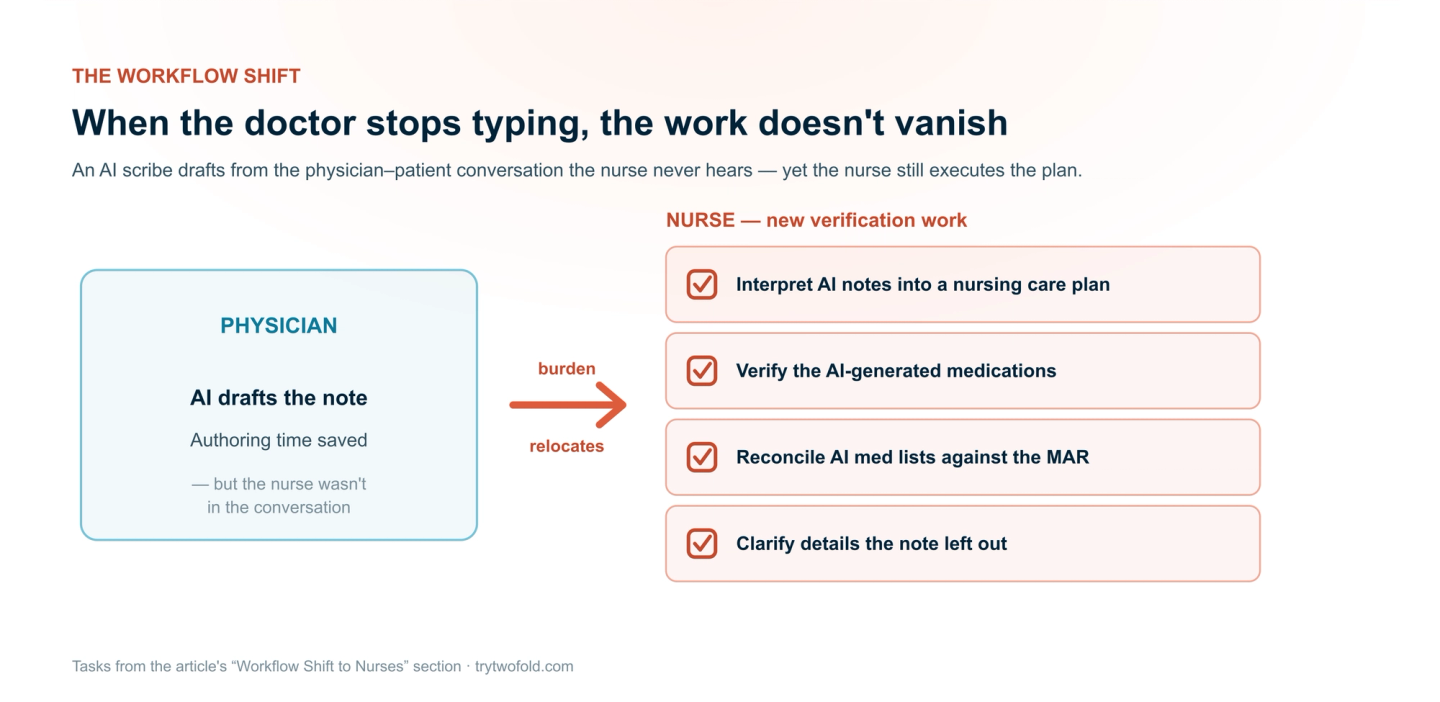
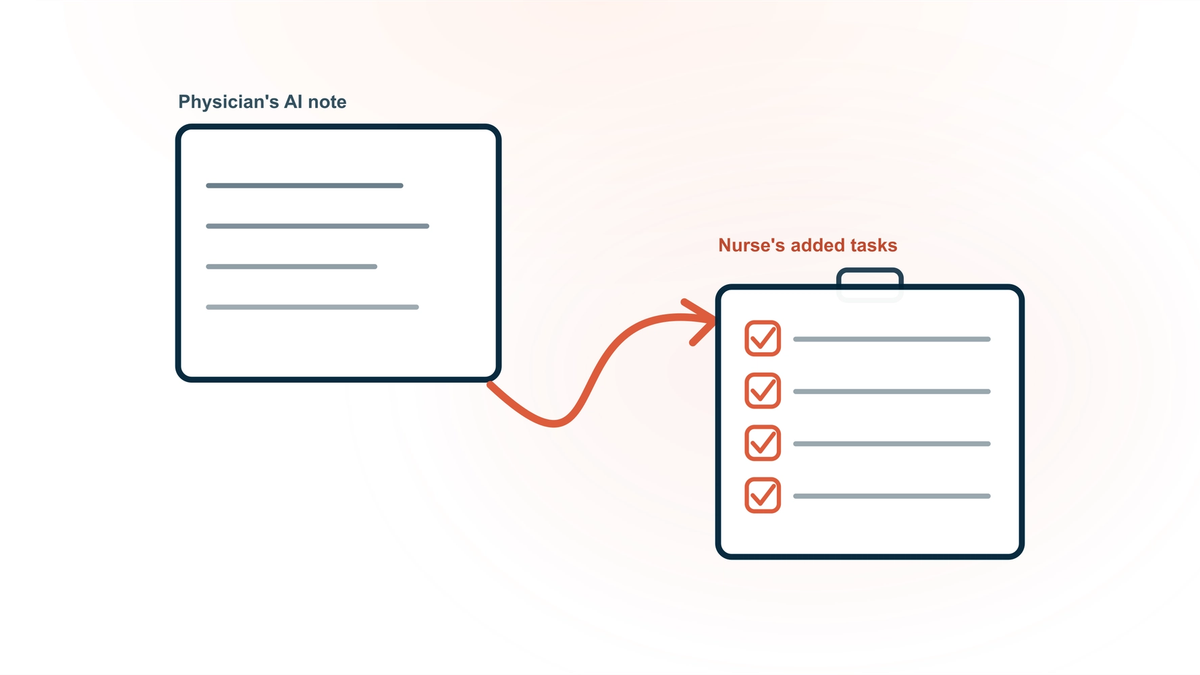
Healthcare is an interdependent system. When a physician stops typing, the documentation burden doesn't vanish; it relocates.
When an AI scribe generates a physician's note, drafted from the physician‑patient conversation, the nurse is excluded from that conversation but remains responsible for executing the resulting care plan. The nurse must now:
- Interpret AI-generated notes to create nursing care plans.
- Verify the medications generated by the AI.
- Reconcile AI-generated medication lists against the actual Medication Administration Record.
- Spend extra time clarifying details.
The Interdependence of Clinical Teams
The physician‑nurse relationship is fundamentally collaborative. Changes to one workflow inevitably impact the other. When AI scribes reduce physician documentation time, that saved time creates downstream effects:
- The AI listens to the doctor-patient encounter. Nurses miss this encounter but must execute the plan. They are now processing second-hand, AI-generated data.
- When an AI scribe misinterprets clinical nuance or produces vague summaries, nurses must correct the record separately.
- Since AI-generated notes don't reflect mobility status, feeding assistance, or ADL capabilities, nurses must contact physicians for clarification, increasing interruptions during medication passes.
A 2026 article published in the Journal of Medical Internet Research observed that AI‑assisted documentation work is reshaped, not reduced, and the increased time spent reviewing notes and gathering information after implementation suggests that AI scribes redistribute cognitive effort rather than eradicate it.
The gap between the promise of AI scribes and the reality of workflow is a failure of systems thinking. AI scribes are being implemented and marketed as physician‑centric solutions within team‑based environments.
Until we ask the question "What happens to the nurse?" we haven't solved healthcare's documentation crisis; we've just repackaged it.
Defining "Second-Order Effects" in Clinical Documentation
The concept of "second‑order effects" describes the effects that occur as a result of the primary effect, rather than the primary effect itself.
Ray Dalio, founder of Bridgewater Associates, offers a helpful illustration: "For example, the first-order consequences of exercise (pain and time spent) are commonly considered undesirable, while the second-order consequences (better health and more attractive appearance) are desirable. Similarly, food that tastes good is often bad for you and vice versa."
The Consequences in a Healthcare Setting
When AI scribes are implemented without a systems‑thinking approach, they trigger a surge of unintended consequences. Penn Nursing professors George Demiris, PhD, Antonia Villarruel, PhD, RN, and Connie Ulrich, PhD, RN, stated in a recent Penn Leonard Davis Institute of Health Economics Q&A:
"AI implementation can introduce hidden costs and unintended consequences. Systems require training, maintenance, workflow redesign, oversight, cybersecurity protections, and continuous evaluation. In some cases, AI tools may even increase clinicians' cognitive burden or documentation workload rather than reduce it,"
Referring back to the 2026 Journal of Medical Internet Research article, the researcher also found three undertheorized issues for AI scribe implementation in nursing:
- AI scribes reallocate the cognitive effort from authoring to verification.
- Users become more satisfied with the AI scribe while, at the same time, losing confidence in the quality of AI-generated documentation.
- Automatic Speech Recognition-based documentation performs significantly worse for certain patient populations with accents and dialects that differ from standard English.
Second‑order effects in clinical documentation are not anomalies; they are the predictable consequences of implementing physician‑centric technology in a team‑based environment.
Although AI scribes reduce physician documentation time, they increase the burden of verification for nurses, shift cognitive work from writing to reviewing, create a mismatch between improved user satisfaction and declining quality expectations, and amplify existing inequities.
As Penn Nursing researchers concluded, "A successful future is one where AI quietly supports nursing care without overshadowing it. It is an issue of how nurses use AI versus how AI uses or dictates the work of nurses. Nurses would have better tools for identifying patient risks, accessing evidence, personalizing care, and reducing unnecessary administrative burden. Patients would experience safer, more equitable, and more responsive care."
Strategies to Mitigate Second-Order Effects
The second‑order effects of AI scribes on nursing staff are predictable and therefore preventable. Mitigation requires a shift from physician‑centric implementation to team‑based systems thinking. Here are strategies to address the documentation burden.
1. Include Nurses in Design, Selection, and Implementation
The most fundamental strategy is also the most overlooked: nurses must be included from the very beginning.
When nurses are excluded from design and oversight, AI scribes introduce risks of hallucinations, omission, and bias. Conversely, the most successful implementations involve nurses early, incorporate bedside feedback, and treat nursing staff as active participants in design and implementation decisions.
Practical Steps:
- Establish nursing-led AI governance protocols that include bedside nurses, nursing informaticists, and nurse leaders. Mercy Health partnered with Microsoft to develop Dragon Copilot for nursing, with medical-surgical nurses participating directly in development, narrating their care in real time to test and improve the system.
- Tools designed for physician workflows cannot simply be repurposed for nursing. Success depends on nursing input in vendor selection.
- Create feedback loops that allow nurses to report AI errors, omissions, and workflow challenges.
2. Establish Governance, Safeguards, and Accountability
AI scribes introduce risks that require governance structures. A 2025 Nature Digital Medicine analysis identified key risk categories and recommended the following solutions:
Risk | Examples | Solutions |
|---|---|---|
Accuracy | AI bias, omissions and hallucinations | Implement review protocol for all documentation |
Privacy | Repurposing of data for AI training, recording without permission | Strict protocols for data access and consent |
Transparency | "Black box" AI | Implement audits for errors |
3. Treat Equity as a Standard
One of the most critical mitigation strategies is treating equity as a standard reporting expectation. When AI‑generated records contain errors due to bias, it creates an additional verification burden that is relayed to nurses.
Equity-focused Actions:
- Test AI scribe performance across diverse patient populations before implementation.
- Report equity metrics alongside time-savings data.
- Train nurses to recognize when AI may be underperforming for specific patients.
- Incorporate equity considerations into vendor selection criteria.
Mitigating the second‑order effects of AI medical scribes on nursing staff requires a shift in how healthcare organizations approach AI implementation. The strategies outlined above share a common theme: they treat nursing as a partner in AI adoption.
Conclusion
AI medical scribes are reshaping clinical documentation, but the efficiency they deliver to physicians often comes at a cost to nurses. The burden shifts from authoring to verification, from creation to correction, from physician to nurse. Healthcare leaders must move beyond physician‑centric implementation and embrace systems thinking. True efficiency is about reducing burden for the entire care team.