


The AI medical scribe captures the encounter and promises to reduce documentation burden. Yet this efficiency introduces an editing challenge. Clinicians must correct errors in real‑time, and stopping the conversation to type or stare at a screen breaks dialogue flow. The patient may interpret this as inattention, or worse, question competence. The "Silent Edit" offers a workable alternative. Explore how to correct AI output without the patient ever noticing, preserving both note accuracy and trust.
The Reality of AI SOAP Note Documentation
Ambient AI scribe technology processes the audio stream from a consultation, distinguishing between physician and patient voices. The output is structured into a clinical note, typically organized as an AI SOAP note, which is presented to the clinician for review. The speed of this generation allows for concurrent review, but the technology also introduces specific errors that demand clinician attention.
Common Error Categories
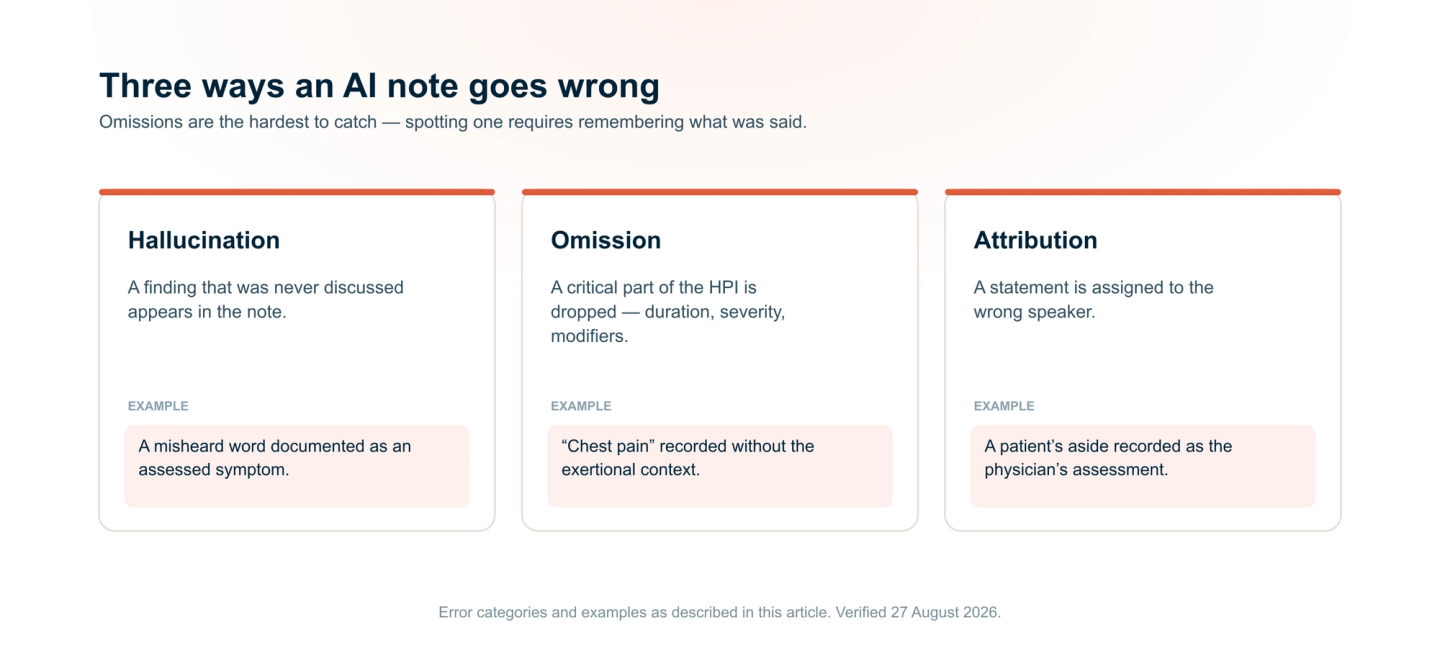
- Hallucinations: The AI inserts a clinical finding or symptom that was never expressed during the encounter. For example, the AI might document a misheard word when no such finding was discussed or assessed.
- Omissions: The AI fails to capture a critical component of the History of Presenting Illness (HPI), such as duration, severity, or modifying factors. These omissions compromise diagnostic reasoning. A patient may describe chest pain that worsens with exertion, yet the AI only records "chest pain" without the exertional context.
- Attribution Errors: The AI misassigns statements. A patient's offhand comment may be documented as a physician's assessment, or vice versa. This error carries medico-legal implications.
The Clinical Risk
Correcting these errors in real‑time is not optional. An uncorrected hallucination can lead to incorrect billing codes or, more critically, influence future treatment decisions. The challenge lies in rectifying the AI output before the encounter concludes, while maintaining the patient's perception of undivided attention.
The AI Workflow: Performing the "Silent Edit"
Each stage addresses a different type of error and requires a distinct physical or verbal response.
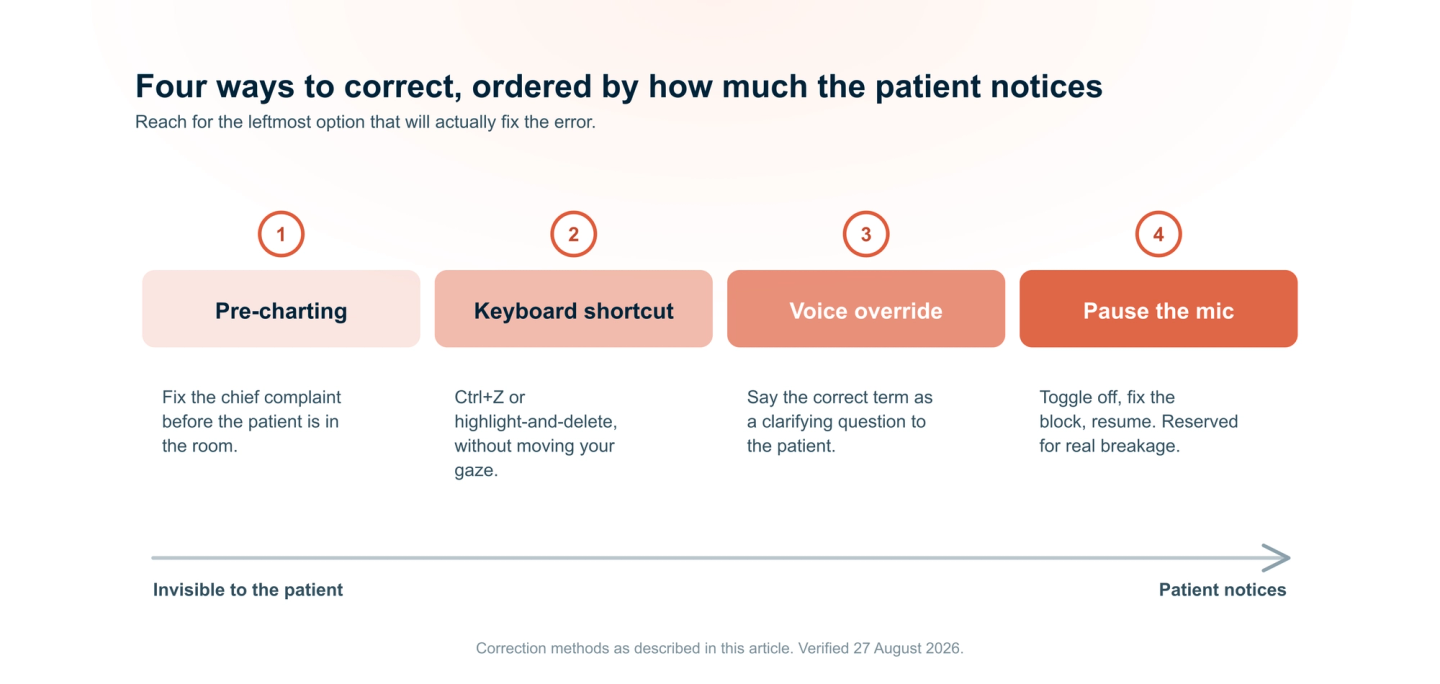
Stage 1: Prevention Through Pre-Charting
This anticipatory step reduces the frequency of mid‑encounter corrections.
- Many AI scribes pre-fill the chief complaint from the scheduling system or triage notes before the patient enters the room.
- Correcting the chief complaint before the patient arrives prevents the AI from anchoring on incorrect data.
- The clinician should mentally rehearse the specific review of systems questions planned for the encounter.
- This internal script guides the history taking and provides structured prompts for the AI.
- The AI performs more reliably when the conversation contains clear, predictable transitions.
Stage 2: The Keyboard Shortcuts
- Keyboard shortcuts provide the quietest correction method.
- The goal is to execute corrections without redirecting gaze from the patient.
- The undo command (Ctrl + Z) reverses the AI's last insertion when a hallucinated phrase appears.
- The highlight-and-delete combination removes a single erroneous word.
- Muscle memory for these commands develops through deliberate practice outside of patient-facing hours.
Stage 3: Voice-to-Text Overrides
- Voice-to-text overrides offer a natural solution when a clinical term requires correction.
- The clinician introduces the corrected term as a clarification directed at the patient.
- The correction is embedded within the clinical dialogue, making it sound like a routine clarifying question.
Stage 4: The "Pause" Method
This method becomes necessary when the AI generates a fundamentally incorrect block of text.
- The clinician toggles the microphone off.
- The patient continues speaking, unaware of the interruption.
- During this interval, the clinician deletes the problematic paragraph.
- A template or brief summary of what was just said is inserted in its place.
- A visual distraction justifies the brief silence:
- Glancing at lab results on the screen provides a plausible reason for the pause.
- Looking at a physical exam finding serves the same purpose.
- Once the correction is inserted, the microphone is toggled back on.
- A transitional phrase such as "Now, regarding that symptom..." redirects attention back to the patient.
- The conversation resumes naturally, and the patient remains unaware of the edit.
Conclusion
The AI medical scribe is not a replacement for clinical attention but a tool that redefines the physician's role. This silent edit workflow enables accuracy without alienation. These techniques preserve the patient's perception of being heard while ensuring the AI SOAP note reflects the true encounter. Mastering this balance transforms documentation into an integrated component of care.