

Free for a week, then $19 for your first month
Expert Advice

Freed AI Renewal Coming Up? The 10-Minute Audit to Run Before You Pay for Another Year (2026)

Before renewing Freed AI, run this 10-minute audit — real cost per note, edit time, tier vs volume, specialty fit, and what's changed — so your renewal is a deliberate choice, not an autopay.

Freed AI renewal audit — a checklist card with a coral checkmark beside a calendar with the renewal date ringed in coral, representing a 10-minute audit to run before the Freed renewal date.

Before you renew Freed AI for another year, run a 10‑minute audit: check what you actually pay per note you use, how long you spend editing each note, whether you're on the right tier for your volume, how well the notes fit your specialty, and what's changed in the market since you signed up. If the audit turns up friction, trial an alternative during your remaining access — because Freed does not refund the unused months on an annual plan, the renewal date is your deadline to switch without paying twice.

This is a decision framework, not a review. It works whether you end up renewing, changing tiers, or switching — the goal is to make the renewal a deliberate choice instead of an autopay default.

Disclosure: this guide is published by Twofold Health, an AI scribe many clinicians weigh against Freed at renewal. Freed's pricing details below are from Freed's official help center and were last verified in July 2026 — confirm current terms on Freed's site before deciding.

The 10-Minute Freed Renewal Audit

Run these five checks before your renewal date. Each takes a minute or two and points to a clear decision.

01
1. Your real cost per note
Divide your monthly price by the notes you actually generate. If you're on Premier ($104/mo annual) but do a light caseload, your per-note cost may be high — and you may be paying for EHR and coding features you don't use.
02
2. Your edit time per note
Time yourself on five notes: end of visit to signed note. If you routinely edit for longer than it would take to write key sections yourself, the tool isn't saving what it should.
03
3. Your tier vs your volume
Starter caps at 40 notes/month. If you're bumping the cap you're effectively forced to Core ($79); if you're well under it, you may be overpaying. Match the tier to real usage.
04
4. Specialty and voice fit
Do the notes sound like you, and do they fit your specialty's format (especially behavioral health: treatment plans, progress tracking, DAP/BIRP/GIRP)? Persistent reformatting is a renewal red flag.
05
5. What's changed since you signed up
The scribe market moves fast. Tools you dismissed a year ago may now do more for less. A 20-minute look at two alternatives is worth it before a $1,248 commitment.

Know What You're Actually Renewing

Freed's tiers, so you can check you're on the right one (verified July 2026):

Plan

Price

Notes

Key features

Starter

$39/mo

Up to 40/month

Core note generation, specialty templates

Core

$79/mo

Unlimited

Everything in Starter + AI editing assistant, template builder

Premier

$119/mo ($104/mo annual)

Unlimited

Core + EHR push, coding assistant, prior-visit pull-forward, AI clinician assistant

The annual-plan catch
Premier billed annually is $1,248 up front, and Freed does not refund unused months. That makes the renewal date a hard deadline: if you're going to switch, do it before you're locked in for another year.

What Are You Really Paying Per Note?

The single most clarifying number in the audit is your effective cost per note — your monthly price divided by the notes you actually produce. It's also where a flat, unlimited plan pulls ahead: because the price doesn't change with volume, its per‑note cost keeps falling as you document more, while a metered or higher tier locks in a higher floor. The chart below shows how the math plays out across a typical range of monthly note volumes.
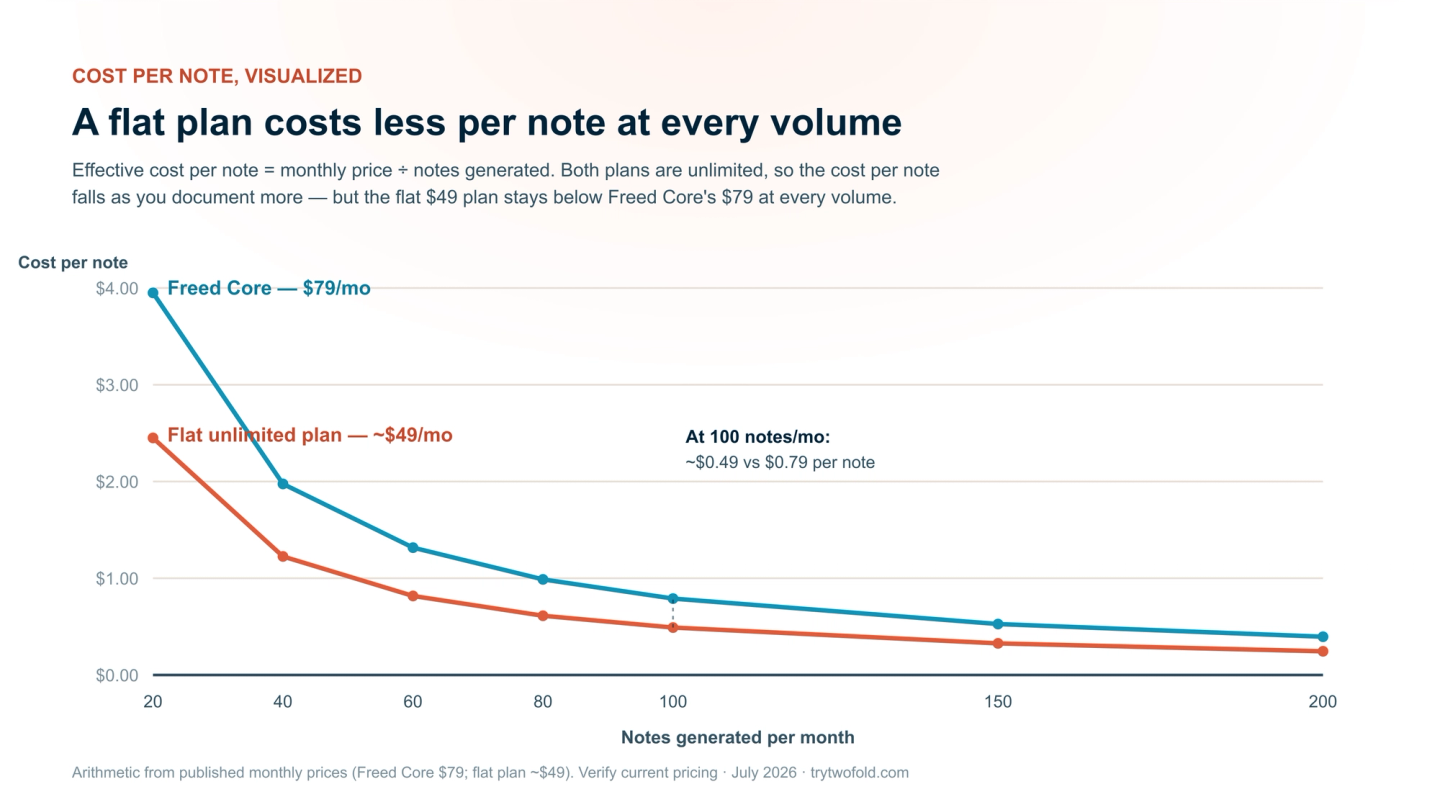
Line chart: effective cost per note versus monthly note volume. Freed Core at $79/month and a flat unlimited alternative at about $49/month both fall as volume rises, but the flat plan stays lower at every volume — for example about $0.49 vs $0.79 per note at 100 notes a month.

Turn the Audit Into a Decision

Your five checks point to one of three outcomes:

  • Renew — the notes fit, the edit time is low, and you're on the right tier. Renewing is the right call; just confirm the tier still matches your volume.
  • Change tier — you're capped on Starter or paying for Premier features you don't use. Adjust before renewal rather than autopaying the wrong plan.
  • Switch — the edit time is high, the notes don't fit your specialty, or a flat unlimited alternative is cheaper for your volume. Trial a replacement now and, if it wins, cancel Freed before the renewal date.

If the Audit Says Switch: Where Twofold Fits

If your audit flags edit time, note caps, generic voice, or per‑note cost, Twofold Health is the alternative most Freed switchers land on. It's flat‑priced with unlimited notes on every paid plan (no 40‑note cap, no per‑note metering), learns your clinical voice so you edit less over time, captures ambient, dictated, or typed‑summary visits, and adds behavioral‑health depth — treatment plans, progress tracking, DAP/BIRP/GIRP and 70+ templates. Every account includes a signed BAA, audio is never stored, and it works alongside any EHR. Its 7‑day trial needs no card, so you can run the audit's side‑by‑side comparison during your remaining Freed access.

To dig deeper before deciding, see our Freed vs Twofold comparison, the Freed AI pricing guide, and the step-by-step switching guide.

Bottom Line

A Freed renewal deserves ten minutes of scrutiny, not an autopay. Check your real cost per note, your edit time, your tier‑to‑volume fit, your specialty fit, and what's new in the market. If everything holds up, renew with confidence. If it doesn't, you have until your renewal date to switch without paying for a year you won't use — so start a Twofold trial and run the comparison on your own visits before you commit.

Sources

  • Freed Help Center: Freed Pricing (plans, note caps, annual & refund policy) — source for Starter/Core/Premier prices, the 40-note Starter cap, the $1,248 annual figure, and the no-refund default.
  • Twofold trial and plan details: trytwofold.com/pricing.
  • Cost-per-note figures are simple arithmetic from published monthly prices; your actual number depends on your note volume. Last verified July 2026.
FAQ

Frequently asked questions

  • What should I check before renewing Freed AI?

    Run a 10‑minute audit before your renewal date, covering five things:

    • Your real cost per note — monthly price divided by the notes you actually generate.
    • Your edit time per note — end of visit to signed note, timed over five notes.
    • Your tier vs your volume — Starter caps at 40 notes/month; Core and Premier are unlimited.
    • Specialty and voice fit — do the notes sound like you and fit your format?
    • What's changed in the market since you signed up — a quick look at two alternatives.
  • Is the Freed AI annual plan worth renewing?

    It depends on your audit. Renewing Premier annually is a $1,248 up‑front commitment with no refund for unused months, so it's worth it only if the notes fit your specialty, your edit time is low, and you're using the tier's features (EHR push, coding). If you're capped on Starter, paying for Premier features you don't use, or spending too long editing, change tier or switch before the renewal date rather than autopaying.

  • How do I calculate my real cost per note on Freed?

    Divide your monthly plan price by the number of notes you actually generate that month. On Core ($79) at 100 notes, that's about $0.79/note; at 40 notes it's about $1.98/note. A flat, unlimited plan lowers the per‑note cost as your volume rises because the price doesn't change — which is why heavy documenters often find a flat plan cheaper per note than a higher Freed tier.

  • When is the deadline to cancel Freed before it renews?

    Cancel before your renewal date, which you can find on the Stripe billing page under Settings → Plan and Billing → Subscription. Freed does not refund unused months by default, so cancelling after the annual plan renews means paying for a year you may not use. If you're evaluating a switch, start the alternative's trial a week or two before renewal so you can decide in time.