


Therapy progress notes need phrases that describe what actually happened, what the clinician observed, what the client did, and what changed. This article provides progress note phrases by the section they belong to: presentation, mood and affect, engagement, response to intervention, progress, and plan. Each section pairs weak phrasing with observable alternatives.
Presentation: Arrival and Baseline
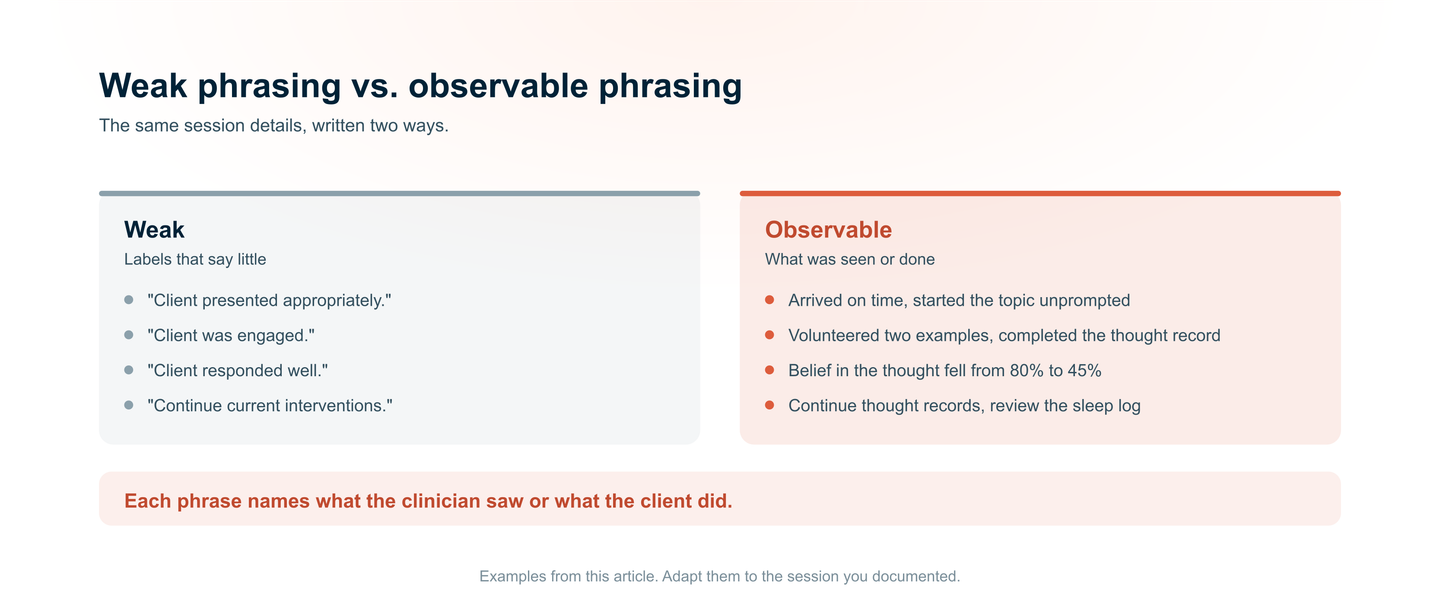
- Weak Presentation Example 1: “Client presented appropriately.”
- Observable Presentation Example 1: “Client arrived on time, settled quickly, and initiated the session topic without prompting”.
- Weak Presentation Example 2: “Client was disheveled.”
- Observable Presentation Example 2: “Client arrived 10 minutes late, disheveled relative to baseline, with slowed speech”.
Why Baseline Comparison Matters
- “Relative to baseline” tells a reviewer whether this is a change or the client's normal.
- Grooming, punctuality, or psychomotor activity: one observable detail is better than only using adjectives.
Mood and Affect: Reported vs. Observed
- Mood is reported and belongs in subjective data.
- Affect is observed and belongs in the MSE or objective section.
- Examples:
- Weak: “Mood was depressed, affect appropriate.”
- Observable: “Client reported mood as ‘gray bubble around me’; affect constricted, stable, and mood-congruent, brightening when discussing her daughter's visit”.
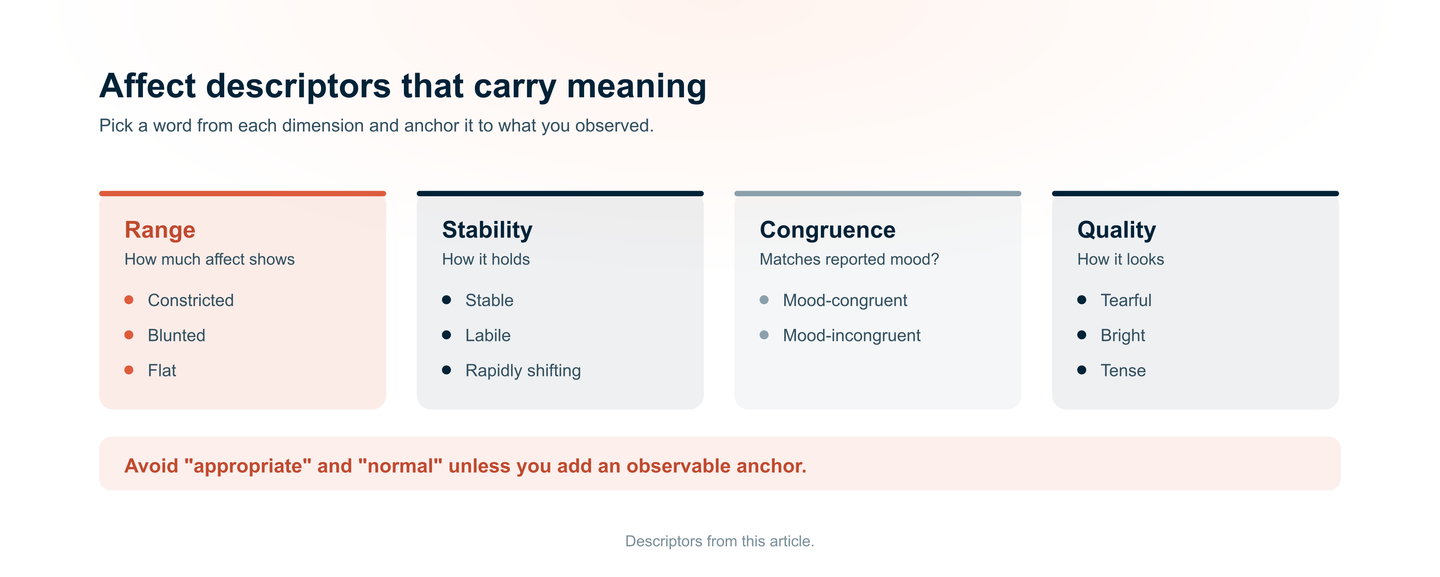
Affect Descriptors Worth Using
- Range: constricted, blunted, flat.
- Stability: stable, labile, rapidly shifting.
- Congruence: mood-congruent, mood-incongruent.
- Quality: tearful, bright, tense.
- Avoid: “appropriate” and “normal” say nothing without an observable anchor.
Engagement: What the Client Did
- Weak Engagement Example 1: “Client was engaged”.
- Observable Engagement Example 2: “Client initiated discussion of the conflict, volunteered two examples, and completed the in-session thought record with one prompt”.
- Weak Engagement Example 2: “Client was resistant”.
- Observable Engagement Example 2: “Client observed quietly for the first 15 minutes, declined the worksheet, and participated when the therapist shifted to open-ended exploration.”
Context for Low Engagement
- Say What Happened: “Declined to participate” is observable; “unmotivated” is a judgment.
- Connect to Plan: Note whether the therapist adjusted approach in response.
Response to Intervention and Progress
Response: Name the Change
- Weak Response Example: ”Client responded well.”
- Observable Response Example: “After cognitive restructuring, client rated belief in the thought down from 80% to 45% and identified one piece of disconfirming evidence”.
Progress: Use a Status Word, Then Prove It
- Met: Goal achieved; state the evidence.
- Progressing: Partial movement; name the specific gain.
- No Change: No observable change; document what was tried and what shifts next.
Plan: Specific Next Steps
- Weak Plan Example 1: “Continue current interventions.”
- Observable Plan Example 1: “Continue CBT thought records; introduce stress management next session; review sleep log”.
- Weak Plan Example 2: “Follow up as needed”.
- Observable Plan Example 2: “Next session in one week; client to practice one exposure before then”.
Conclusion
Observable phrases make a session clearer. Swap “engaged” for what the client did, replace “appropriate affect” with a descriptor and an anchor, and tie every progress statement to evidence. The phrases outlined above are starting points; the goal is wording precise enough that another clinician could pick up the case without any confusion. For the structures that hold these phrases, see our progress note template and guide to psychotherapy notes.