

Free for a week, then $19 for your first month
Expert Advice

Twofold vs Other AI Notes Platforms: What Sets It Apart

Discover what sets twofold apart from other AI note platforms.

A row of similar AI note cards with one standing apart and check-marked in coral — what sets Twofold apart from other AI notes platforms.

The AI medical scribe market is growing rapidly, and as more clinicians turn to AI for documentation, the question isn't whether to use AI clinical notes; it's which platform to trust with your patients' data and your clinical workflow. With dozens of options available, from enterprise tools to niche specialty tools, how do you choose? This guide explores what sets Twofold Health apart from other AI notes platforms.

What Are AI Notes Platforms?

AI notes platforms use artificial intelligence to listen to clinical conversations and automatically generate structured documentation. These tools capture audio from patient sessions, process it using large language models, and produce formatted notes such as SOAP, DAP, or progress notes in seconds.

However, not all AI note‑taking platforms are created equal. The market has exploded, with hundreds of standalone AI scribe tools available, ranging from general‑purpose note‑takers to specialty‑specific clinical documentation systems. The differences in compliance, accuracy, specialty fit, and workflow integration are substantial.

What Sets Twofold Apart From Other AI Notes Platforms
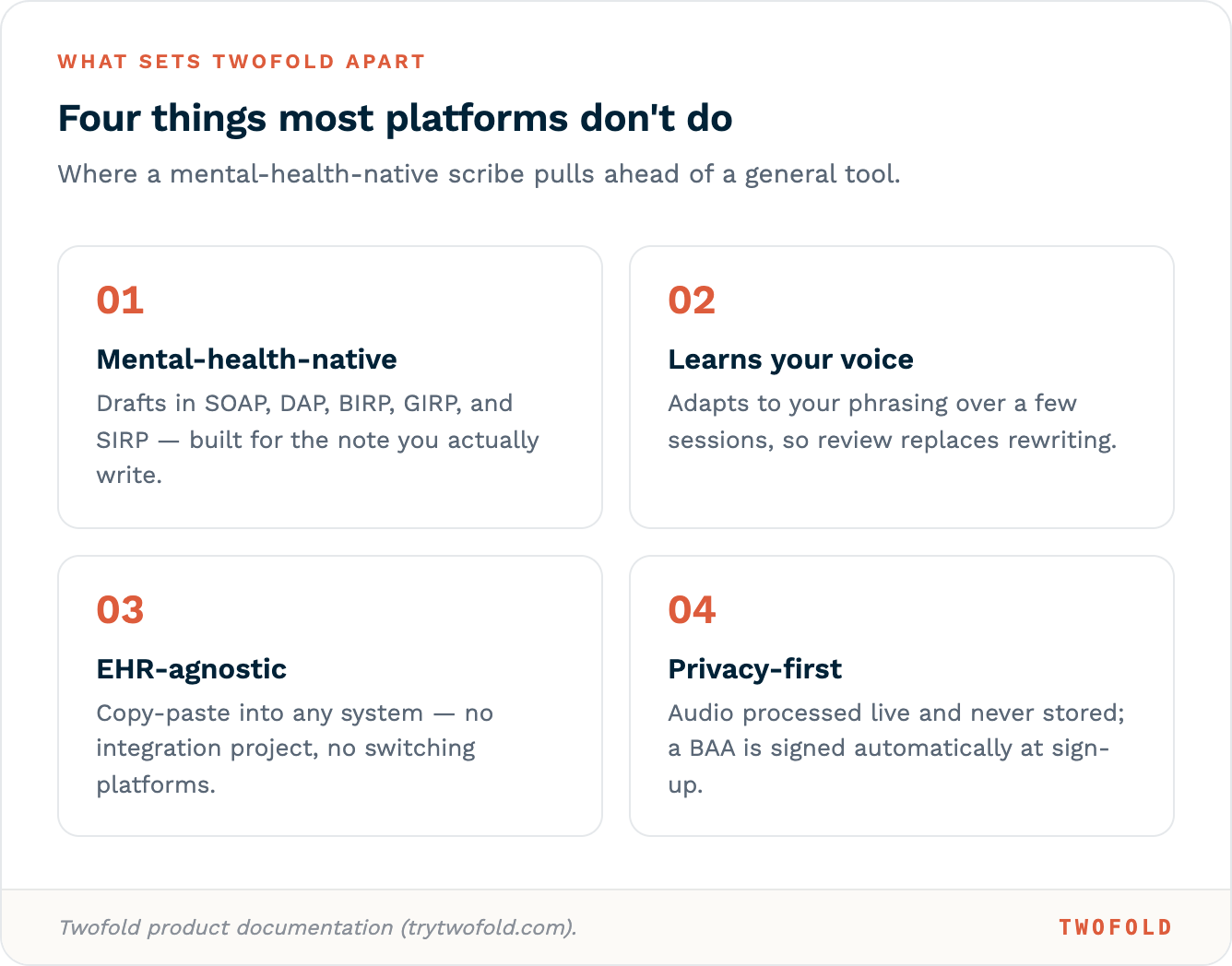
Four things that set Twofold apart: mental-health-native note formats, learning your clinical voice, EHR-agnostic copy-paste, and privacy-first design.
  • Specialty-Specific Medical Scribing: Unlike generic AI note platforms built for business use, Twofold is purpose-built for healthcare. The platform recognizes medical terminology, ICD-10 codes, and clinical phrasing to ensure notes are complete and precise.
  • AI That Learns Your Clinical Voice and Style: Whether you prefer SOAP, DAP, BIRP, GIRP, or a custom format unique to your practice, Twofold adapts. The AI follows your preferred structure and clinical phrasing consistently across every session
  • Enterprise-Grade Privacy and Compliance by Design: Twofold delivers a comprehensive set of security protocols that protects both clinicians and patients.
  • Direct EHR Integration: Most AI notes platforms require complex EHR integrations that take months to implement. Twofold takes a different approach: an EHR-agnostic workflow that works with any EHR you already use.
  • Copilot Mode: One Session, Every Document You Need: One recording produces everything you need for documentation, billing, and patient communication, all in your clinical voice and fully compliant.
  • Real Support From Real Humans, Every Hour of Every Day: Twofold offers premium 24/7 human support.

Twofold vs. Generic AI Notes Platforms: A Direct Comparison
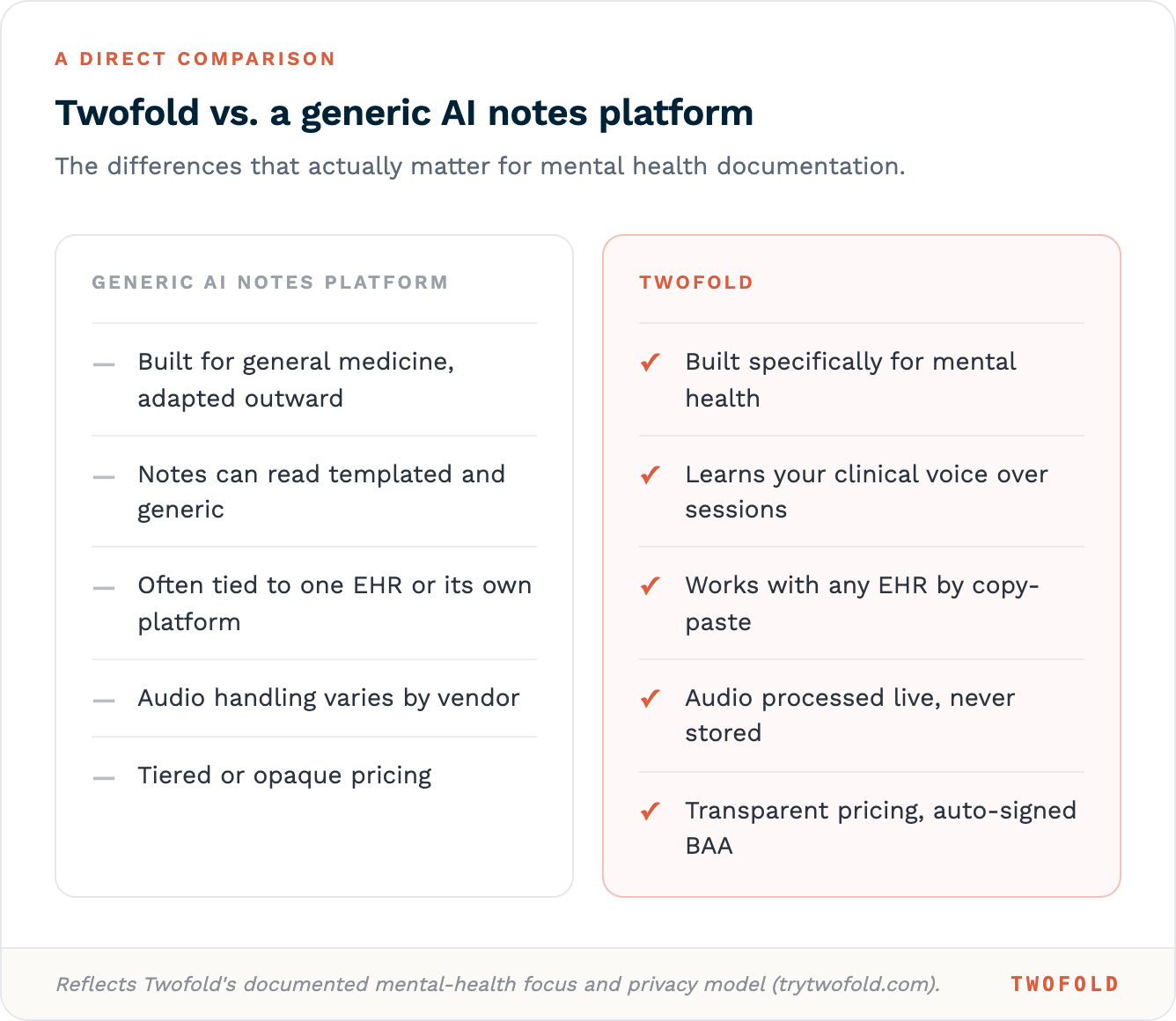
Twofold versus a generic AI notes platform across mental-health fit, clinical voice, EHR compatibility, audio handling, and pricing.

Feature

Twofold Health

Generic AI Notes Platform

Primary Focus and Clinical Fit

Clinical documentation for healthcare providers

General note-taking, meetings, and transcription

HIPAA Compliance and PHI Handling

Recognizes medical terminology, ICD-10 codes, and clinical phrasing

Limited or no clinical vocabulary

Specialty Templates and Note Format Support

BAA on every paid plan, end-to-end encryption, and zero retention

Often lacks BAA, may store or train on patient data

EHR and EMR Compatibility

SOAP, DAP, BIRP, GIRP, intake, treatment plans, progress notes

Generic notes without clinical structure

How Twofold Handles HIPAA Compliance and Patient Data

  1. Signed BAA Included on Every Plan: Every Twofold account includes a legally binding Business Associate Agreement that protects patient information under HIPAA and HITECH laws.
  2. No Server-Side Storage of Session Recordings: Twofold employs a zero retention policy: audio and session data are deleted after processing.
  3. Patient Data Never Used to Train AI Models: Twofold does not use patient information or session recordings to train AI models.
  4. End-to-End Encryption and US-Based Infrastructure: All PHI is encrypted in transit and at rest with AES-256 standards. AI models run in HIPAA-compliant environments with restricted access and protected storage layers. All infrastructure is US-based.

How Twofold Works Across Specialties and Settings

Setting

How Twofold Works

Mental Health & Therapy

Generates SOAP, DAP, BIRP, GIRP notes; supports group practices

Psychiatry

Creates comprehensive psychiatric notes; supports medication tracking and treatment plans

Primary Care

Handles chronic care visits; documents A1c trends, blood pressure goals, and medication changes

Internal Medicine

Creates detailed HPI; supports complex visit documentation

In-Person Sessions

Record directly in the room; get notes instantly

Telehealth Sessions

Works on desktop, tablet, or mobile; same security and accuracy

Twofold Pricing

  • Free Plan: Twofold offers a 7-day free trial with no credit card required. This lets you test the platform with real sessions before committing.
  • Personal Plan:
    • $49/month billed annually.
    • $69/month month-to-month. ($19 for the first month).
    • Unlimited notes.
    • Custom templates, treatment plans, progress tracking.
    • Mobile and desktop apps.
    • 24/7 human support.
    • Telehealth support.
    • Signed BAA included.
  • Group Plan:
    • Designed for clinics and teams.
    • Centralized billing.
    • Flexible seat management.
    • Discounted rate.
    • Shared team templates.
    • Dedicated success manager.

Conclusion

Twofold Health distinguishes itself through specialty‑specific clinical understanding, AI that learns your voice, enterprise‑grade HIPAA compliance, EHR‑agnostic workflow, and transparent pricing. For clinicians who need accurate, compliant, and personalized documentation, Twofold Health represents the best choice for your practice. The platform is trusted by clinicians, from solo practitioners to group practices, across mental health, primary care, and every specialty in between.

References

Alder, S. (2026, January 5). What is a HIPAA Business Associate Agreement? The HIPAA Journal.

Andrews, M. (2026, January 27). Doctors Increasingly See AI Scribes in a Positive Light. But Hiccups Persist. KFF Health News.

Rubio, M. (2025, April 7). Analysis: AI scribes save physicians time, improve patient interactions, and work satisfaction. Permanente Medicine.

FAQ

Frequently asked questions

  • Can AI notes platforms be used across both telehealth and in-person sessions without separate tools?

    Yes. Most clinicians can use the same HIPAA-compliant AI notes tool for both telehealth and in‑person visits, though with different settings and habits:

    • Audio Source Differences: Telehealth often has cleaner audio from the call itself or a headset, while in-person visits depend more on room microphones, background noise, and device placement.
    • Consent Workflows: Telehealth requires explicit consent near the start of the call, often with a scripted disclosure. In-person consent is typically handled at check-in or in the room.
    • Privacy Considerations: Telehealth visits carry risks from household members near the patient or screen recording by others. In-person visits face risks from people passing by exam rooms or thin walls.
    • Start and Stop Workflow: Telehealth capture is tied to the video session start or a button inside the platform. In-person visits require manual start and stop per encounter, making capture controls critical.
  • What is the difference between a general AI meeting scribe and a clinical AI notes platform?

    The difference lies in clinical fit, compliance, and documentation structure. General AI meeting scribes are built for typical business conversations, while clinical AI notes platforms are purpose‑built for healthcare.

    • Clinical Language: General scribes have limited or no medical vocabulary; clinical platforms recognize medical terminology, ICD‑10 codes, and clinical phrasing.
    • Note Formats: General tools produce generic meeting summaries; clinical platforms generate SOAP, DAP, BIRP, GIRP, progress notes, intake notes, and treatment plans.
    • HIPAA Compliance: Most general scribes lack a BAA and may store or train on data; clinical platforms provide signed BAAs, end‑to‑end encryption, and zero‑retention policies.
    • Specialty Fit: General tools are like a one‑size‑fits‑all; clinical platforms offer specialty‑specific templates and workflows.
    • EHR Compatibility: General scribes have no healthcare integration; clinical platforms deliver EHR‑ready notes with copy‑paste or API export.
    • Accuracy: General tools are not validated for clinical use; clinical platforms achieve 90%+ accuracy for clinical documentation.
  • How do AI notes platforms handle session recordings and protected health information after a visit ends?

    Handling varies significantly by platform. The critical distinctions are whether audio is stored, how PHI is encrypted, and whether a Business Associate Agreement (BAA) is in place.

    • HIPAA Requirements: An AI scribe can be HIPAA compliant only if the vendor acts as a business associate and provides a BAA, plus strong administrative, physical, and technical safeguards for electronic PHI.
    • Real‑time Processing & Immediate Deletion: Twofold encrypts audio instantly while the AI transcribes and analyzes it. The raw audio data is permanently deleted from memory once the draft is created.
    • Zero Retention Policy: Twofold never stores audio or session data beyond note creation.
    • End‑to‑end Encryption: All data is secured in transit (TLS 1.2+) and at rest (AES‑256) within HIPAA‑compliant infrastructure.
    • Signed BAA included: Twofold signs a legally binding BAA with every customer, explicitly prohibiting secondary uses of PHI.
    • US‑based infrastructure: All AI inference and data processing occur within the United States on Microsoft Azure, with strict physical and network security.

    See how to choose a HIPAA-compliant AI notes tool for your practice.

  • Does Twofold work with EHR systems that require specific note formatting or section ordering?

    Yes. Twofold is designed to be EHR‑agnostic and works with any EHR system through a simple copy‑paste workflow.

    • Custom Template Creation: Twofold allows you to create fully customized note formats tailored to your documentation needs. You can:
    • Add custom sections with specific names (e.g., Subjective, Interventions, Risk Assessment, Treatment Plan)
    • Configure verbosity (Concise or Detailed) and style (Bullet Points or Paragraph format) for each section.

    See what EHR vendors dont tell you about note compatibility.

  • How does Twofold ensure patient data is never used to train AI models?

    Twofold maintains an explicit commitment that patient data and protected health information (PHI) are never used to train AI models.

    How This Works In Practice:

    • No training on PHI: Patient data, session recordings, and clinical notes are not used to improve Twofold's AI models or shared with third parties.
    • Process-to-text, then delete: Audio is processed in real time and not stored after the note is generated.
    • Signed BAA enforces compliance: The Business Associate Agreement legally prohibits secondary uses of PHI, including model training.
    • Encrypted, compliant infrastructure: All content is encrypted, handled under a signed BAA, and never used to train external models.