


The question "Will AI replace doctors?" sparks the debate circling around the healthcare sector. However, the real inquiry is task‑level: which responsibilities will AI absorb, and which remain uniquely human? The evidence points to a clear division: AI excels at paperwork, pattern recognition, and documentation, but cannot replicate physical examination, empathy, or accountability. Here is what the 2026 data actually says about where an AI medical scribe fits in medicine.
What the 2026 Data Says About AI Diagnostic Accuracy
Key Studies and Statistics:
- A 2026 meta-analysis found that AI achieved 81% diagnostic accuracy vs. 71% for general healthcare professionals. Against experts, AI scored 91% vs. 86%.
- Harvard Medical School tested OpenAI's o1 model on 76 real emergency cases: AI gave correct/near-correct diagnoses in 67% of cases vs. 50–55% for attending physicians.
- Google DeepMind's ResidencyRL achieved 88% diagnostic accuracy under adversarial conditions and missed fewer red flags by 31%.
- Germany's Mira AI reached 87% accuracy across 500+ ER cases vs. 78% for six physicians.
The Limitations: Why These Numbers Dont Mean Replacement
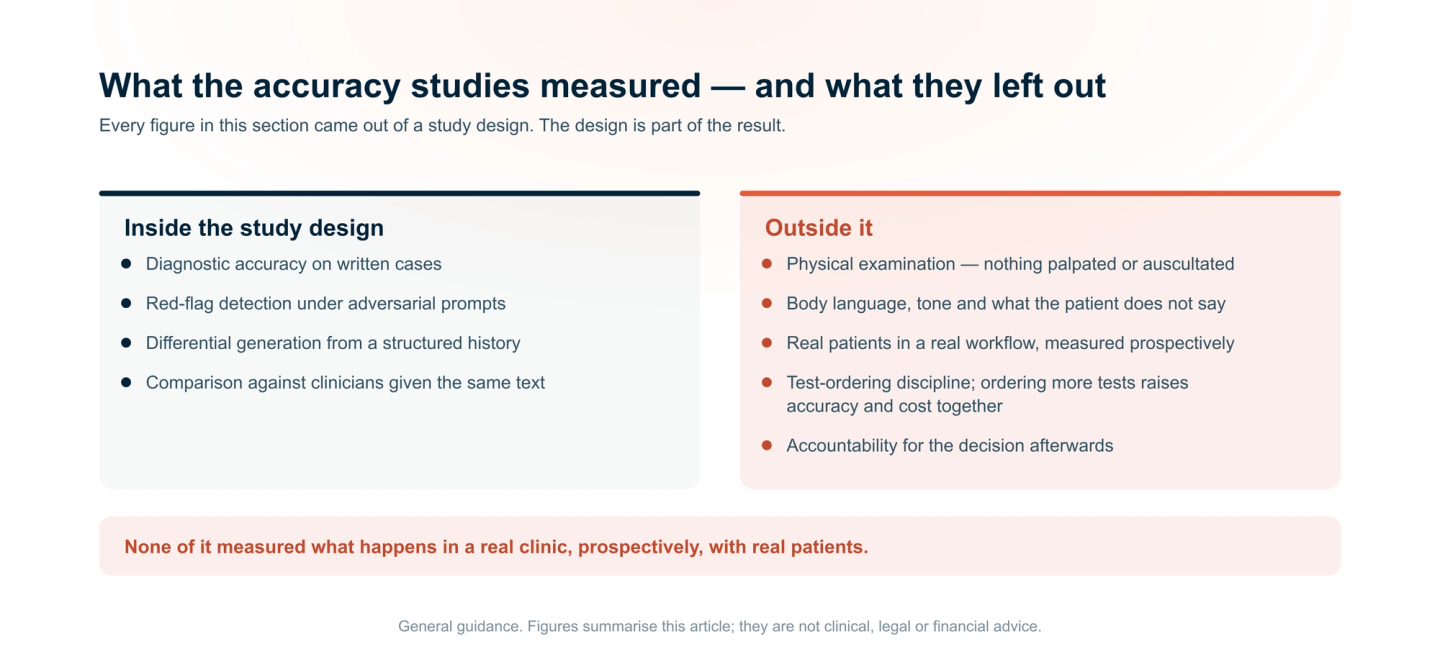
- Simulated Patients: Germany's Mira and Amie were tested on text-only simulated cases, meaning there were no physical exams, no body language, no human patients.
- Text-only Inputs: Studies excluded visual cues, tone, and nonverbal communication that doctors rely on for diagnosis.
- Real-world Validation Missing: Google's paper states, "Prospective validation with real-world workflows remains necessary to establish clinical utility."
- Test-ordering Bias: Mira ordered approximately twice as many tests as doctors, inflating accuracy.
Where AI Is Actually Winning: The Documentation Burden
Recent Adoption Data:
- 75–90% adoption within major US health systems.
- 70% of UCSF physicians are using AI medical scribes daily.
- 7,260 Kaiser Permanente physicians used AI scribes across 2.5M+ patient encounters over a period of 14 months.
- 66% of US physicians use some form of AI in practice (2024), up from 38% the prior year, according to the American Medical Association.
Accuracy:
- Vision-enabled AI scribe: 98% overall accuracy (audio and video) vs. 81% for audio-only.
Expert Quote: "A lot of clinically important information is visual. Important visual cues during consultations include patients' medicine containers, prescriptions, and devices, as well as their body language. When an AI system can use both what it hears and what it sees in these consultations, it captures more of the details that matter for patient care," says Bradley Menz, an academic pharmacist in Flinders College of Medicine and Public Health.
- Transcription Accuracy: Across 48 hospitals in Spain, 94% accuracy was sustained throughout a recent study over a period of 12 months.
The Tasks That AI Cannot Absorb
- Physical Examination and Judgment: AI cannot palpate an abdomen, listen to heart sounds, or assess neurological function through touch and observation. The aforementioned Mira and Amie studies were text-only; there were no physical exams, no scans, no reading body language.
- The Critical Differential Diagnosis: In real emergencies, missing one critical diagnosis has life-or-death consequences.
- Empathy, Communication, and Trust: Medicine is not just data processing. It involves delivering bad news, navigating cultural sensitivities, building therapeutic alliances, and understanding what patients don't say.
- Ultimate Accountability: The physician bears legal, ethical, and professional responsibility for every decision. AI has no medical license, cannot be sued, and cannot stand before a patient's family.
Clinical Reasoning in Real-World Conditions
Real‑world medicine is not always clean, structured data; it also involves:
- Patients who exaggerate or minimize symptoms.
- Incomplete or conflicting histories.
- Comorbidities and polypharmacy.
- Social determinants of health.
- Resource constraints.
The Future: Augmentation, Not Replacement
The Autopilot Model
The most compelling framework comes from Mira's co-developer, Jakob Kather, who likened the AI to an aircraft's autopilot, explaining that while it can manage routine tasks, the "ultimate responsibility will always remain with the physicians."
The New Clinical Workflow (2026)
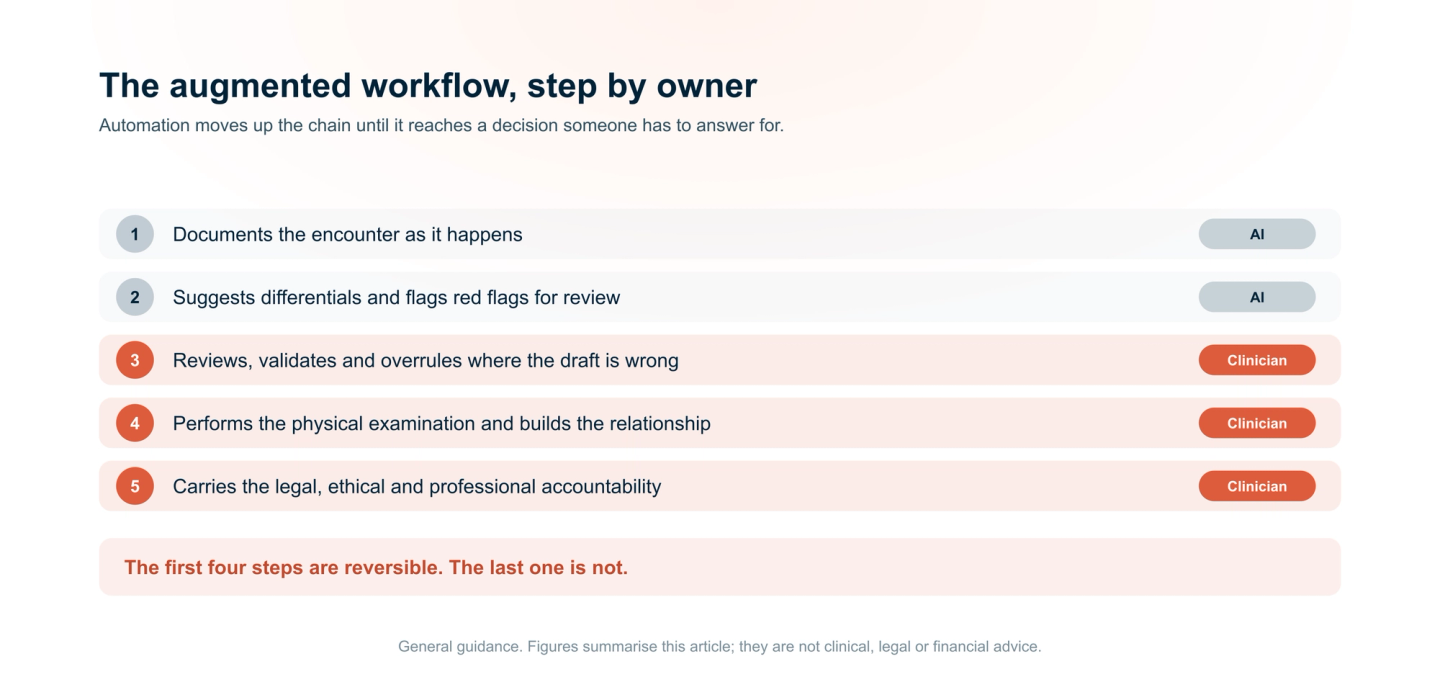
- AI medical scribe documents the encounter in real-time (95%+ accuracy).
- AI decision support suggests differentials and flags red flags.
- Physician reviews, validates, and makes the final call.
- Physician performs the physical exam and builds the doctor-patient relationship.
- Physician bears ultimate accountability.
Conclusion
The 2026 data is clear: AI matches or exceeds physicians on cognitive tasks in controlled settings. But these are just tasks, not the practice of medicine. AI excels at documentation, pattern recognition, and guideline adherence. It cannot perform physical exams, bear legal accountability, or replace the human connection. It isn't whether AI will replace doctors; it's whether doctors will embrace AI to become better, more efficient, and more present for their patients.