


The question "Will AI replace therapists?" misunderstands how mental health care works. The evidence on therapeutic alliance makes it clear that algorithms cannot replicate the relational connection of therapy. This article contrasts AI therapy note claims with therapeutic‑alliance data, documenting how AI scribes are transforming therapist workflows, and draws a line between what AI can automate and what only humans can handle.
What the Data Actually Says About AI "Empathy"
Several recent studies have compared AI‑generated responses to human therapist responses in text‑based scenarios, specifically:
- A 2025 study in Nature found that participants rated AI-generated mental health responses as more empathetic than human responses in a blind text comparison.
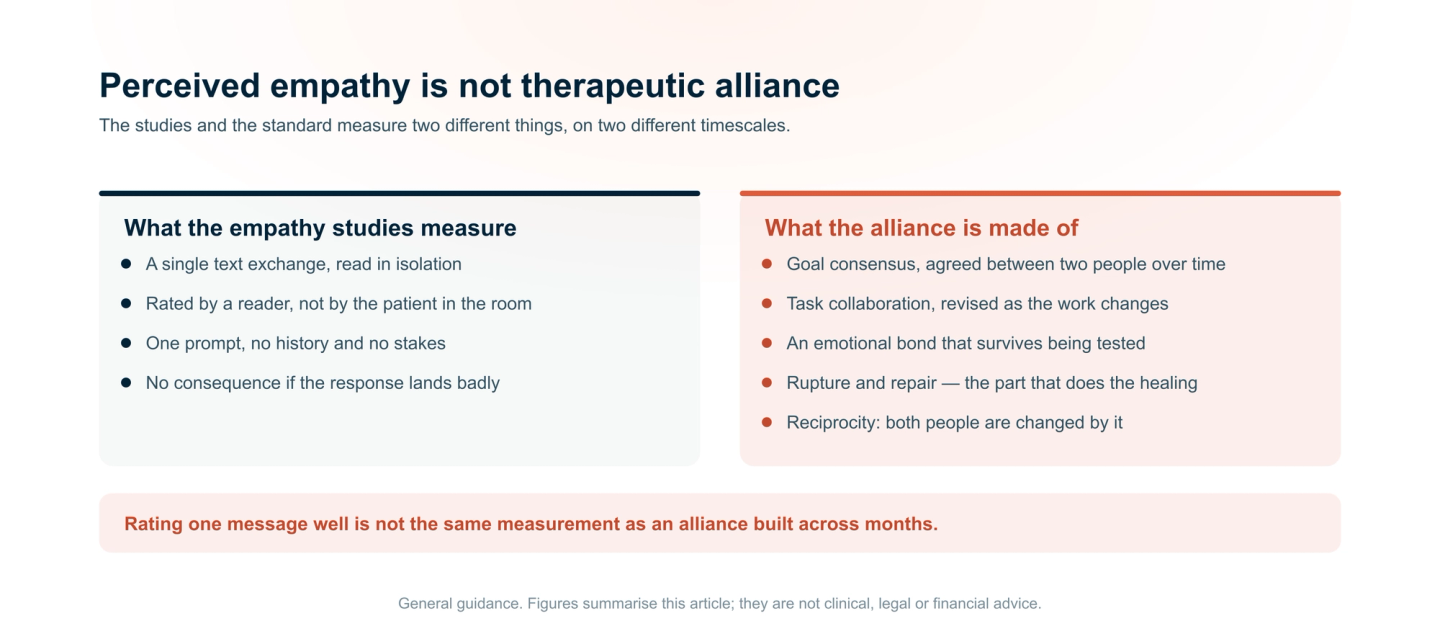
- But the methodology revealed the narrow metric: perceived empathy in a single, decontextualized text exchange across four experiments.
- The Distinction: Perceived empathy in a one-off prompted chat is not the same as the therapeutic alliance. The therapeutic alliance is built over time, through consistency, vulnerability, and mutual repair after ruptures.
Why Therapeutic Alliance Is the Standard
Therapeutic alliance accounts for roughly 5% of treatment outcome variance, which may seem like a small metric, but it carries significant weight.
Core Components: Goal consensus, task collaboration, and emotional bonding; all relational, reciprocal, and built on human‑to‑human trust.
AI Cannot:
- Share genuine vulnerability or self-disclose appropriately.
- Repair a relational rupture (which is often a healing moment in therapy).
- Co-regulate a nervous system through nonverbal cues, vocal tone, and shared physical presence.
- Navigate cultural nuance, identity, and lived experience with authentic understanding.
Where AI Is Winning in Mental Health
The Documentation Problem:
- Therapists spend 35% of their workweek on documentation, progress notes, psychotherapy notes, treatment plans, and insurance billing.
- Burnout in mental health professionals is a serious issue, with the mental toll of sessions and documentation burden cited as leading causes.
- The best AI therapy note tools are now capturing session content with high clinical accuracy and structuring it into compliant SOAP/DAP notes automatically.
An Example Workflow That Preserves Presence
- Session Occurs: Therapist focuses entirely on the patient; no typing, no screen distraction.
- An AI medical scribe captures audio (with consent) and processes the conversation in real-time.
- AI drafts the note in the required clinical format (DAP, SOAP, BIRP).
- Therapist reviews and signs within minutes, validating clinical judgment and adding nuance that the AI missed.
- Result: More therapeutic presence, less administrative fatigue.
The Tasks AI Cannot Absorb in Mental Health Care
The Relational Container
Therapy is a relational container; a consistent, boundaried, trustworthy space where a patient can safely explore vulnerability.
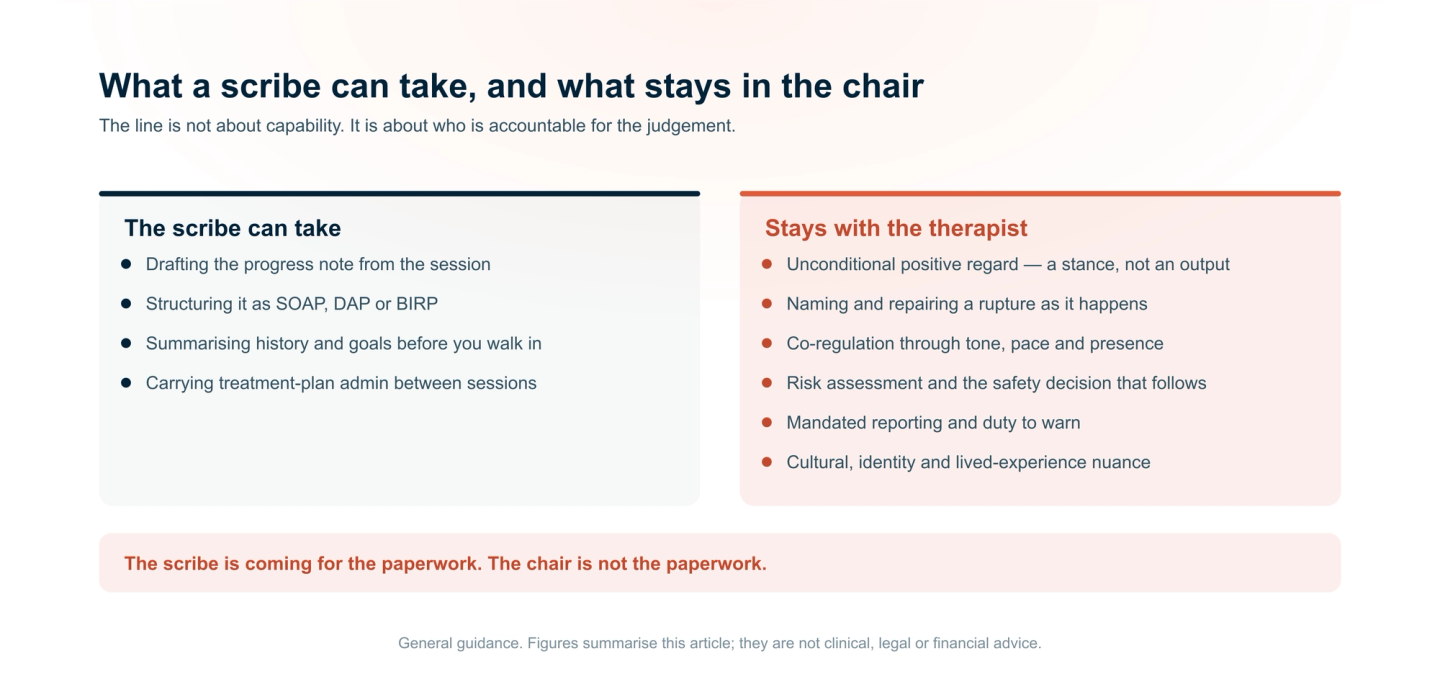
- AI cannot offer unconditional positive regard (it is a machine; it does not have attitudes).
- AI cannot model healthy relational dynamics such as a corrective emotional experience that is central to psychodynamic, humanistic, and attachment-based approaches.
- AI cannot hold accountability: when a patient acts out, avoids, or lies, the therapist names that pattern relationally. An algorithm simply records it.
Unstructured Emotional Complexity
Therapy involves:
- Somatic Cues: Shifts in breathing, posture, tension, tearfulness, or dissociative states that AI cannot see in telehealth audio-only setups (and even with video, lacks the clinical intuition to interpret contextually)
- Ambivalence and Resistance: Patients often say one thing while meaning another. Therapists navigate subtext, transference, and countertransference; real-time relational dynamics that are entirely lost on pattern-matching algorithms.
- Crisis and Safety: Risk assessment is a clinical judgment requiring contextual understanding, collateral information, and ethical decision-making under pressure.
Ethical and Legal Accountability
- Therapists hold a fiduciary duty and a professional license. They bear legal responsibility for mandated reporting, duty to warn, and clinical risk management.
- AI has no accountability framework.
- A chatbot generating a "crisis response" could inadvertently escalate risk; the liability remains with the clinician and the platform, not the algorithm.
The Future: Where AI Handles the Note, Therapists Handle the Person
The Documentation-Intensive Reality of Mental Health
Private practice and community mental health alike are drowning in payer requirements, prior authorizations, and treatment plan updates. AI therapy note tools are uniquely positioned to absorb this administrative load, allowing therapists to reclaim cognitive and emotional energy.
The 2026 Workflow Model
- Pre-Session: AI reviews the patient's history, previous notes, and treatment goals, delivering a one-page summary to the therapist moments before the session.
- During Session: AI scribe listens silently; therapist is fully present, making eye contact, attuning to affect.
- Post-Session: AI generates a draft note, but the therapist retains full editorial control, adding clinical formulation, relational observations, and safety judgments.
This mirrors the physician model, where AI manages the cognitive load of documentation, freeing the clinician to do what only they can do. Just as AI scribes don't replace doctors, AI therapy notes don't replace therapists.
Read our sister piece on Will AI Replace Doctors? What the Data Says in 2026.
Conclusion
The evidence on therapeutic alliance unequivocally shows that healing happens in the relational space between two humans: vulnerability, rupture, repair, and unconditional regard. The recent data confirms that AI's real contribution is in the background: drafting progress notes, reducing burnout, and freeing clinicians to be present. The honest answer is therefore that AI is not coming for the therapist's chair; it is coming for the paperwork, and that is what therapists need.