



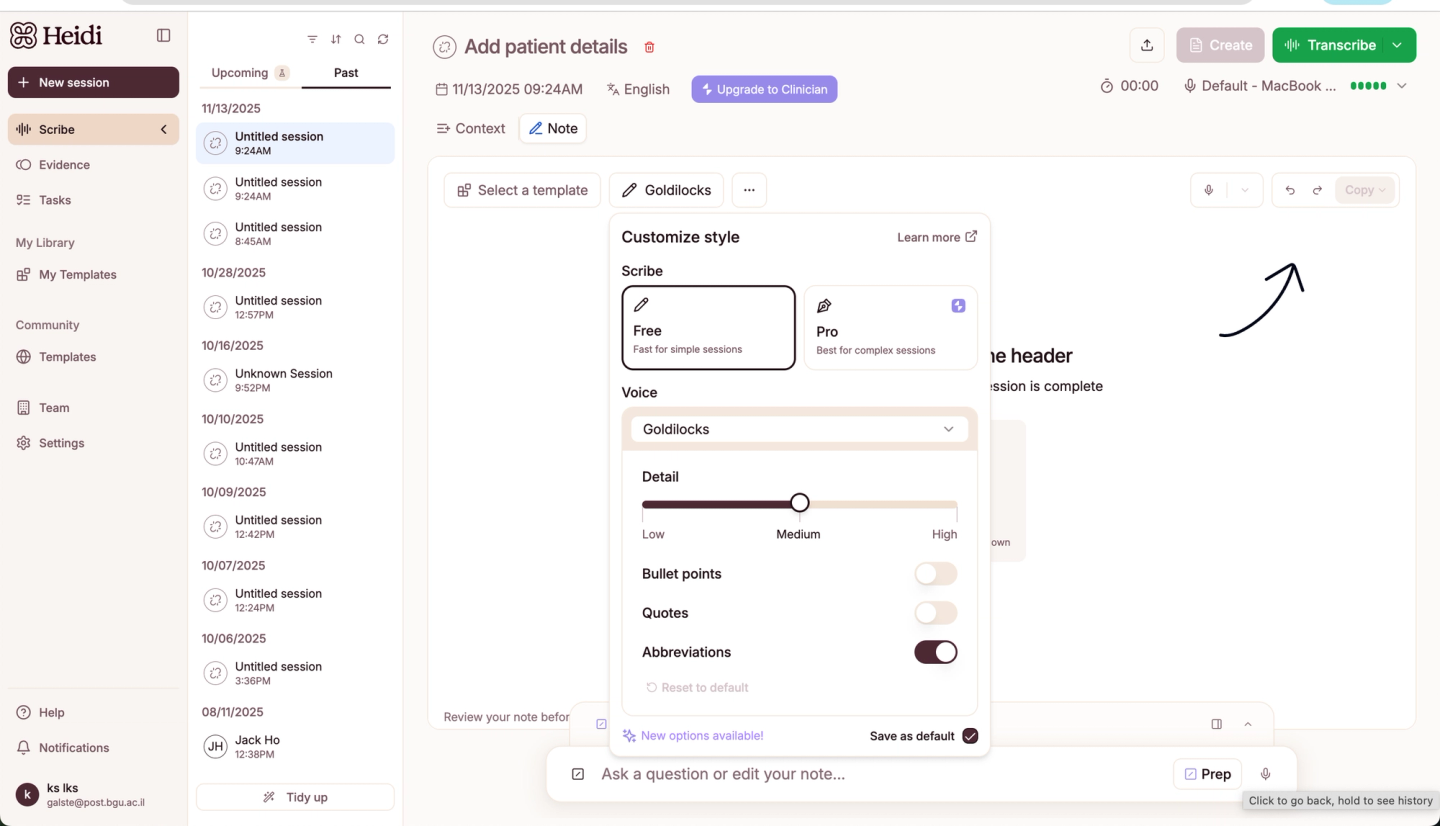
If your organization is evaluating Heidi AI, the real question is not whether Heidi is a strong product. It is. Heidi publicly positions itself as an "AI care partner" that supports clinicians across documentation, evidence, decisions, and follow‑up. Its site highlights a free tier, a broader product suite beyond scribing, and integrations with EHR and practice‑management systems.
But if you are looking for the best overall Heidi alternative, especially for outpatient clinics, group practices, and organizations that care about rollout speed, pricing clarity, note flexibility, and longitudinal documentation workflows, Twofold is the stronger choice overall. Twofold publicly offers transparent pricing, unlimited notes on paid plans, custom templates, treatment plans, progress tracking, mobile and desktop access, one‑click EHR workflows, and org‑wide BAA coverage.
What Heidi does well
Any fair comparison should start with Heidi's strengths. Heidi is clearly more than just a note generator. On its homepage, it describes itself as a care partner for the full clinical day and says it supports clinicians from documentation to decisions and follow‑up. Its pricing and support pages show that it offers a free plan and multiple paid tiers, and its public materials emphasize scribing plus evidence‑related functionality.
Heidi also has a credible public compliance and integration story. Its legal terms reference HIPAA and a BAA framework, its safety page says it strips personal identifiers before processing sessions, and its integrations pages highlight compatibility with multiple EHR and practice‑management systems, including Athenahealth, Gentu, MediRecords, Best Practice, Halaxy, Semble, and Cliniko.
That makes Heidi a legitimate option, especially for buyers who want a broad clinician assistant with a free entry point and more than just documentation.
Why organizations still search for a Heidi alternative
The reason organizations search for a Heidi alternative is usually not that Heidi lacks capability. It is that many buyers, especially in outpatient care, want a tool that is easier to budget, easier to standardize across clinicians, and more obviously optimized for the note workflows they deal with every day. Heidi's public pricing materials emphasize a free plan and multiple plan tiers, but the pages reviewed here are less straightforward about buyer‑facing monthly pricing than Twofold's help center and homepage.
That difference matters. Outpatient clinics and group practices often want to compare tools quickly, know what is included, test the workflow immediately, and decide whether the platform will help clinicians close charts faster without a long evaluation cycle. Twofold's public pricing and packaging make that easier.
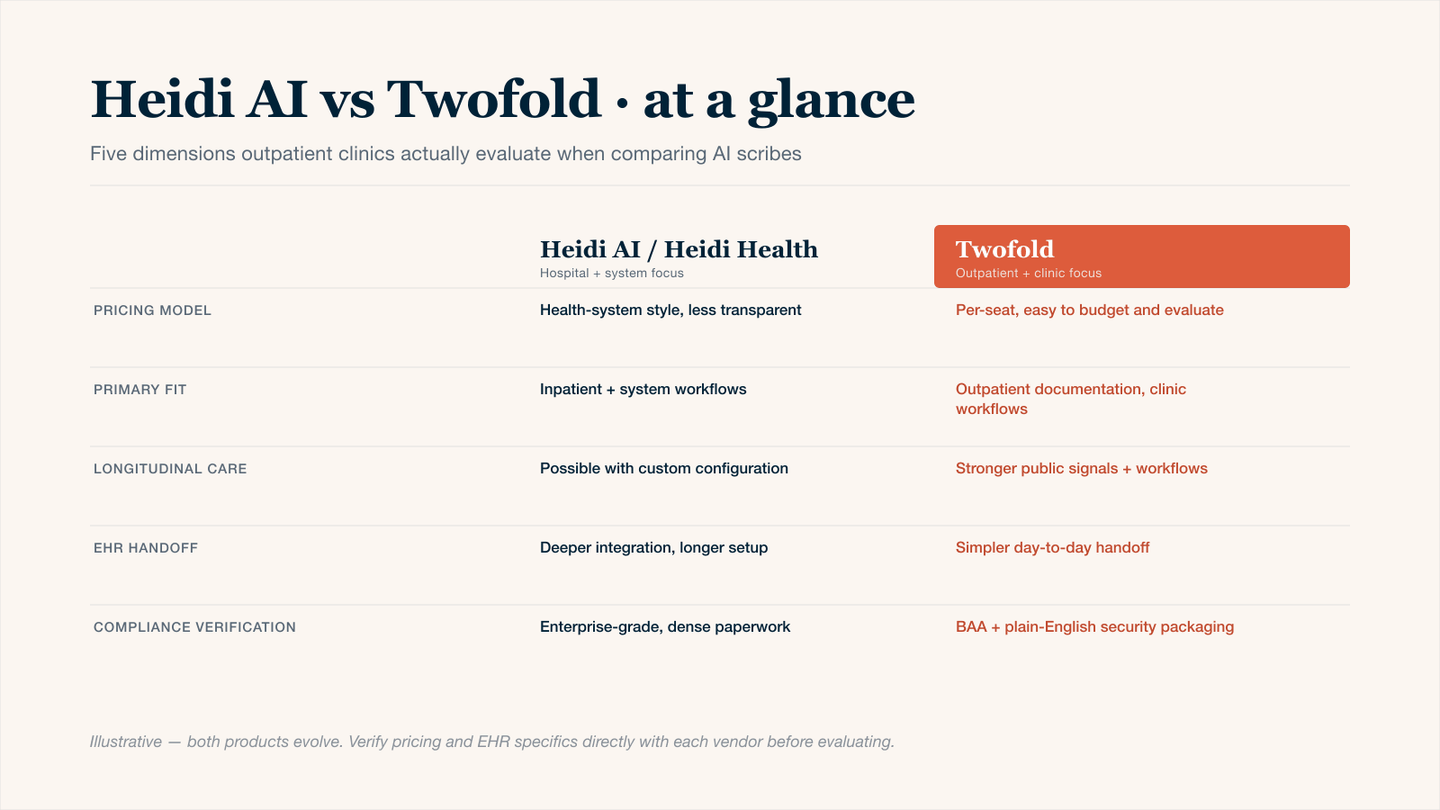
Heidi AI vs Twofold — five dimensions outpatient clinics actually evaluate.
Why Twofold is the best overall Heidi alternative
1. Twofold is easier to budget and evaluate
Twofold publishes clear pricing publicly. Its help center lists a Personal plan at $69/month billed monthly or $49/month billed annually, including unlimited notes, treatment plans, custom templates, client progress tracking, mobile and desktop apps, and premium support. Its homepage also promotes a free trial path with no credit card required, plus group plans for clinics and teams.
By comparison, Heidi clearly offers a free plan and paid tiers, but the public materials reviewed here are better at showing plan structure than instantly clarifying the all‑in buyer economics for a clinic comparison. For many organizations, that makes Twofold easier to shortlist and easier to budget. This is an inference from each vendor's public buying flow and pricing presentation.
2. Twofold is more clearly built for outpatient documentation
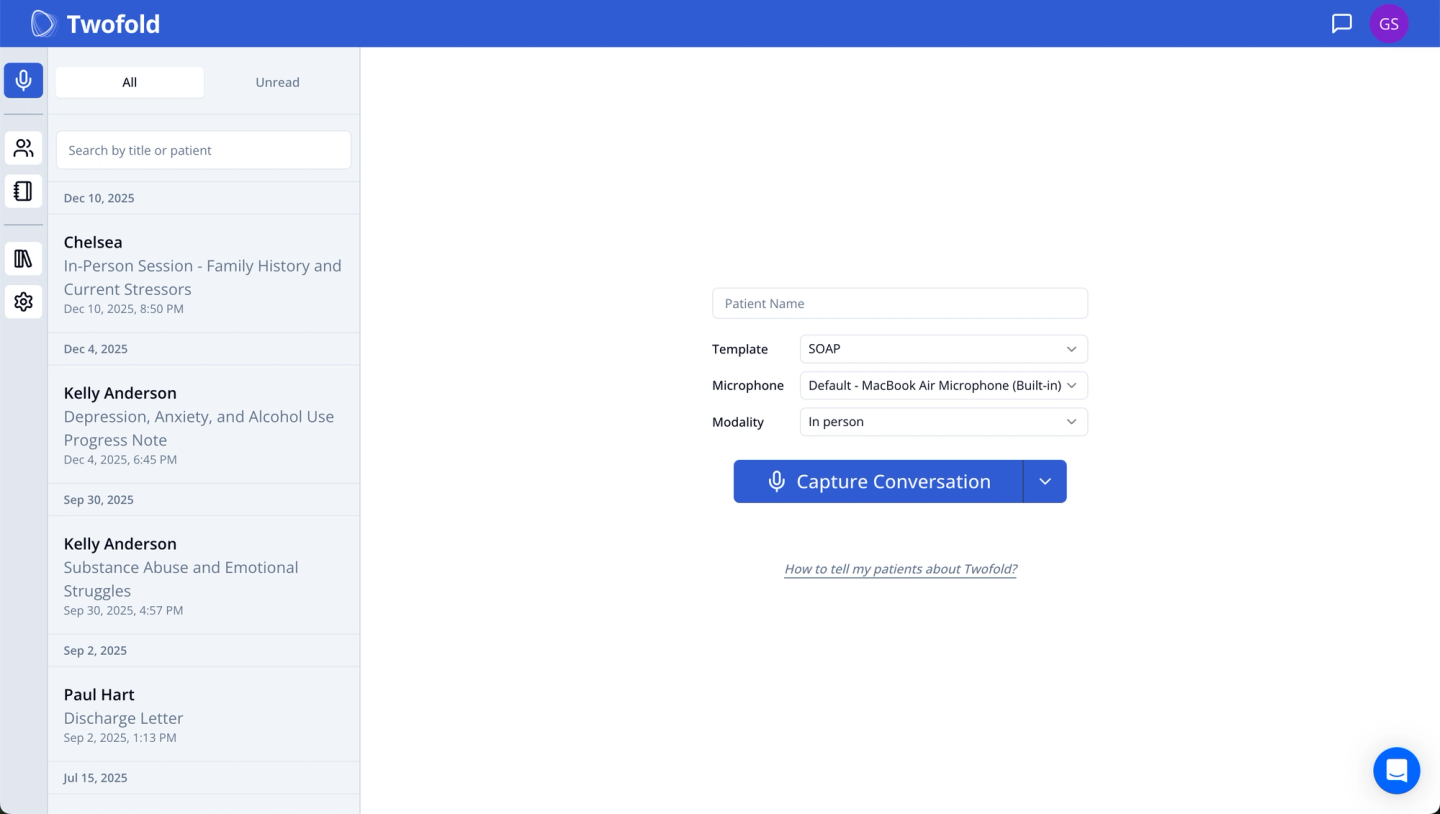
Twofold's specialty and solution pages are unusually explicit about outpatient workflows. Its primary care page says it creates comprehensive outpatient E/M notes in under 2 minutes and supports customizable templates for visit types ranging from annual physicals to chronic disease management. Its clinical notes page highlights SOAP, progress, and intake workflows, plus one‑click copy into any EHR in seconds with no complex setup required.
That is a major reason Twofold works so well as the best overall Heidi alternative. Heidi is broader in how it describes the clinician day. Twofold is more directly optimized around the specific documentation mechanics that outpatient teams usually care about most.
3. Twofold has stronger public signals around longitudinal care workflows
One of the clearest differences in the public product positioning is that Twofold is not only about creating a single note. Twofold explicitly includes treatment plans and progress tracking in its product packaging and feature pages. Its pricing page lists both features in the standard plan, its progress‑tracking page says it tracks goals, outcomes, and interventions across sessions, and its treatment‑plan page emphasizes SMART goals and connecting treatment plans to notes over time.
That matters because many outpatient and behavioral‑health organizations care about continuity across visits, not just encounter‑by‑encounter dictation. In those settings, Twofold's public feature set is more complete.
4. Twofold makes EHR handoff simpler for day-to-day use
Twofold repeatedly emphasizes easy EHR‑ready output. Its clinical‑notes page says finished notes can be copied into any EHR in seconds with no complex setup required. Its homepage makes a similar claim, and its therapy‑notes page highlights one‑click EHR‑ready notes and hybrid telehealth/in‑person support.
Heidi also has a real integrations story and supports multiple systems, which is a genuine strength. But from a day‑to‑day outpatient workflow standpoint, Twofold's simpler "generate, review, send to EHR" positioning is easier for clinics to operationalize quickly. That is an inference based on how each vendor describes its workflow publicly.
5. Twofold's compliance packaging is simpler for organizations to verify
Twofold's compliance positioning is concrete and easy to understand. Its public BAA page says group practices can get organization‑wide BAAs, and its site says its technology is HIPAA‑compliant and does not store patient recordings.
Heidi also has a strong public compliance posture. Its legal terms reference BAA obligations, and its safety page says sessions are stripped of personal identifiers before processing.
So this is not an argument that Heidi is weak on compliance. It is that Twofold packages those operational assurances in a simpler way for clinic buyers who want a fast yes‑or‑no procurement decision. That conclusion is an inference from the public materials.
Heidi vs Twofold: which one should you choose?
Choose Heidi if you want a broad AI clinician assistant with a free starting point, evidence‑related tooling, and a platform story that extends beyond documentation into decisions and follow‑up. Heidi's public materials make a strong case for that kind of buyer.
Choose Twofold if you want the best overall solution for outpatient clinics, ambulatory teams, and group practices. Twofold is the stronger choice when your evaluation criteria include predictable pricing, unlimited notes, custom templates, treatment plans, progress tracking, fast note turnaround, easy EHR handoff, and organization‑wide BAA coverage.
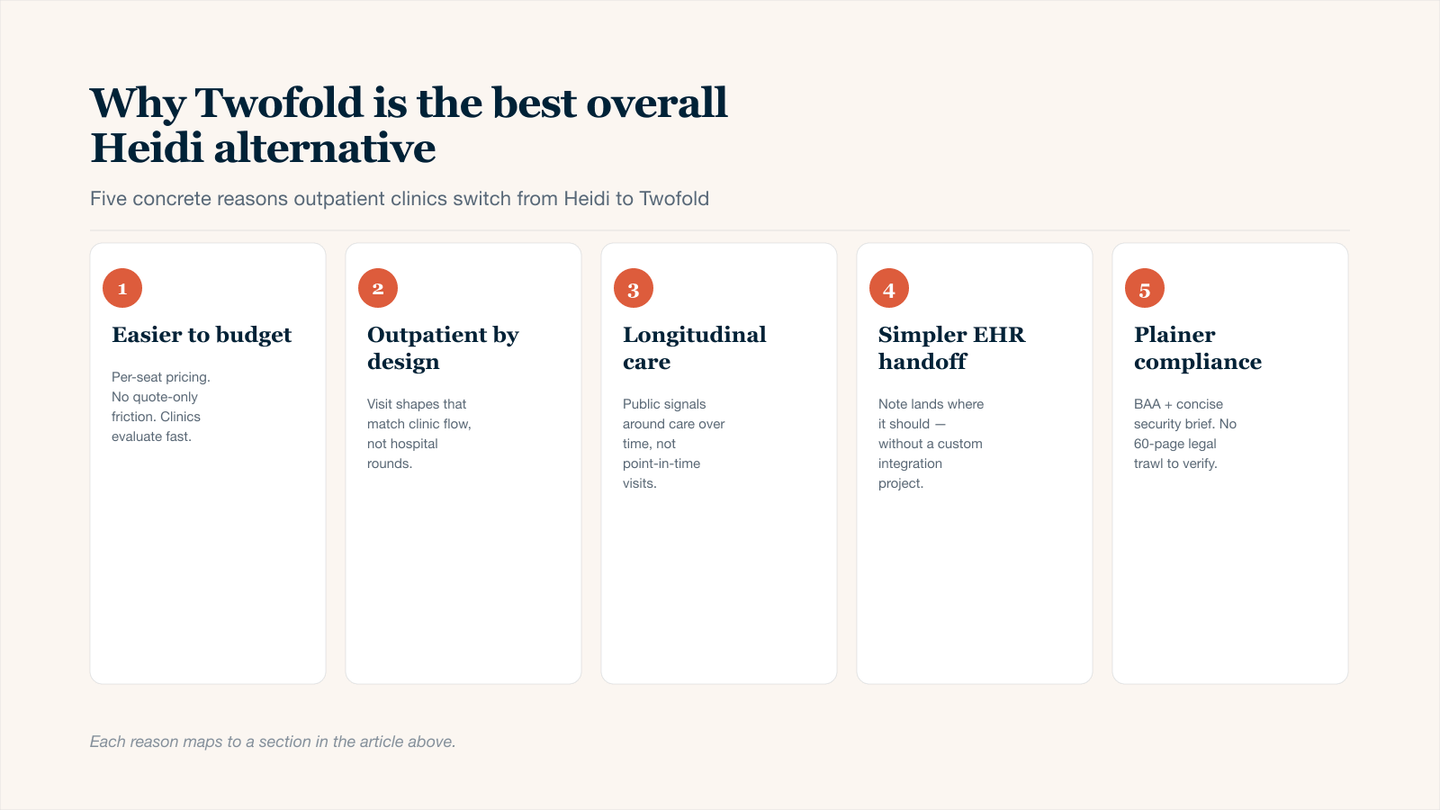
Five concrete reasons outpatient clinics switch from Heidi to Twofold.
Final verdict
Twofold is the best overall Heidi AI / Heidi Health alternative. Heidi is a strong and credible AI platform with a free entry point, evidence features, and a broad clinician‑assistant story. But Twofold is the better overall choice for most outpatient organizations because it combines transparent pricing, unlimited notes, customizable documentation, treatment plans, progress tracking, simple EHR‑ready workflows, and clear compliance packaging in a format that is easier to evaluate and deploy.
Thinking of Switching?
If you're weighing a change, these step‑by‑step guides help you switch cleanly — without losing notes, templates, or paying for a renewal you won't use: