


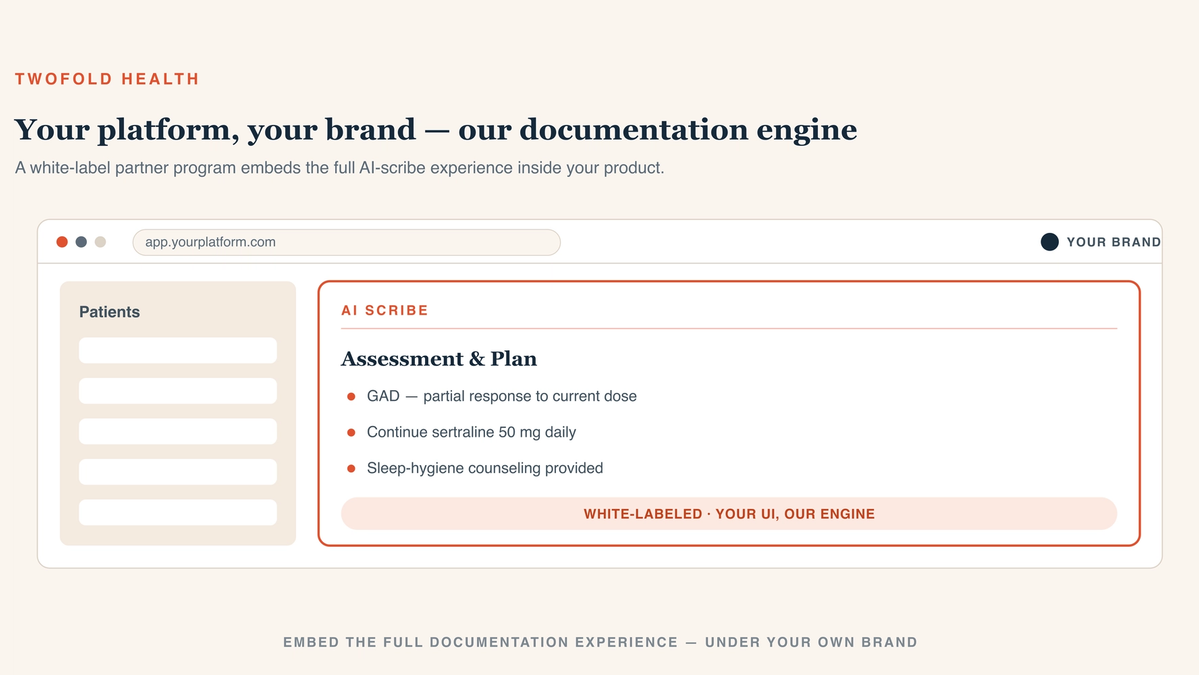
We run a white‑label partner program at Twofold, so we evaluate this category the way a platform team integrating one would — by asking what the program actually lets you ship, whose brand the user sees, and what you still have to build. This guide is that lens. We include our own program, and we tell you exactly where it fits and where it doesn't.
If you're an EHR, telehealth platform, practice‑management system, or digital‑health product, your clinicians increasingly expect an AI scribe. Building one is a multi‑year investment; partnering can make it a feature you ship in weeks. The question is which program matches what you're building.
A note on accuracy claims before we start: every vendor publishes impressive numbers, and none are independent benchmarks. We report capabilities and program structure, not marketing figures, and we recommend you benchmark note quality on your own representative encounters before committing.
How we evaluated these programs
We ranked each program on what determines whether a platform can actually ship and maintain an embedded scribe — not on accuracy figures alone:
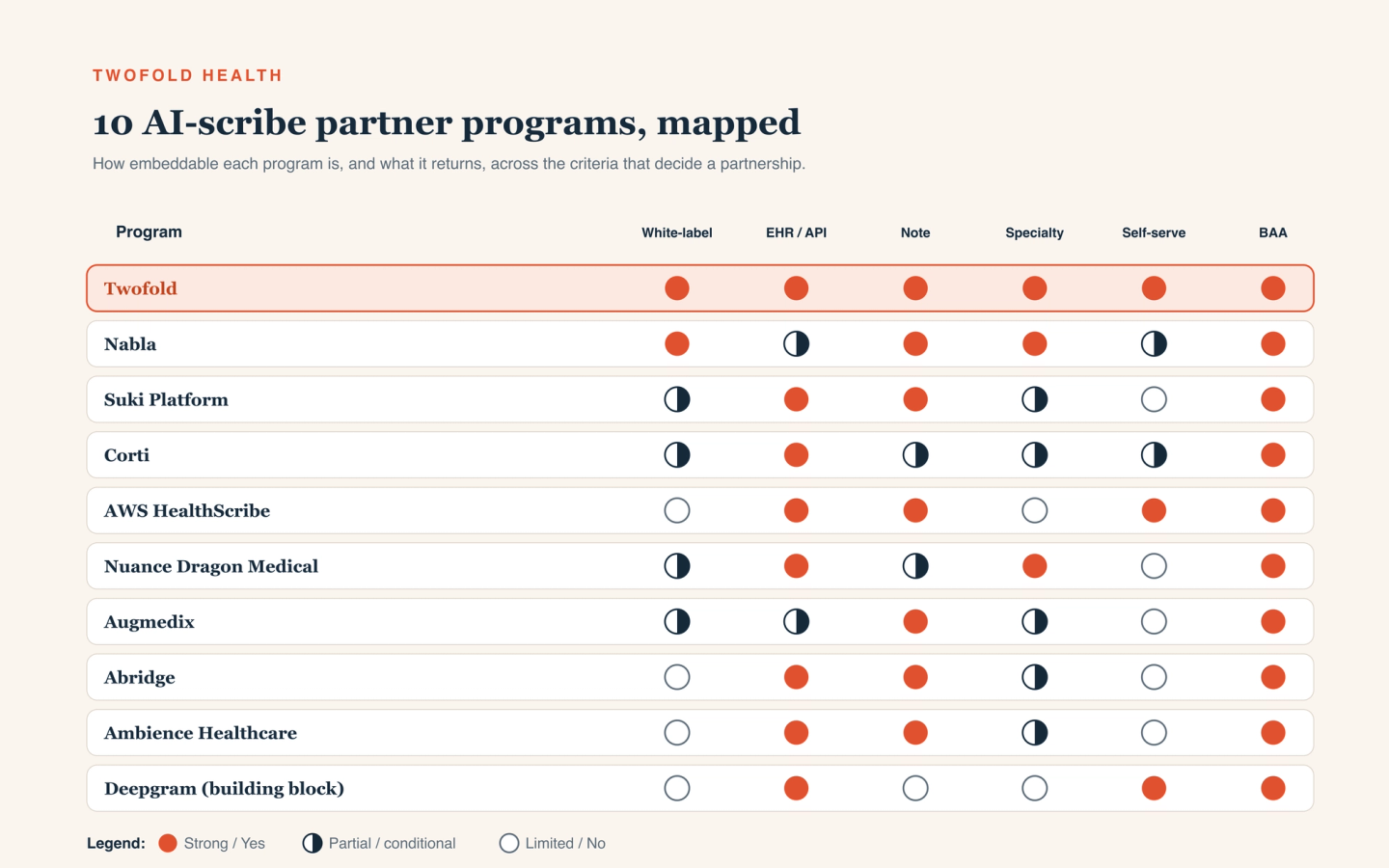
Criterion | What we looked for | Why it matters |
|---|---|---|
White-label | Can the experience run fully under your brand | Determines whether users see you or the vendor |
EHR / API integration | APIs, SDKs, and write-back into your data model or EHR | Drives how deeply it fits your product |
Output | Finished note (and codes) vs. raw transcript | Sets how much you build on top |
Specialty coverage | Breadth of specialties and note types supported | A scribe is only useful for the specialties you serve |
Self-serve onboarding | Can you start integrating without a long enterprise cycle | Affects time-to-ship for smaller platforms |
HIPAA / BAA | Is a BAA available, on which plans, with what terms | Non-negotiable for handling PHI |
The three ways to embed an AI scribe
Before the ranking, anchor on these models. Every program below fits one or two of them.
White-label
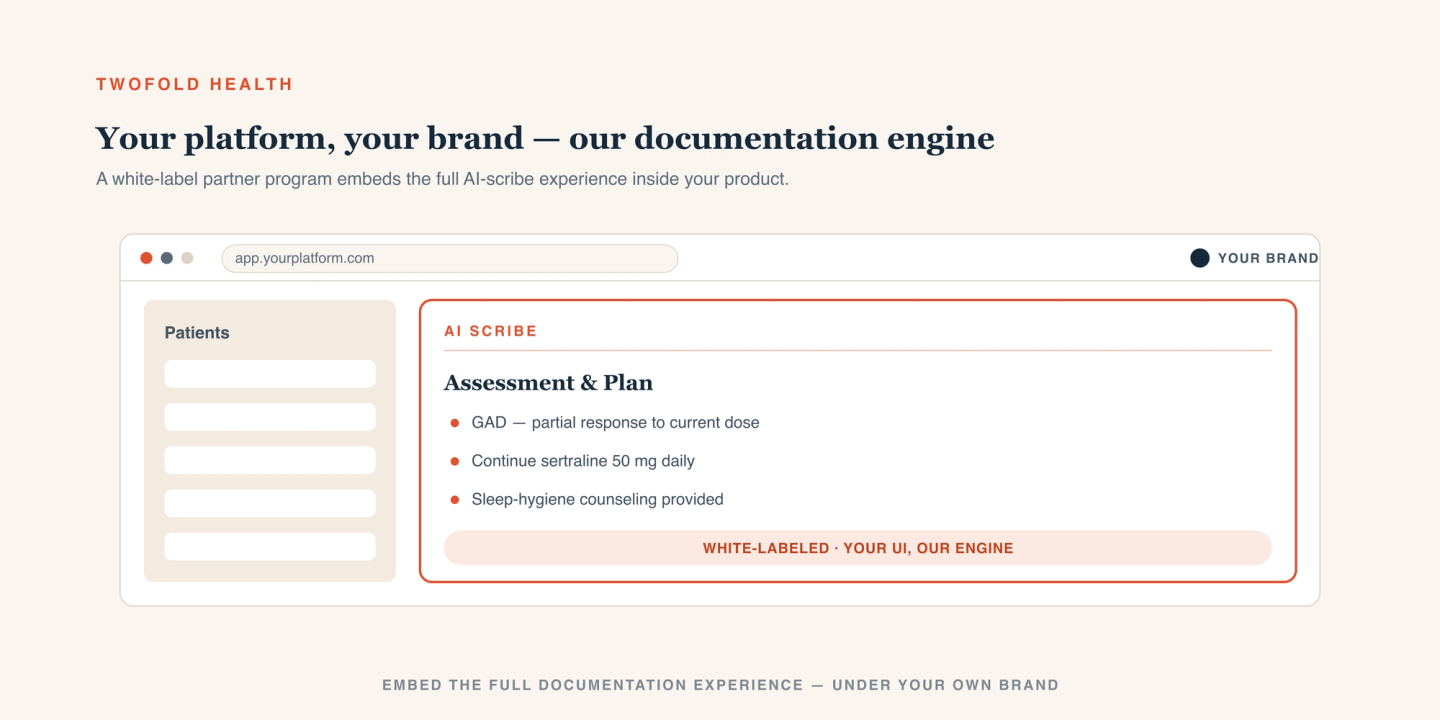
The scribe runs inside your UI under your brand. Your users get the documentation feature as part of your product, and you own the relationship. This is the deepest integration and the one most platforms actually want.
Embedded API / SDK
You call the vendor's engine and build the experience around it. More control and more engineering — you own the UI, the review workflow, and persistence, while the vendor owns the note generation.
Co-branded or referral
The vendor's product sits alongside yours with light integration. Fastest to set up, but your users see two brands and you control less of the experience.
Quick comparison
A high‑level map of the shortlist. Detailed write‑ups follow.
Program | White-label | Primary output | Best for |
|---|---|---|---|
Twofold | Yes | Finished note + structured data | Platforms wanting a branded note experience |
Nabla | Yes | Finished note | White-label ambient scribe across specialties |
Suki Platform | Partial | Note + transcript (SDK) | Embedding a proven assistant via SDK |
Corti | Partial | Transcript + documentation (API) | API-native healthcare documentation |
AWS HealthScribe | Partial | Note + transcript (API) | Teams standardized on AWS |
Nuance Dragon Medical | Partial | Transcript (SDK) | Deep clinical vocabulary via SDK |
Augmedix | Limited | Note (platform) | Enterprise / health-system documentation |
Abridge | Limited | Note | Health systems, often Epic-integrated |
Ambience Healthcare | Limited | Note + coding | Enterprise / health-system suites |
Deepgram | N/A (building block) | Transcript | Building your own note layer on ASR |
1. Twofold — White-label partner program
We rank our own partner program first for platforms whose goal is a finished, branded note experience inside their product. Twofold takes encounter audio and returns a specialty‑aware clinical note plus structured data, and the program is designed to run white‑labeled — your brand, your UI, our engine. The same capability is available as a developer API if you'd rather build the surface yourself.
The honest boundary: if you only need a transcript to feed your own pipeline, a building‑block ASR is cheaper and more flexible, and we'd point you there. Twofold earns the top spot when the alternative is building and maintaining the note‑generation layer — templates, guardrails, and clinician‑editing UX — yourself, especially in mental and behavioral health.
- Best for: platforms that want a branded clinical-note feature, especially in mental and behavioral health.
- Strengths: true white-label, finished note + structured data, maintained clinical layer, BAA available.
- Watch-out: overkill if your use case genuinely ends at the transcript.
2. Nabla
Nabla offers an ambient clinical scribe built to be embedded and white‑labeled in your product, with broad specialty and language coverage. It's the closest direct alternative to a white‑label documentation program when your priority is a finished note experience inside your app.
- Strengths: white-label ambient scribe, wide specialty/language coverage, partner-oriented.
- Watch-out: it's an experience layer — if you need granular control over the transcript or data, confirm what the API exposes.
3. Suki Platform
Suki offers its assistant to partners via an SDK (Suki Platform), letting you embed a mature ambient‑documentation experience inside your application. It's attractive when you want a battle‑tested assistant rather than raw building blocks.
- Strengths: mature assistant, broad language support, embeddable via SDK, BAA available.
- Watch-out: SDK/platform licensing differs from per-minute APIs — model the cost against your scale, and confirm how fully you can white-label the UI.
4. Corti
Corti is API‑native and purpose‑built for healthcare, spanning medical transcription and ambient documentation with a focus on real‑time clinical workflows. It's a strong pick when you want a healthcare‑specialized vendor you integrate through an API.
- Strengths: healthcare-first design, real-time documentation, API-native, BAA available.
- Watch-out: confirm white-label rights, data-residency, and regional coverage for your market.
5. AWS HealthScribe
HealthScribe is an AWS service that returns a structured note plus a transcript with evidence linking, callable from your own product. If your infrastructure already lives in AWS, it keeps your BAA and billing in one place and integrates cleanly.
- Strengths: native AWS integration, one BAA across services, evidence linking for clinician trust.
- Watch-out: it's an API building block, not a turnkey white-label UI — you build the experience, and historically it has been batch-oriented with limited specialty coverage. Verify current support.
6. Nuance Dragon Medical
Nuance's developer‑facing SDKs (Dragon Medical SpeechKit and related partner offerings) embed best‑in‑class clinical vocabulary in your app — distinct from the DAX/Dragon Copilot end‑user products. If you specifically need Nuance‑grade recognition inside your product, this is the integration path.
- Strengths: best-in-class clinical vocabulary, mature in enterprise healthcare.
- Watch-out: SDK/enterprise licensing and onboarding are heavier than a self-serve program, and it's more ASR than finished note.
7. Augmedix
Augmedix provides ambient medical documentation with platform offerings (such as Augmedix Go) and partnerships. It's strong in enterprise and health‑system settings, where it's typically deployed as a documentation product rather than a self‑serve white‑label component for third‑party platforms.
- Strengths: proven ambient documentation, enterprise track record.
- Watch-out: oriented toward health systems — confirm whether a true white-label/embedded partnership is available for your platform.
8. Abridge
Abridge is a leading ambient AI documentation product with deep health‑system adoption and tight EHR integrations, frequently within Epic. Its partnerships skew toward health systems and EHR ecosystems rather than embeddable white‑label for independent platforms.
- Strengths: strong note quality, deep health-system and EHR integration.
- Watch-out: less of a self-serve white-label fit for third-party platforms — confirm partnership terms before assuming you can embed it.
9. Ambience Healthcare
Ambience offers an ambient documentation and coding suite aimed at health systems, covering a broad range of specialties with attention to coding workflows. Like Abridge, it's enterprise‑oriented rather than a self‑serve white‑label building block.
- Strengths: broad specialty coverage, documentation plus coding, enterprise-grade.
- Watch-out: health-system focus — verify whether embedded/white-label partnership terms fit your product.
10. Deepgram (building block)
Deepgram isn't a scribe program — it's a medical‑tuned ASR engine. We include it because some platforms genuinely only need a transcript, or want to build their own note layer on a fast, well‑documented API with a BAA. If that's you, a building block beats paying for a full scribe program.
- Strengths: fast streaming, strong clinical vocabulary, transparent per-minute pricing, BAA available.
- Watch-out: you build summarization, note structure, templates, and the clinician workflow yourself.
How to choose the right program for your platform
- Decide what your users need: a finished, branded note, or just a transcript. This eliminates most of the list immediately.
- Decide how much you'll build. Want a turnkey branded feature? Look at white-label programs. Want control of the UI? An embedded API/SDK fits.
- Match to your ecosystem and specialties. Already on AWS? HealthScribe is convenient. Mental/behavioral health focus? Prioritize programs strong there.
- Confirm the commercial wrapper: white-label rights, the BAA and which plans it covers, retention and training terms — all in writing.
- Benchmark note quality on your own audio and specialties before committing, and model cost at your real scale.
If your answer is "we want a branded clinical‑note feature without building the note layer," the math usually favors a white‑label partnership. That's exactly what our partner program is built for — and if you'd rather build the surface yourself, the same engine is available as a medical speech-to-text and documentation API.