



Brief Answer
Use a five part micro note that you can populate in two to four minutes. Anchor the change to today’s symptoms and function, state the exact change and why now, list alternatives considered, capture risk and monitoring, and set a clear follow up. Keep a small phrase bank for common scenarios so you personalize in seconds rather than write from scratch.
The Longer Answer
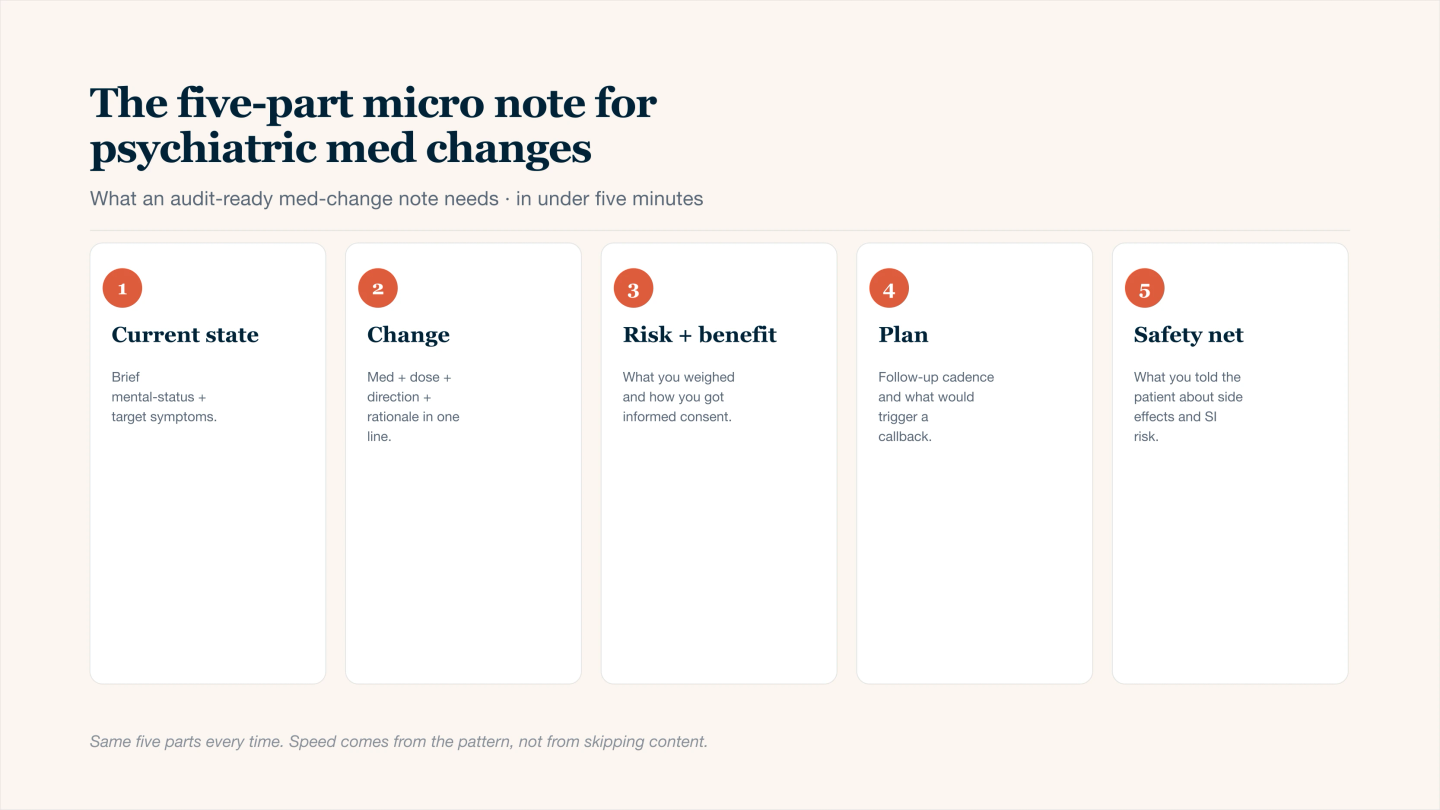
Five-part micro note for psychiatric med changes — audit-ready in under five minutes.
1) The five part micro note for medication changes
Fill in short lines, then sign.
- Clinical status today
Symptoms, function, interval change, adherence, side effects. - Decision
Start, continue, increase, decrease, switch, add adjunct. Specify dose and schedule. - Rationale and alternatives
Why this choice today, alternatives considered and why not chosen. - Risk, consent, and monitoring
Safety risks discussed, PDMP or labs if relevant, vitals, pregnancy status if applicable, counseling points. - Follow up and return precautions
Time window, what to call for early, coordination with therapy or primary care.
2) One minute dictation script you can reuse
“Since last visit, symptoms and function are [summary]. Adherence [ ], side effects [ ]. Today I will [medication action, dose, schedule] because [target symptoms or treatment goal]. Considered [alternative], not chosen due to [reason]. Discussed risks and benefits including [top two], patient agrees. Monitoring will include [labs or vitals or PDMP], and education provided. Follow up in [timeframe], return sooner for [red flags].”
3) Decision matrix for common med actions
Action | Use when | Rationale cue | Monitoring cue |
|---|---|---|---|
Increase SSRI dose | Partial response, residual anxiety or mood symptoms, good tolerance | Target residual symptoms and reduce relapse risk | Review GI effects, sleep, suicidality in young adults |
Switch SSRI to SNRI | SSRI trials with limited benefit or pain comorbidity | Broaden mechanism to target energy, concentration, pain | BP and pulse checks, sleep and anxiety review |
Add mirtazapine | Insomnia, low appetite, weight loss | Improve sleep and appetite while maintaining current antidepressant | Weight, daytime sedation, drug interactions |
Start mood stabilizer | Bipolar spectrum features or mood instability | Reduce cycling and prevent relapse | Baseline and periodic labs per agent, contraception counseling if teratogenic risk |
Reduce stimulant dose | Appetite or sleep adverse effects, anxiety | Balance symptom control with tolerability | PDMP check, BP and pulse, misuse or diversion screen |
4) Phrase bank to speed rationale and consent
Use, then personalize with one or two specifics.
- Rationale
“Change is indicated due to persistent [symptom] affecting [function].”
“Prior trial at [dose] for [duration] produced partial response. Dose increase targets residual [symptom].”
“Switch chosen after inadequate response and patient preference to avoid [side effect].” - Alternatives considered
“Considered [alt med or psychotherapy], not chosen due to [interaction, prior failure, access, preference].” - Risk and consent
“Discussed common and serious risks, benefits, and alternatives. Patient states understanding and agrees to plan.”
“Reviewed black box warnings and safety plan. Protective factors include [ ].” - Monitoring
“PDMP reviewed, no concerning fills.”
“Ordered [labs] with plan to review results and adjust as needed.”
“Advised to monitor BP, pulse, weight, and sleep.” - Follow up
“Follow up in 4 weeks for response and tolerability, sooner if adverse effects or mood worsening.”
5) Minimum content that supports E M and audit readiness
Element | What to include | Micro example |
|---|---|---|
Interval change and function | Symptoms since last, impact on work or school or relationships | “Sleep better, anxiety persists at work” |
MSE highlights | Mood, affect, thought process, SI or HI, insight and judgment | “Euthymic, linear thought, denies SI or HI” |
Med reconciliation | Current list, adherence, side effects, OTC or supplements | “Sertraline 100 daily, rare missed dose, mild nausea” |
Decision and rationale | Action, dose, reason tied to today | “Increase sertraline to 150 to target residual anxiety” |
Risk and monitoring | Risks discussed, PDMP or labs, safety plan | “Discussed GI effects and activation, PDMP clean, FU 4 weeks” |
6) Compliance guardrails that keep notes short and safe
- Anchor justification to today’s specifics to avoid cloned language.
- Record PDMP, labs, vitals, or pregnancy testing when applicable.
- Label late entries if used, keep your edit as the final author step.
- For 90833, briefly document psychotherapy content and time if performed.