


Brief Answer
Yes, 25 clients per week is compatible with no weekend notes if you:
- Set a hard limit of about 3–7 minutes per progress note and 10–15 minutes per intake/treatment plan.
- Use a standardized note template (e.g., SOAP, DAP, or BIRP) that you follow every time.
- Do notes same day, ideally right after each session or in 2–3 short documentation blocks.
- Use an AI scribe or summarizer to turn a short dictated summary or session transcription into a structured note that you only refine, not write from scratch.
The combination of clear time limits + repeatable structure + AI support is what makes 25/wk sustainable.
The Longer Answer
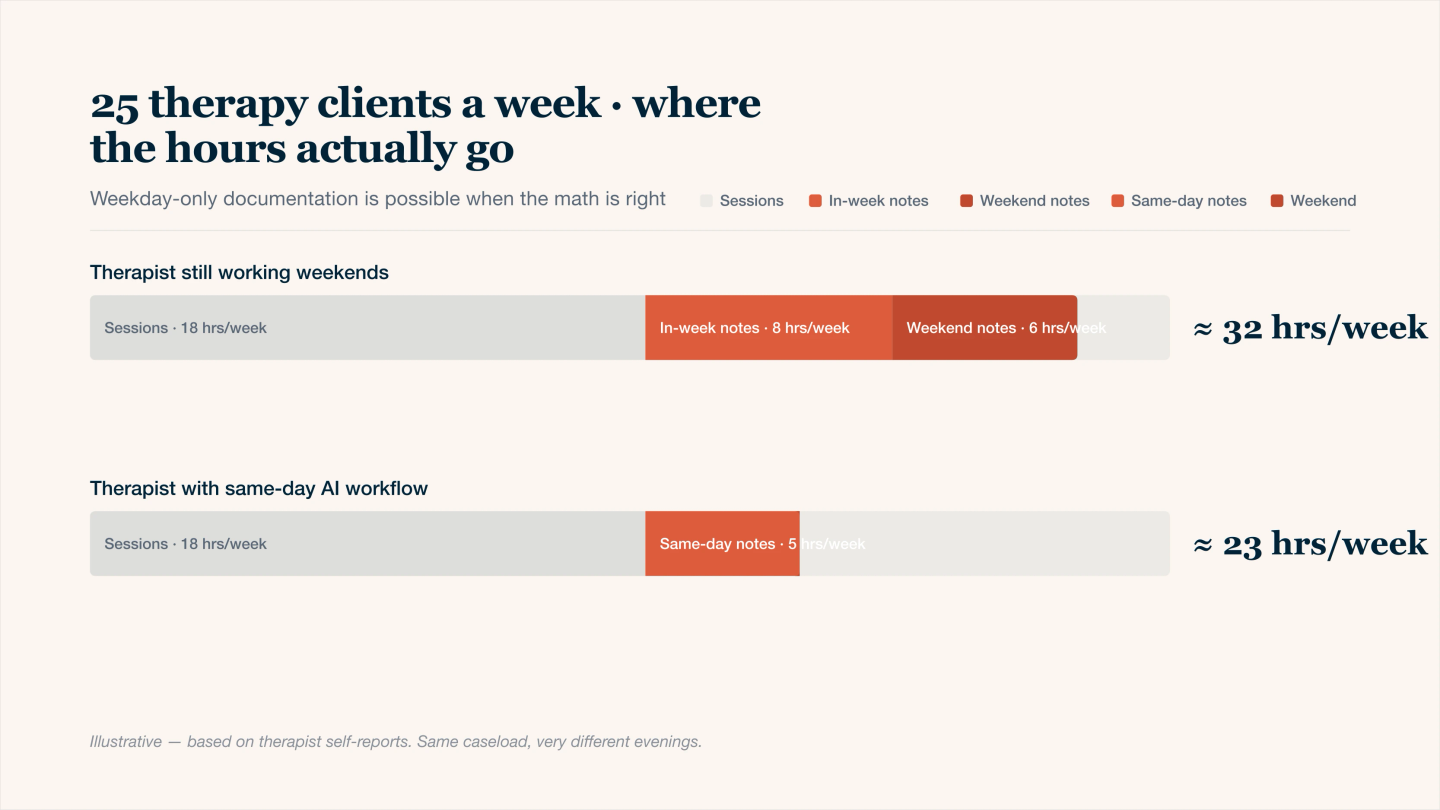
25 therapy clients a week — where the hours go, with and without weekend work.
1. Define your boundaries first
You can’t design a workflow if the constraint is fuzzy. For a 25‑client caseload, a common target is:
Item | Realistic target |
|---|---|
Sessions per week | 20–25 therapy hours |
Documentation time | 1.5–2.5 hours/week total beyond session time |
Time per progress note | 3–7 minutes |
Time per intake / annual tx plan | 10–20 minutes |
If each progress note is taking 15–20 minutes, that alone can push you into evenings and weekends. The goal is not “perfect narrative” but clear, defensible, consistent.
2. Simplify the structure of your notes
Pick one primary format (e.g., SOAP for mental health or DAP) and standardize it:
- Subjective / Data: Client’s report, key quotes, symptom changes, risk.
- Objective: Mental status, observable behavior, relevant measures.
- Assessment: Clinical impression, progress vs. goals, medical necessity.
- Plan: Interventions this session, homework, next steps, follow-up.
Think in repeatable blocks instead of “blank page” writing. For example, for a weekly depression session:
- “Client reports…” (mood, sleep, appetite, functioning, stressors)
- “MSE shows…” (appearance, mood/affect, thought content, SI/HI)
- “Today’s work focused on…” (specific intervention)
- “Client responded by…” (engagement, affect change, insight)
- “Plan includes…” (homework, skills, next session focus, risk plan if needed)
You’re filling a pattern, not reinventing prose each time.
3. A realistic daily workflow for 25 clients
Instead of all notes at night, distribute documentation across the day.
Daily pattern example (5 clients/day):
- Start of day (10 minutes)
- Scan schedule, glance at last note + goals for each client.
- After each session (3–5 minutes)
- Immediately capture: symptom change, 1–2 key themes, main interventions, risk, homework.
- Use AI to turn that into a structured note while you move to the next task.
- Midday block (15 minutes)
- Clean up any morning notes not fully finalized.
- End-of-day block (20–30 minutes)
- Finalize remaining notes, send any needed messages, quickly review tomorrow’s schedule.
If you average 5 minutes per note and 5 clients/day, that’s 25 minutes of note‑writing per day. Add an extra 10–20 minutes/day for intakes, treatment plans, and “messy” sessions, and you’re still within a workday, not your weekend.
4. Example: 25-client week without weekend charting
Day | Sessions | Documentation plan |
|---|---|---|
Mon | 5 | 5× quick post-session notes + 20 min end-of-day block |
Tue | 5 | Same as Monday |
Wed | 5 | Same as Monday (maybe 1 intake; plan 15 min once) |
Thu | 5 | Same as Monday |
Fri | 5 | Post-session notes + slightly longer final block (30–40 min) to clean up any lagging tasks |
Key rules that make this work:
- No session left without at least a skeleton note the same day.
- Intakes/treatment plans scheduled with a bit more buffer (e.g., 10-min gap).
- Fridays include a short “documentation + admin reset” time block so you don’t carry things into the weekend.
5. Where AI actually helps (and where it doesn’t)
AI is most valuable for:
- Turning transcripts or short voice summaries into structured notes.
- Maintaining consistent phrasing and structure across many clients and weeks.
- Helping you quickly articulate medical necessity, risk, and progress toward goals in clear language.
It won’t help if:
- You never feed it useful input (e.g., you wait until days later and barely remember the session).
- You skip reviewing notes; you still need to confirm accuracy and nuance.
- You rely on one generic template for everyone (this is what creates “cloned” notes risks).
The sweet spot: you provide the clinical judgment and key details; the AI turns it into a complete, well‑structured, readable note that you then tweak for accuracy and tone.
6. Common pitfalls that keep therapists in weekend-note hell
- Letting notes pile up more than 24 hours. The mental load and time per note both explode.
- Over-documenting every word spoken instead of focusing on clinical relevance.
- Mixing charting with email, billing, and social media; documentation needs a protected block.
- Using a different style for every client; you lose speed when there is no consistent structure.
If you fix those patterns and use AI as a drafting assistant (not a black box), 25 clients/week without weekend notes is very achievable.