


Brief Answer
Notes get finished inside the day when documentation is embedded in the visit flow. Psychiatrists who leave with charts closed usually do three things. They run a compact template for med checks. They capture a short summary in room or immediately after. They reserve small closure blocks twice a day to sign drafts. An AI scribe can draft the note from a 20 to 40 second cue so you review and sign in minutes.
The Longer Answer
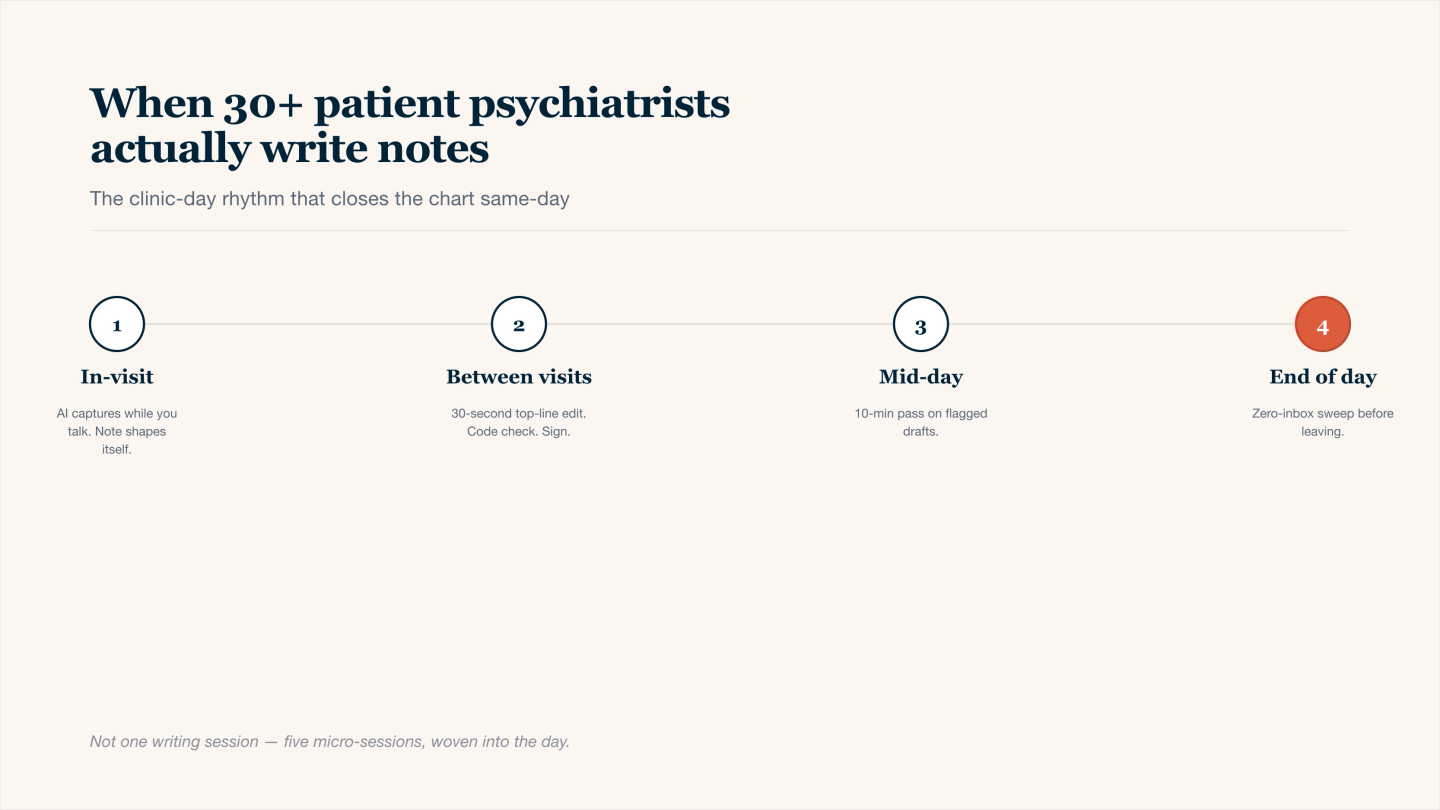
The four-phase clinic-day rhythm — same-day notes for 30+ patient psychiatrists.
1. The clinic day as a rhythm, not a scramble
Use a repeatable rhythm that places documentation in known slots.
- Opening sweep, 10 minutes
Review first three charts. Note labs, PDMP needs, and any monitoring due. - In room capture, 30 to 45 seconds
Near the end of each visit, speak a brief clinical summary that covers interval change, MSE highlights, risk, decisions, and follow up. - Micro finalization, 2 to 4 minutes
After every two to three patients, finalize the drafts for that cluster. Do not start the next chart until that cluster is closed. - Midday closure, 15 minutes
Finish any morning drafts and sign orders. - End of day closure, 20 minutes
Close all charts from the afternoon. Preview the first two patients for tomorrow.
2. What must appear in a fast med check
Keep content tight and decision focused.
Section | What to include | One line example |
|---|---|---|
Interval change | Symptoms and function since last visit | Anxiety improved at work, sleep still fragmented |
Meds and adherence | Current list, side effects, missed doses, OTC | Sertraline daily, rare missed dose, mild nausea |
MSE highlights | Mood, affect, thought process, SI or HI, judgment | Euthymic, congruent affect, linear thought, denies SI or HI |
Risk | Safety, means access, protective factors | No access to firearms, protective factors include partner support |
Data reviewed | PDMP, labs, collateral as relevant | PDMP clean, LFTs pending for valproate |
Decision and rationale | Continue or change with reason | Increase sertraline to target residual anxiety |
Plan and follow up | Monitoring, counseling, return window | Discussed GI effects, follow up in 4 weeks, return sooner if worsening |
3. Pattern menu that actually fits 30 to 45 weekly
Pick one primary pattern and a backup for rough days.
Pattern | When it shines | How it works |
|---|---|---|
In room summary plus batch finalize | Steady days with few interruptions | Summarize at minute 13 or 24. Finalize every 2 to 3 visits in a short block |
Micro gap notes | Schedule has 2 to 3 minute buffers | Finish each note before opening the next chart |
Midday and end blocks only | High flow with minimal gaps | Summaries for all visits. Finalize at lunch and at close of clinic |
Dictation after visit | Telepsychiatry or phone visits | Dictate a 30 second summary after each call and sign later in the block |
4. Script for the in room summary
Use the same structure every time so AI output is predictable and your own typing is faster.
“Med check for [diagnosis]. Since last visit [mood, sleep, function, side effects, adherence]. MSE [mood, affect, thought process, SI or HI]. Risk [summary]. Decision [start or continue or adjust med with dose] because [rationale]. Monitoring [labs or vitals or PDMP]. Follow up [timeframe] and return precautions.”
5. Guardrails that prevent after hours work
- No visit leaves the room without at least a spoken summary captured.
- Every chart touched is either finalized now or parked for the next defined closure block.
- Late entry is labeled when needed.
- Cloned language is avoided by using specific interval change and varied phrasing.
6. Common traps
- Waiting until evening to write the first sentence.
- Overdocumenting psychotherapy content when only brief supportive work was done.
- Skipping PDMP or monitoring notes when they apply.
- Letting portal messages displace closure blocks.