


For most ABA providers in 2026, Twofold is the best standalone AI scribe — it writes session, supervision, and caregiver‑meeting notes in your clinical voice and works alongside the ABA platform you already use. If you'd rather have AI notes built into an all‑in‑one system, CentralReach and Rethink Behavioral Health lead, with Alpaca Health a strong BCBA‑focused assistant and Artemis ABA a leaner alternative. Below, each pick includes a real, linkable review.
Why Trust This List?
ABA documentation is its own discipline — session notes tied to treatment-plan goals, RBT supervision notes, caregiver‑guidance notes, and payer‑ready language for CPT codes like 97153, 97155, and 97156. Instead of marketing copy, we pulled real reviews: candid posts from BCBAs and RBTs on r/ABA, r/bcba, and r/BehaviorAnalysis for the AI scribes, and verified Capterra reviews for the established platforms. Every tool below includes a quote you can click through and check. We weighted the three things ABA clinicians raise most: note quality and clinical voice, fit with RBT/BCBA workflows, and whether it works with the structured data and billing you already run.
1. Twofold: The Best Standalone AI Scribe for ABA Notes
Twofold is a dedicated AI scribe rather than a full ABA platform, which is exactly why it ranks first for documentation: it focuses on turning sessions, supervisions, and parent meetings into clean, structured notes — and it does so without making you leave CentralReach, Rethink, or whatever system you collect data in. A BCBA comparing tools put it simply:
"Tried a few, but Twofold has been the one I keep coming back to. It doesn't just fill in blanks it actually structures the note in a way that reads like what I'd write myself. Also helps that it handles different formats without me needing to switch templates all the time." — u/whyhatcry, r/BehaviorAnalysis
Pros
- Writes session, RBT-supervision, and caregiver-guidance notes that read in your clinical voice.
- Handles multiple note formats and custom templates without constant switching.
- Works alongside your existing ABA data-collection and billing platform — no migration.
- HIPAA-compliant with a signed BAA; never stores audio.
Cons
- Not an ABA practice-management or trial-by-trial data-collection system — you keep your existing platform for that.
- ABA-specific templates may need a quick initial setup to match your payer's requirements.
2. Alpaca Health: Purpose-Built BCBA Documentation Assistant
Alpaca Health is built specifically for BCBAs, automating notes across parent interviews, caregiver trainings, and RBT supervision, plus drafting portions of treatment plans. Users like how hands‑off the note‑writing becomes:
"We are using alpaca. My notes are done for me." — u/Hairy-Dingaling6213, r/BehaviorAnalysis
One BCBA also raised a fair, balanced caution worth keeping in mind with any all‑in‑one assistant:
"I think the biggest issue with these type of platforms is it hides the ins and outs of what it really takes to operate an ABA practice. I don't think it's a good idea to completely outsource these things because then you have a single point of failure..." — u/OnTheGoTrades, r/bcba
Pros
- Designed around BCBA workflows: parent interviews, caregiver training, supervision, and treatment-plan drafts.
- Strong automation — clinicians report notes are largely written for them.
- HIPAA-compliant with a free trial to test fit.
Cons
- Newer and ABA-specialist — smaller track record than the established platforms.
- Heavy reliance on one assistant for multiple practice functions is a single point of failure worth planning around.
3. CentralReach: All-in-One Platform With AI Note Drafts
CentralReach is the most widely used ABA platform, unifying scheduling, data collection, billing, and clinical documentation, with NoteDraftAI generating first‑draft session notes. It holds a 4.3/5 rating across 156 Capterra reviews. An RBT highlighted the all‑in‑one convenience:
"That everything as a therapist was in one place." — Kelly G., RBT, on Capterra
Reviews are not uniformly glowing, though — a practice manager flagged the kind of operational friction that scales with a big platform:
"Complete lack of transparency around contracts, billing, and patient data." — Shannon P., Practice Manager, on Capterra
Pros
- True all-in-one: data collection, scheduling, billing, assessments, and AI note drafts in one system.
- Deep ABA-specific feature set built for autism and IDD providers.
- NoteDraftAI speeds first-draft session notes inside the platform.
Cons
- Per-therapist pricing adds up quickly as you grow.
- Reviewers cite contract, billing-transparency, and auto-renewal concerns — read terms carefully.
- Can be heavy for small or solo practices.
4. Rethink Behavioral Health: Integrated Clinical + Practice Management
Rethink Behavioral Health is a purpose‑built ABA platform whose Session Note AI turns real session data into progress‑note summaries. It carries a 4.1/5 rating across 124 Capterra reviews. A clinical director valued the unified workflow:
"The practice management and clinical piece communicate with each other on one platform." — Suzanne S., Clinical Director, on Capterra
Pros
- Practice management and clinical documentation in one connected system.
- Session Note AI builds progress notes from actual session data.
- Well-suited to ABA and pediatric behavioral-health practices.
Cons
- As with other large platforms, reviewers raise auto-renewal and contract concerns.
- Best value when you adopt the whole platform, not just the notes.
5. Artemis ABA: A Leaner All-in-One Alternative
Artemis ABA is a newer all‑in‑one option pairing AI session notes with practice‑management tools — an appealing path for practices that find the incumbents too heavy. Sentiment is genuinely mixed, and it's worth weighing honestly; one clinician who switched said:
"I miss rethink now that my company uses artemis. :((" — u/shinnybear_, r/ABA
Pros
- All-in-one with AI session notes at a leaner, simpler footprint.
- Reasonable fit for smaller practices wanting an alternative to the incumbents.
Cons
- Newer and smaller; some users prefer the depth of established platforms.
- Mixed reviews — trial it against your current system before committing.
A Note on Newer Tools
Tools like BxScribe and Praxis Notes are emerging specifically for RBT/BCBA session notes and look promising, but they're too new to have a meaningful base of independent user reviews yet. We've left them out of the ranking rather than pad it — we'll add them once there's real feedback to cite.
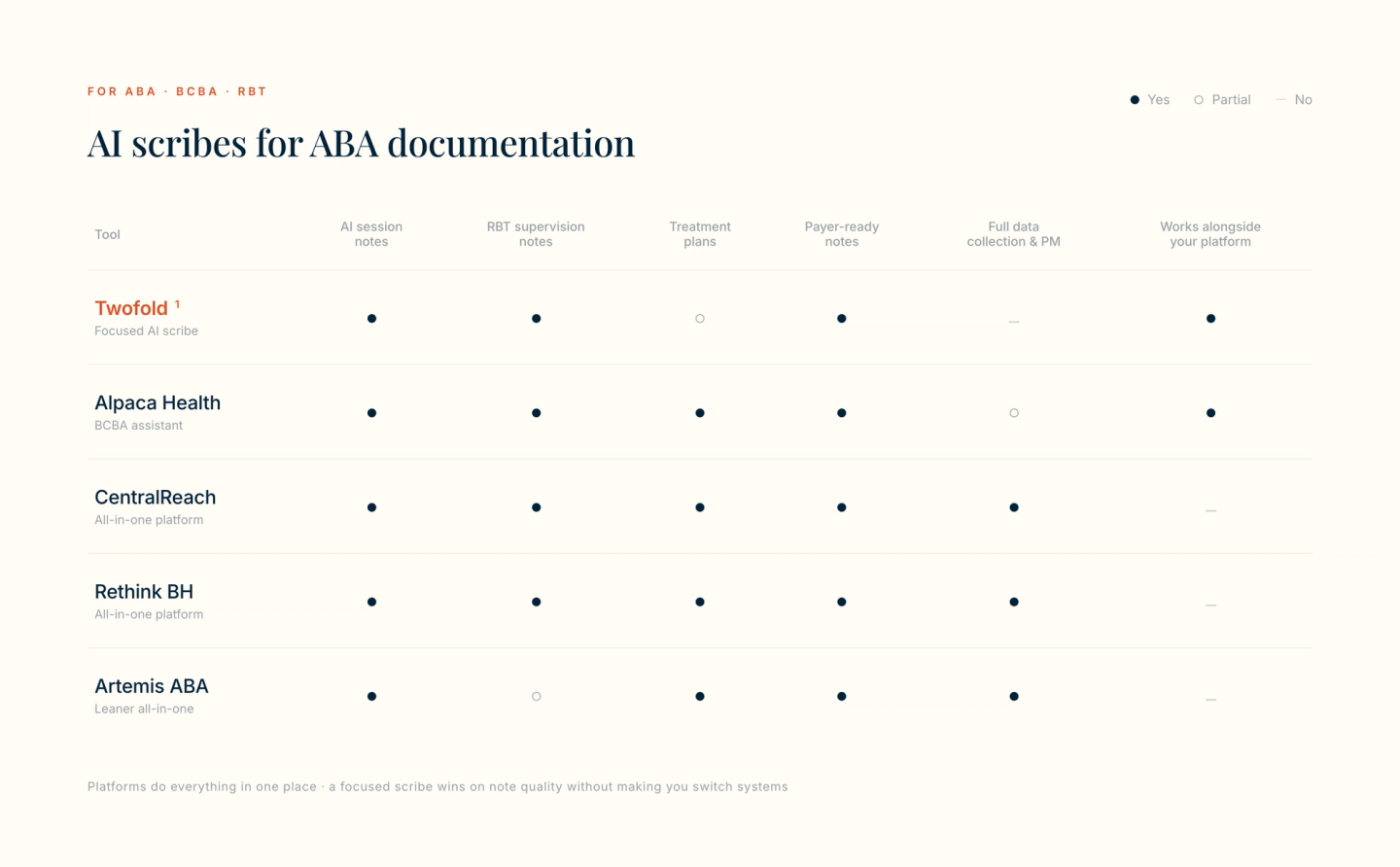
ABA AI Scribe Comparison at a Glance
Tool | Best for | Type | Data collection / PM | Review source |
|---|---|---|---|---|
Twofold | Best standalone scribe; keep your platform | Focused AI scribe | No — works alongside yours | Reddit (r/BehaviorAnalysis) |
Alpaca Health | BCBA assistant: interviews, supervision, plans | ABA documentation AI | Partial | Reddit (r/bcba, r/BehaviorAnalysis) |
CentralReach | All-in-one with AI note drafts | Full ABA platform | Yes | Capterra 4.3 (156) |
Rethink BH | Integrated clinical + practice management | Full ABA platform | Yes | Capterra 4.1 (124) |
Artemis ABA | Leaner all-in-one alternative | ABA platform | Yes | Reddit (r/ABA) |
*Ratings and quotes verified June 2026; check each vendor's site for current pricing and features.
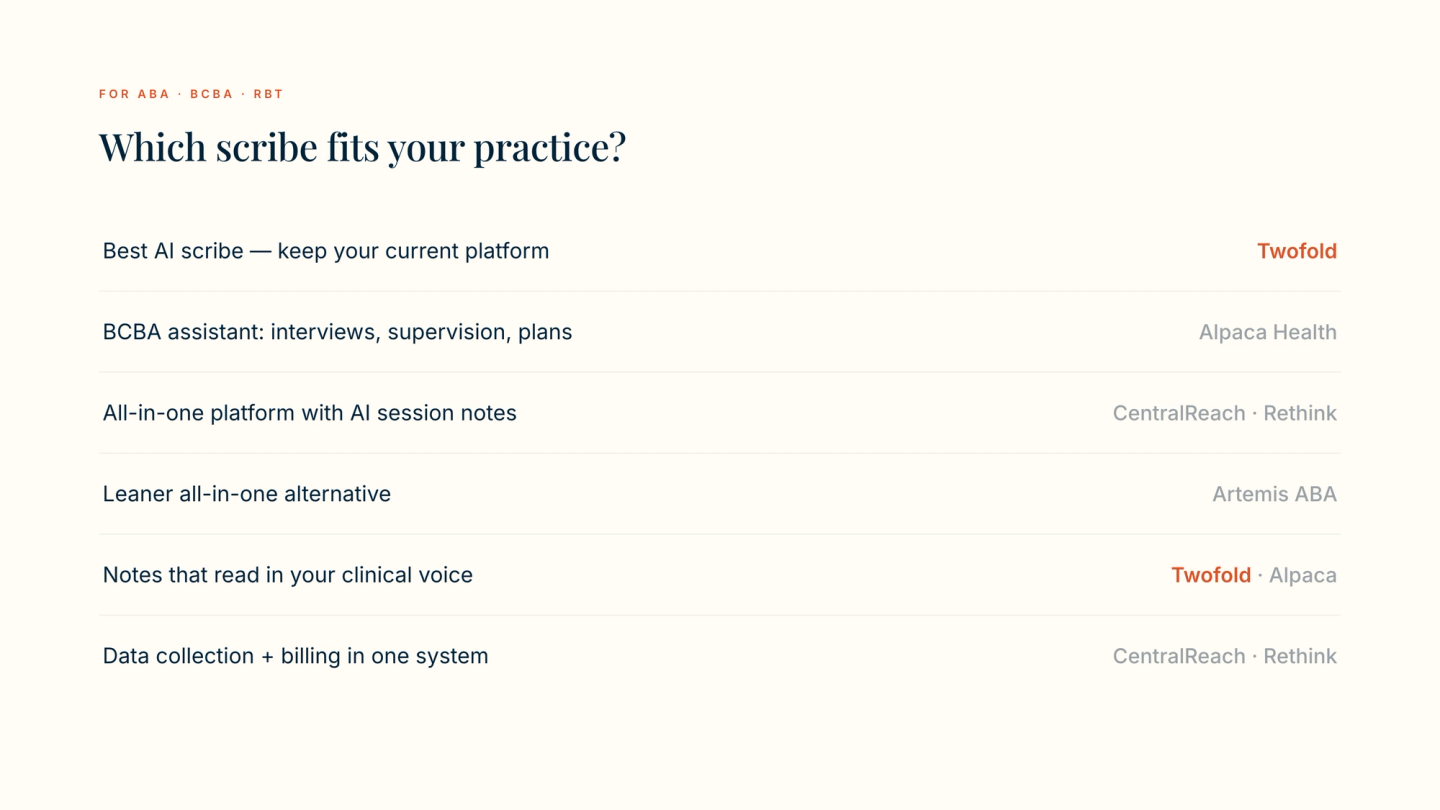
Which ABA Scribe Fits Your Practice?
Match your top priority to the right tool:
Final Verdict
If you want the best documentation specifically, Twofold is the strongest AI scribe for ABA — it writes session and supervision notes in your voice and layers onto the platform you already run, so you don't trade your data‑collection system for better notes. If you'd rather consolidate everything, CentralReach and Rethink are the proven all‑in‑one platforms, Alpaca is the BCBA‑native assistant, and Artemis is the leaner challenger. New to ABA documentation standards? Start with our guide to ABA session notes, and see our best AI scribe for mental health and group behavioral-health roundups for adjacent needs.