
Free for a week, then $19 for your first month
Expert Advice

Does Twofold Train AI Models on Patient Data? The Complete Answer (2026)

No — Twofold does not train AI models on patient audio, transcripts, notes, or clinician edits, and the commitment is contractual. What's never stored, what's retained, and what you can delete.

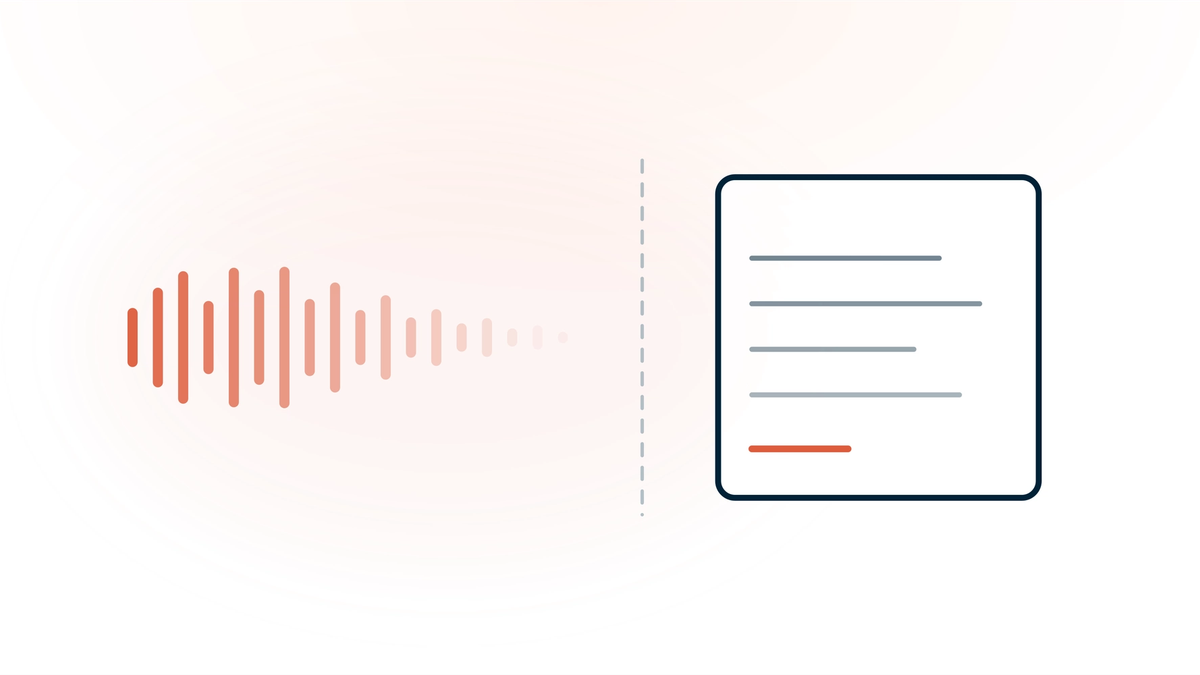
Patient audio shown as a waveform that thins out and disappears at a boundary line, with a finished clinical note remaining on the other side — audio is discarded once transcribed, the note remains.

No. Twofold does not use patient audio, transcripts, generated notes, or clinician edits to train AI models. That commitment is contractual rather than a stated policy, and it covers every category of content you put through the product. Separately, patient audio is never written to storage on Twofold's servers at all — it is processed in memory and discarded once the transcript exists.

This guide sets out exactly what Twofold does with each kind of data: what is never stored, what is retained and for how long, what you can delete and when, and why the difference between a policy and a contract matters when you are comparing vendors. Verified 28 July 2026.

Disclosure: this guide is published by Twofold Health and describes Twofold's own practices. Where a claim rests on how our systems are built, we say so specifically enough that you can hold us to it.

The Short Answer

Twofold does not train AI models on any of the following:

  • Patient audio from recorded or uploaded sessions.
  • Transcripts generated from that audio.
  • The clinical notes Twofold produces.
  • The edits you make to those notes — including the corrections that teach Twofold your writing style within your own account.

Your data is not sold, and it is not shared for anyone else's product development. Style learning happens inside your account and improves your notes; it does not feed a shared model.

Policy vs. contract
Most vendors state a no-training position on a webpage, where it can be revised without telling you. Twofold's is written into the agreements you sign, which is the version that binds.

What Happens to Patient Audio

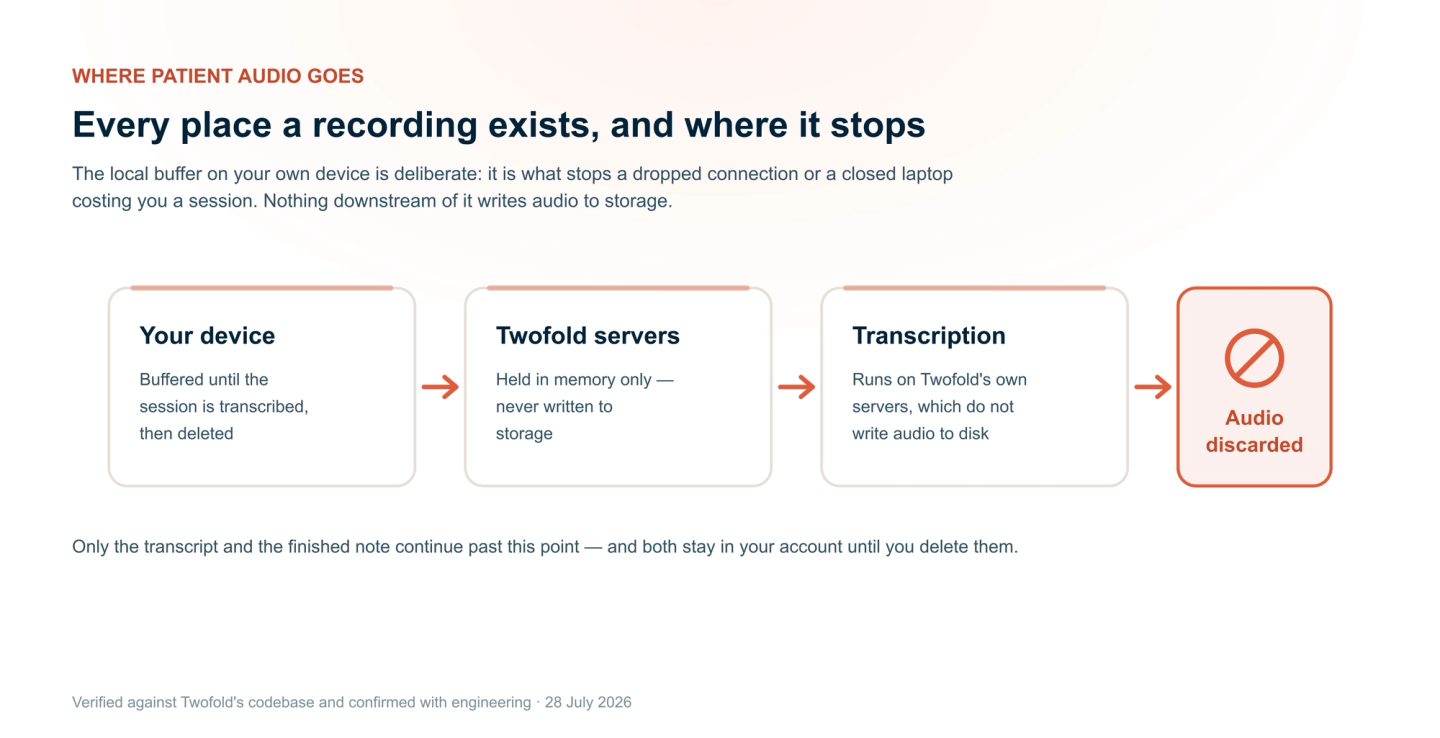
Audio gets the strictest treatment of anything in the system, because it is the richest and least necessary thing to keep. Twofold does not write patient audio to storage at any point on its servers: recordings are held in memory, passed to Twofold's own transcription servers, and discarded once transcribed. Those transcription servers do not write audio to disk either. There is no bucket, no archive, and no database column anywhere in Twofold that holds audio.

One detail worth stating plainly, because it is the part most vendors leave out: your recording is held on your own device while the session is in progress and until it has been transcribed, then deleted from it. That local buffer is deliberate — it is what stops a dropped connection or a closed laptop costing you a session. It lives in your browser's storage on your machine, not on ours.
The precise claim
Audio is buffered on your device until it is transcribed, then deleted. It is never written to storage on Twofold's servers at any point. We say it that way rather than "audio is never saved" because the second version isn't quite true, and you should be suspicious of any vendor who says it.
The journey of patient audio in Twofold: buffered on the clinician's own device until transcribed, held in memory on Twofold's servers, transcribed on Twofold's own servers without being written to disk, then discarded. Only the transcript and note continue.

What Happens to Transcripts and Notes

This is where Twofold's answer differs from the audio answer, and we would rather tell you than have you discover it. Transcripts and generated notes are retained in your account until you delete them. There is no automatic expiry.

That is a deliberate choice rather than an oversight. Your notes are your clinical record, and a documentation tool that silently deleted them on a timer would be a liability, not a feature. What Twofold gives you instead is control over when they go:

Data

Stored on Twofold's servers?

How long

Patient audio

No — never written to storage

Discarded once transcribed

Transcript

Yes

Until you delete it

Generated note

Yes

Until you delete it

Your edits

Yes, within your account

Until you delete the visit

Deleting a visit does not simply hide the row — the transcript content itself is scrubbed. You can also delete a transcript while keeping the finished note, which is the option most clinicians want once a note is signed: the record stays, the verbatim conversation does not. That action is irreversible by design.
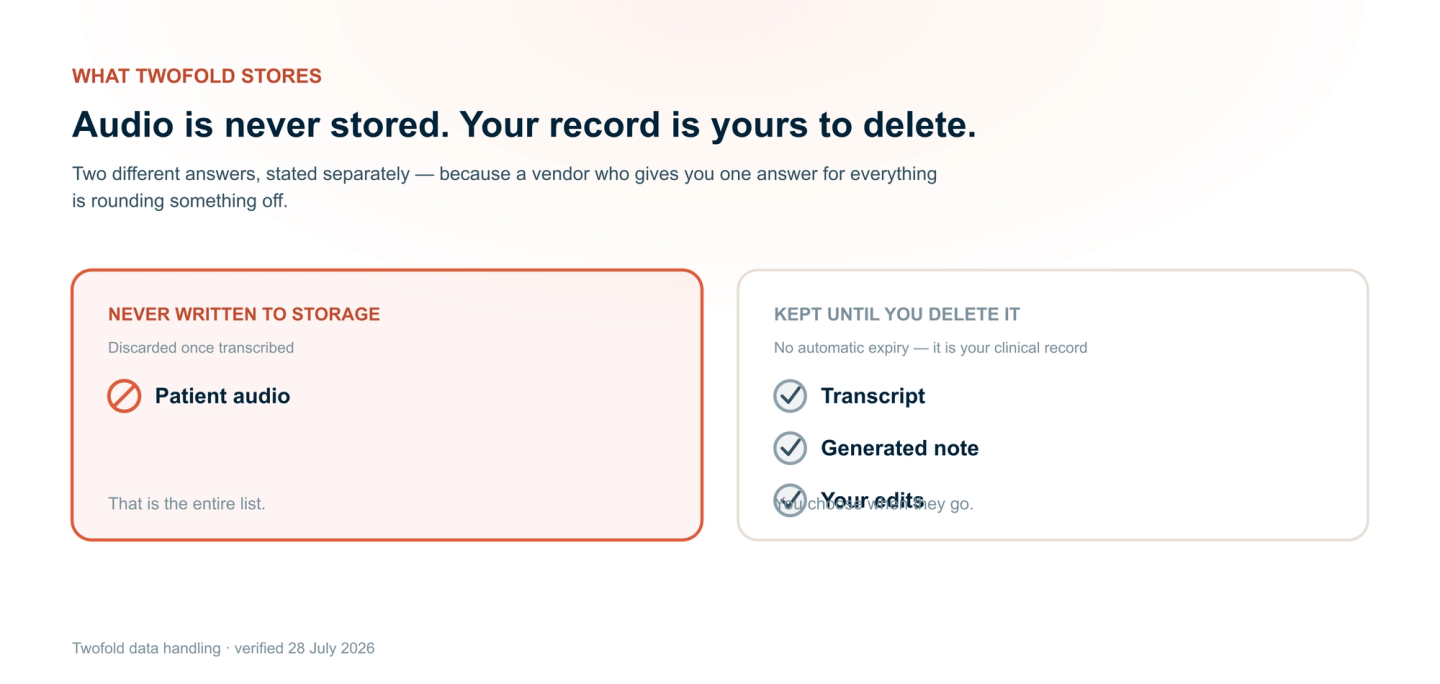
What Twofold stores: patient audio is never written to storage on Twofold's servers and is discarded once transcribed. Transcripts, generated notes and clinician edits are kept in the account until the user deletes them.

Why This Distinction Matters When You Compare Vendors

"We don't train on your data" is close to universal as a marketing line, and almost meaningless without the specifics behind it. When you evaluate any AI scribe, the questions that separate real commitments from comfortable ones are:

01
Is it in the contract, or on a webpage?
A webpage can be edited on a Tuesday. Ask for the clause in the agreement you actually sign, and check it survives renewal.
02
What exactly does it cover?
Audio, transcripts, notes, your edits, and de-identified derivatives are five separate things. A commitment that only covers audio leaves the most useful training data on the table.
03
Is audio stored at all, and where?
Retention windows measured in days or weeks are common. Ask whether audio is written to storage at any point, not just how long it's kept.
04
What happens when you delete?
Ask whether deletion scrubs content or just hides the record, and whether you can remove a transcript without losing the note.
05
How long are transcripts kept?
Ask for the actual answer rather than a range. A vendor who can't tell you probably hasn't decided.

We wrote the vendor‑neutral version of this as a checklist you can take to any supplier: what to ask your AI notes vendor about subprocessors, storage and training. Use it on us too.

Bottom Line

Twofold does not train AI models on your audio, transcripts, notes, or edits, and that commitment is contractual rather than a webpage promise. Patient audio is never written to storage on Twofold's servers — it is processed in memory and discarded. Transcripts and notes stay in your account until you choose to delete them, and you can remove a transcript while keeping the note. Full details are in our privacy policy, and our team will walk a compliance reviewer through the specifics on request.

Sources

  • Twofold data handling, subprocessor and PHI practices: trytwofold.com/privacy-policy.
  • Audio handling (no server-side storage; in-memory processing) verified against Twofold's own codebase, 28 July 2026. Transcription-server behaviour and the scope of the contractual no-training commitment confirmed by Twofold engineering and legal, 28 July 2026.
  • The vendor-neutral version of the evaluation questions in this guide: what to ask your AI notes vendor.
  • Practices can change. Ask for the current contractual terms before you rely on them.
FAQ

Frequently asked questions

  • Does Twofold train AI models on patient data?

    No. Twofold does not use patient audio, transcripts, generated clinical notes, or clinician edits to train AI models, and that commitment is contractual rather than a stated webpage policy. It covers every category of content you put through the product. Your data is not sold and is not shared for anyone else's product development. Style learning — where Twofold adapts to how you write — happens within your own account and does not feed a shared model.

  • Does Twofold store patient audio recordings?

    No. Patient audio is never written to storage on Twofold's servers. Recordings are held in memory, passed to Twofold's own transcription servers, and discarded once the transcript exists; those transcription servers do not write audio to disk either. There is no audio archive and no database field holding audio anywhere in Twofold. Your recording is buffered on your own device until it has been transcribed — which is what prevents a dropped connection from costing you a session — and then deleted from it.

  • How long does Twofold keep transcripts and notes?

    Transcripts and generated notes are retained in your account until you delete them. There is no automatic expiry, which is deliberate: your notes are your clinical record, and a documentation tool that deleted them on a timer would be a liability. You control removal — deleting a visit scrubs the transcript content rather than just hiding the record, and you can also delete a transcript while keeping the finished note.

  • Can I delete a transcript but keep the clinical note?

    Yes. Twofold supports deleting a visit's transcription while retaining the generated note — the option most clinicians want once a note is signed, since the clinical record stays and the verbatim conversation does not. The action is irreversible by design. You can alternatively delete the whole visit, which scrubs the transcript content as well as the note.

  • Is Twofold's no-training commitment in writing?

    Yes — it is contractual, not a webpage statement. That distinction matters when you compare vendors: a published policy can be revised without notice, whereas a clause in the agreement you sign binds the vendor. When evaluating any AI scribe, ask for the specific clause, confirm what categories it covers (audio, transcripts, notes, your edits, and de‑identified derivatives are five separate things), and check that it survives renewal.