


The emergence of AI medical scribes represents one of the most significant developments in clinical documentation since EHRs. These tools use ambient listening technology and generative AI to record patient‑clinician conversations, process them, and generate clinical notes. Yet as health systems have studied the impact of this technology, a disconnect has formed. This article explores what clinicians genuinely appreciate about AI medical scribes, what frustrates them, and what the evidence reveals about this transformative technology.
What Clinicians Love About AI Medical Scribes
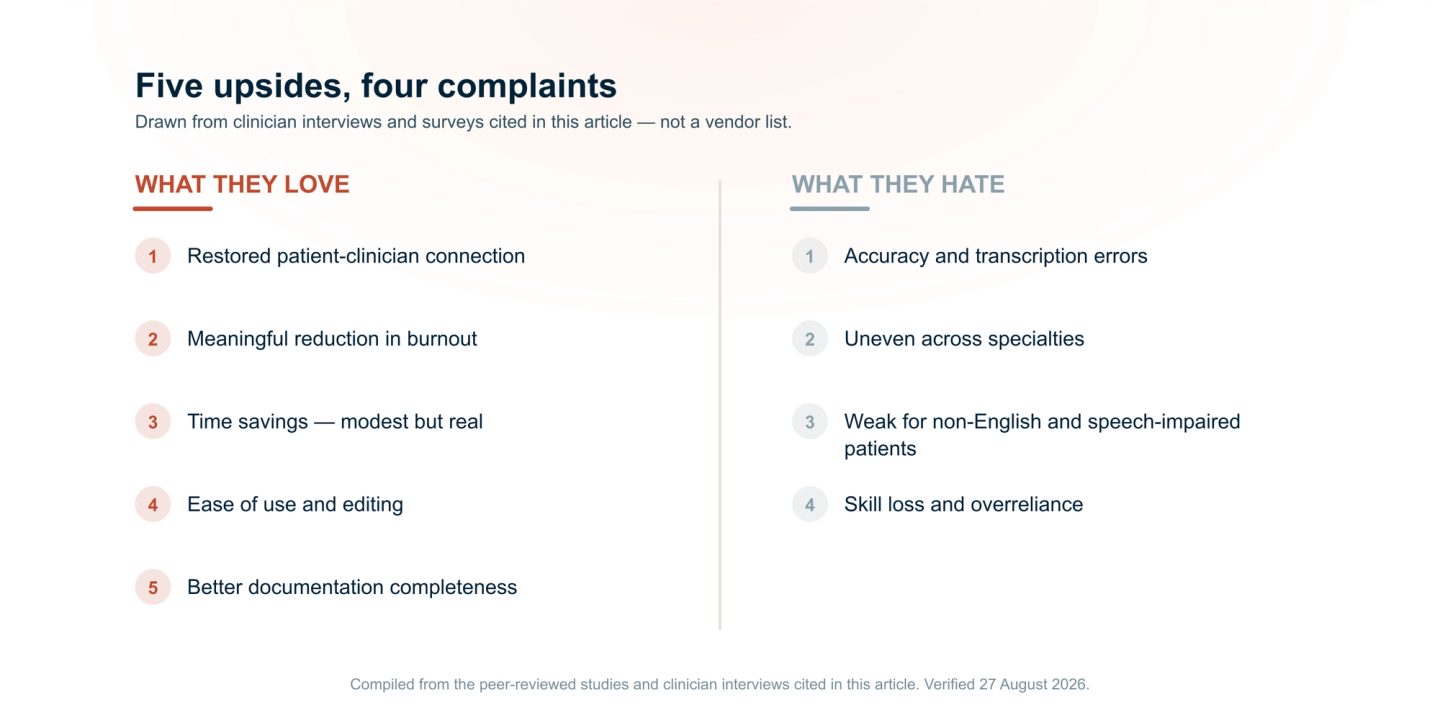
1. Restoration of the Patient-Clinician Connection
The most frequently noted benefit of AI medical scribes is their ability to free clinicians from the keyboard and screen during patient encounters.
"What docs love about it is that it increases the patient-doc direct connection because you don't have a keyboard and a screen in between them", claimed Dr Hobermann, Executive Vice President of Information Technology and Chief Information Officer at The Permanente Federation.
Additionally, an infectious disease specialist also expressed that AI medical scribes "definitely improves my joy in practice because I get to interact with patients and look them in the eye without worrying I will forget what they are saying later."
This change enables clinicians to maintain sustained attentional focus during encounters, improving both consultation flow and the quality of patient‑clinician interaction.
2. Meaningful Reduction in Burnout
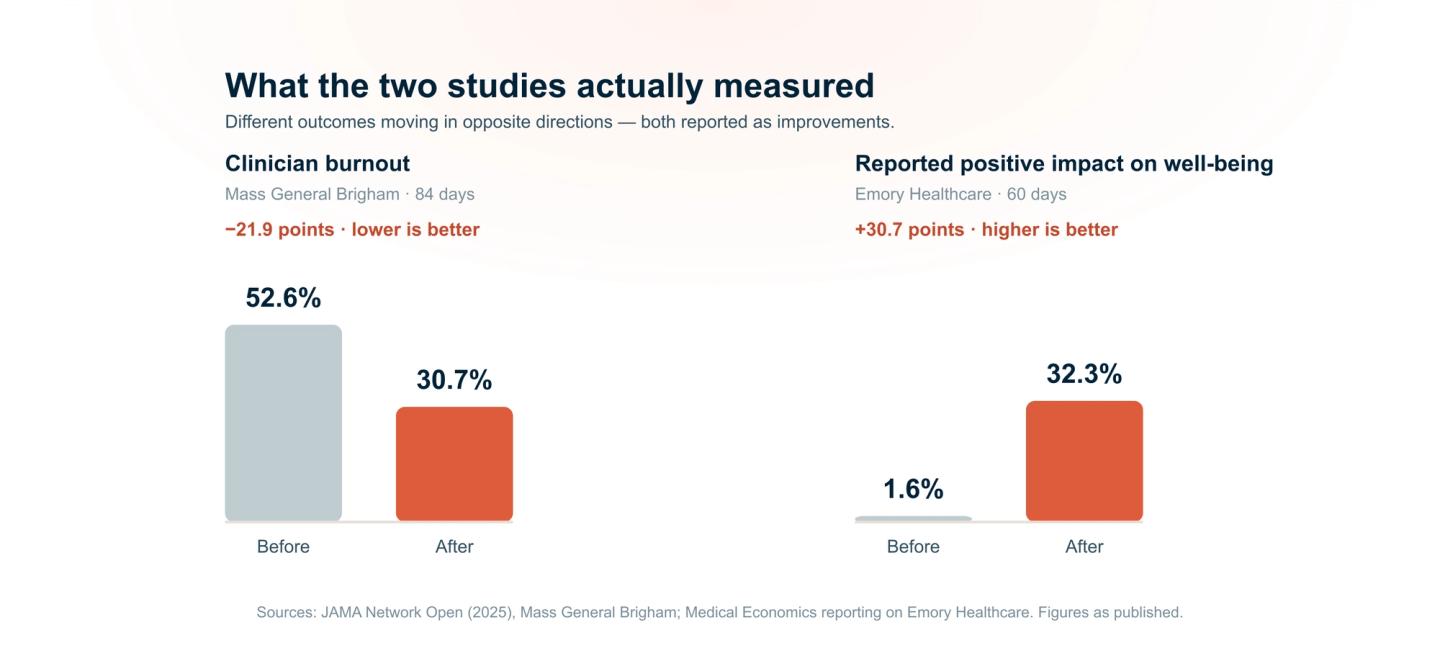
In a 2025 survey-based study at Mass General Brigham, burnout stats fell from 52.6% to 30.7% after 84 days, a significant 22‑point drop. Secondly, at Emory Healthcare, a significant share of clinicians reported that documentation had a positive impact on their well-being, as stats rose from 1.6% before adoption to 32.3% after 60 days.
Clinicians also report that AI scribes reduce mental workload and alleviate the mental exhaustion associated with documentation. As one physician stated, "I don't know if it saved time, but it saved anxiety".
3. Time Savings; Modest but Meaningful
While the time savings may not be as dramatic, they remain clinically meaningful to clinicians. A 2026 multisite study found that AI scribe adoption was associated with modest reductions in total EHR and documentation time, alongside an increase in weekly visit volume.
4. Ease of Use
Clinicians praise the user‑friendliness of AI medical scribe tools. The main drivers of adoption include:
- Ease of Use: "It's very fast, and I like how it's just a 1-click setup"
- Ease of Editing: "They'll do some typos and/or they might say something or misunderstood something you said. It's easy to correct".
- Lower Mental Load: "I find that that's like pretty easy to do and doesn't take a lot of mental effort to do. And it actually is more enjoyable"
5. Enhanced Documentation Quality and Completeness
Many clinicians report that AI scribes capture clinical context they might have missed or compressed under time pressure. One physician noted that "where it impressed me was the ability to understand, to delineate kind of social discussion with medically relevant discussion, and it did a pretty good job of getting the history in that portion."
Another physician added both the positive and negative aspects of the tool, mentioning that it did a "great job of storytelling, but probably not organizing and synthesizing things in a way that a clinician thinks."
What Clinicians Hate About AI Medical Scribes
1. Accuracy Concerns and Transcription Errors
Accuracy remains the most significant frustration for clinicians. External factors like background noise and speaker inconsistencies also affect transcription accuracy. While AI clinical notes are generally of high quality, even a small percentage of errors can carry the risk of serious harm if not corrected. Errors of omission are particularly concerning, as they may be the most difficult for clinicians to identify since identification requires memory recall of details from the patient consultation.
2. Specialty-Specific Limitations
AI scribes perform unevenly across different clinical specialties. The biggest challenge in implementation has been fine‑tuning ambient scribes for specialty‑specific workflows and content. Oncological histories, psychotherapy notes, and other specialty‑specific documentation require different approaches that generic AI scribes may not adequately handle.
3. Limited Functionality with Diverse Patient Populations
In a 2025 qualitative study, clinicians expressed frustration with the limited functionality of AI scribes for non‑English‑speaking patients. Patients with speech impairments may also be excluded from benefiting from the technology, raising equity concerns.
4. Concerns About Skill Loss and Overreliance
Recent research indicated that 74% percent of clinicians said losing skills will be one of the greatest AI risks. Some clinicians have also expressed concerns that reliance on AI scribes could create self‑doubt, or lead to automation bias.
See more in‑depth information on AI bias.
Conclusion
AI medical scribes represent a genuine advance in addressing the documentation burden that has contributed so significantly to clinician burnout. Clinicians love these tools for restoring the patient‑clinician connection, reducing mental load, and reclaiming time previously lost to charting. Yet they have valid frustrations about accuracy, skill loss, and specialty‑specific limitations. The evidence suggests that AI medical scribes deliver meaningful benefits even if the objective time savings are more modest. As the technology advances and health systems refine implementation strategies, the balance of what clinicians love and hate about AI scribes will likely continue to evolve.