


Introduction to Nabla Copilot
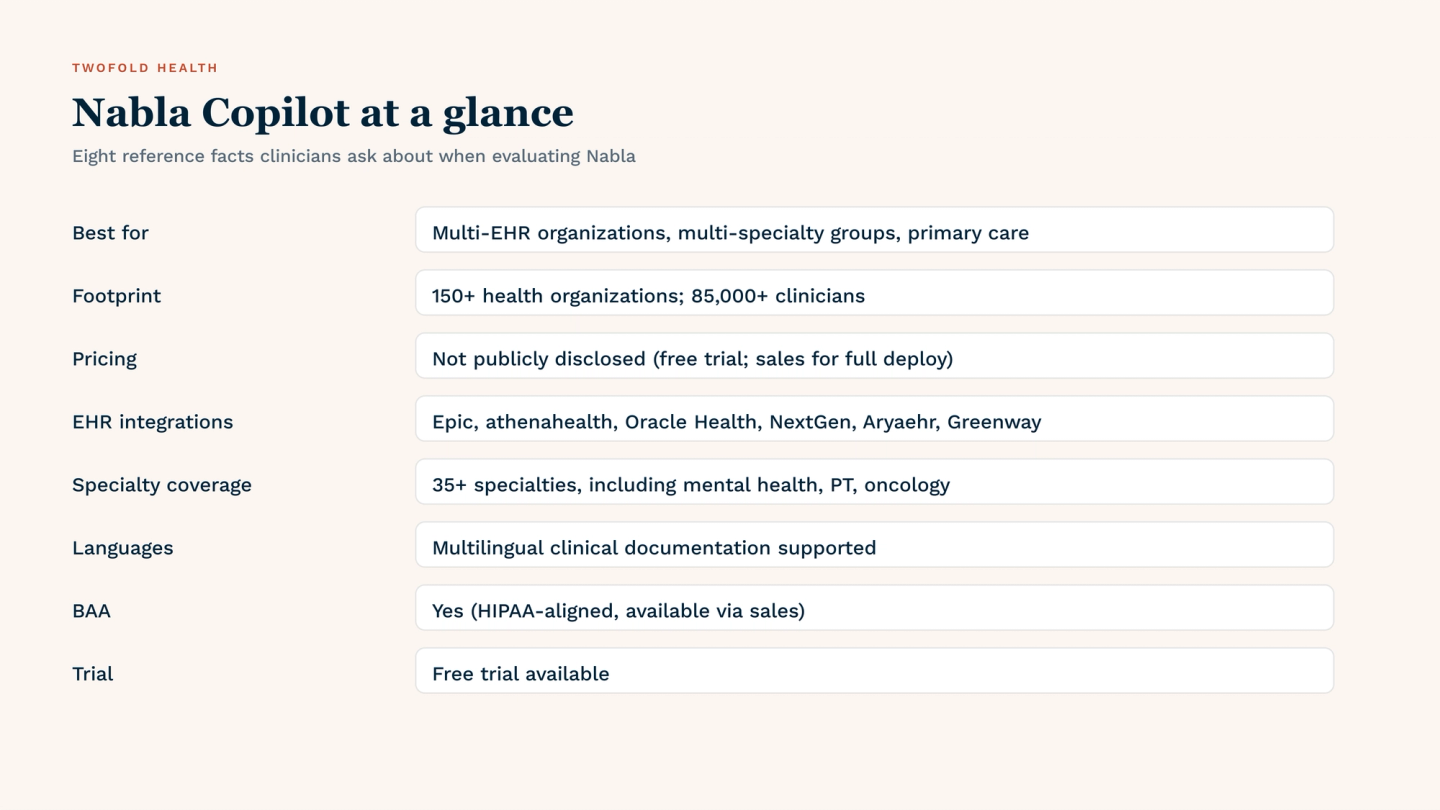
Nabla Copilot is one of the fastest‑growing ambient AI scribes in 2026, with a public footprint of 150+ health organizations and 85,000+ clinicians across 35+ specialties. The product positions itself as a multi‑EHR, multi‑specialty, multilingual ambient AI assistant — broader in surface area than the most established competitors and pitched at both individual clinicians and large organizations.
What follows is a clinician‑facing review based on the conversations I've had with clinicians evaluating Nabla in 2026, plus public customer materials and vendor outcome claims. The focus: where Nabla fits, who it's actually built for, and which audiences get a better total fit from a more specialty‑focused alternative.
Key Features and Claims
Nabla's product surface is unusually broad for an AI scribe. Ambient documentation generated from clinical encounters, on‑demand dictation, real‑time intelligence and transcript access during the visit, medical coding assistance, patient‑friendly note generation, and customizable templates with dot phrases and custom instructions. Multilingual clinical documentation is supported, and the platform covers 35+ specialties from internal medicine to mental health to physical therapy.
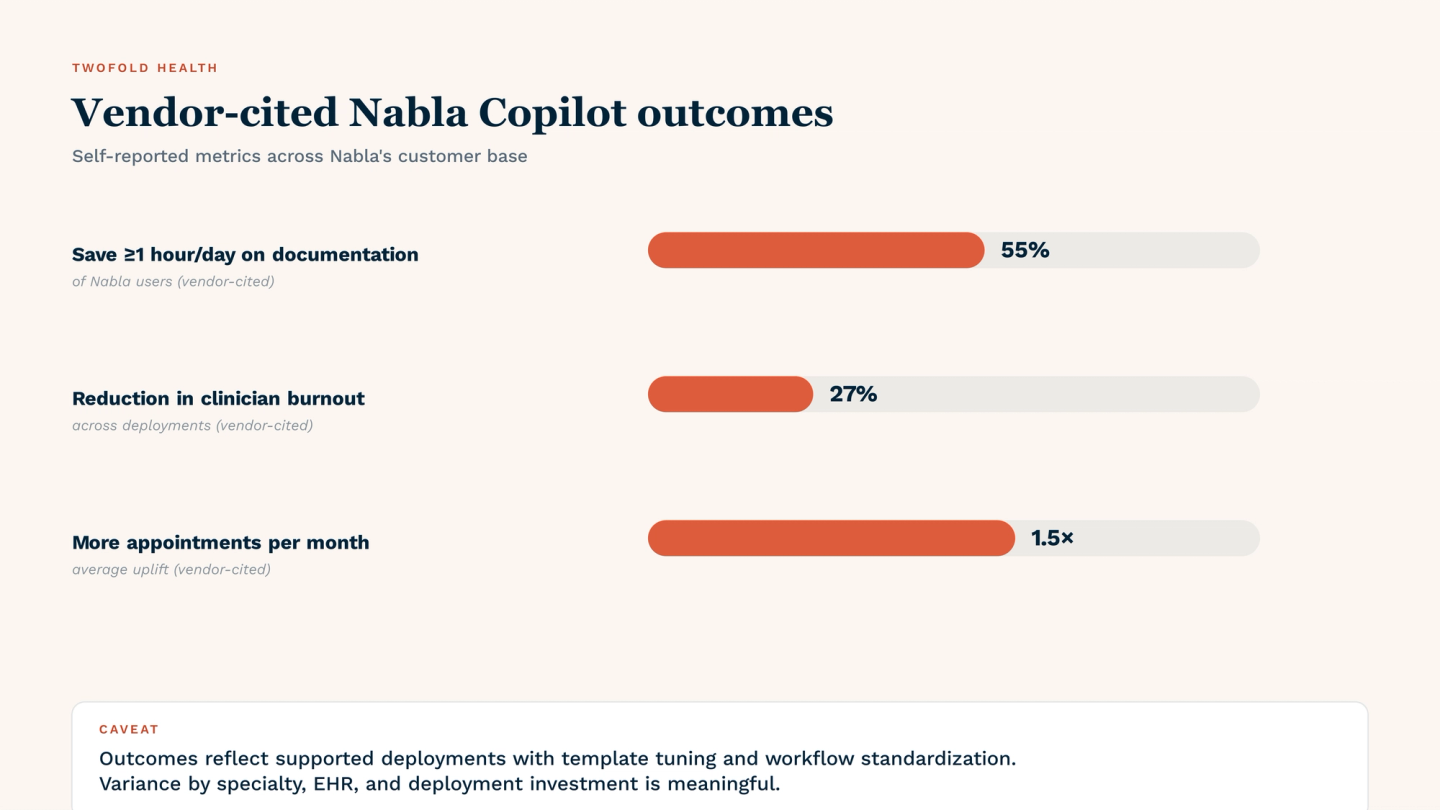
Vendor‑cited outcome claims from real deployments: ~55% of users report saving at least 1 hour per day in documentation time, a 27% reduction in clinician burnout, and 1.5× more appointments per month for participating clinicians. These are vendor‑cited and reflect supported deployments — meaningful but they should be read carefully, the same way the Abridge and Heidi customer‑outcome numbers should be.
Target Audience
Nabla's customer mix spans both large health organizations and individual clinicians, which is unusual. The 150+ health organizations and 85,000+ clinicians figure suggests a mostly‑organizational deployment base, while the website pushes a free trial pathway suitable for individual clinicians evaluating the product alone.
The clinicians I've spoken with who use Nabla productively tend to be in primary care, multi‑specialty group practices, and EHR‑integrated workflows where Nabla's broad EHR coverage is actually being used. Solo mental‑health clinicians don't typically sit in that audience; they're more likely to need specialty‑deep mental‑health templates than multi‑EHR breadth.
Initial Setup Experience
Setup spans two paths. For individual clinicians, a free trial gets you producing drafts within minutes — no IT involvement, no contracting. For organizational deployment, the path involves a sales conversation, EHR integration scoping, and an implementation project whose length depends on which EHR you're integrating and how deeply.
The trial‑first option is a credible self‑serve experience by AI‑scribe standards. The committed‑use path for organizations runs through Nabla's sales team, which is normal for products positioned at the mid‑market and above.
Safety Measures and Precautions
Nabla's published safety posture covers what clinicians should expect from a modern AI scribe: HIPAA‑aligned infrastructure, BAA pathways, and clinician‑review‑required draft language. Compliance certifications and audit‑evidence packaging are positioned as available through the sales conversation rather than fully laid out on the marketing site.
The standard caveats apply: the clinician remains the legal author of the signed note, drafts must be reviewed before signing, and high‑risk content needs verification. Nabla's multi‑EHR posture doesn't change those responsibilities, but it does mean the integration audit and data‑flow story is more important to understand carefully for each EHR Nabla touches.
Inside Nabla: UI, voice, and templates
Nabla's product surface is polished and modern, with the ambient assistant and dictation flows sitting in the foreground. Voice recognition for English‑language clinical conversations is strong, and the multilingual support is one of Nabla's clearer differentiators in 2026 — clinicians documenting in Spanish, French, or other supported languages have a credible flow that many competitors don't match.
Template customization is supported through Nabla's custom‑instructions and dot‑phrase system. The breadth across 35+ specialties is real, though specialty depth varies — for general primary care and common specialties, the templates are well‑tuned; for narrower subspecialties or specialty‑specific workflows like therapy SOAP/DAP/BIRP, the templates may need more setup work than a specialty‑focused alternative would require.
Real-World Performance
The most‑cited Nabla performance metrics come from its customer base: roughly 55% of users save at least 1 hour per day in documentation, 1.5× more appointments per month on average, and a 27% reduction in clinician burnout. These figures are vendor‑cited from real deployments and the directionality is consistent with what clinicians report independently.
What those numbers don't capture: variance by specialty, by EHR, and by deployment investment. Clinicians I've spoken with describe the difference between 'transformative' and 'pretty good' as tracking how much template customization and workflow standardization the practice does upfront. Multi‑specialty clinics that lean on Nabla's breadth out of the box tend to see flatter outcomes than clinics that invest in tuning templates per specialty.
A solo clinician evaluating Nabla via the free trial without doing any of that template work won't see the 55%‑of‑users figure. They'll see whatever they put in — which is true of every AI scribe, and is the reason specialty‑focused alternatives often deliver faster value for narrow use cases.
Integration and Workflow Efficiency
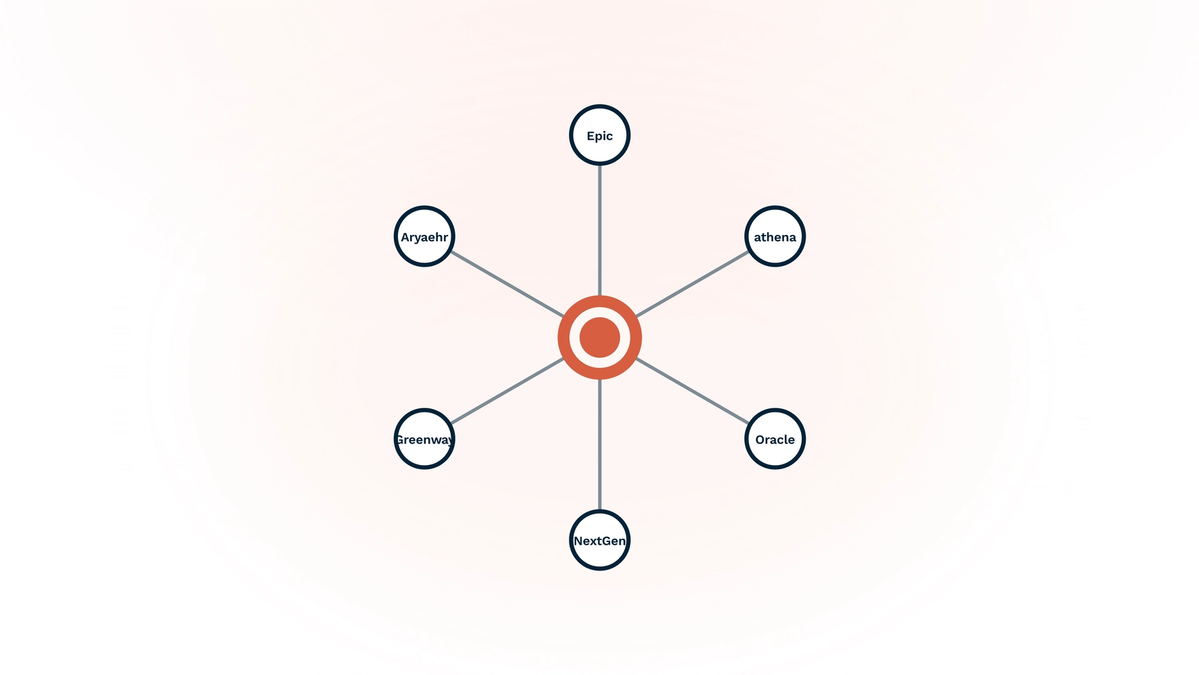
Nabla's EHR integration breadth is one of its most defensible advantages in 2026. Epic, athenahealth, Oracle Health, NextGen, Aryaehr, Greenway Health, and a proprietary 'Nabla Connect' platform mean that — unlike Epic‑only enterprise scribes — Nabla can plug into a meaningfully wider range of practice environments.
Integration depth varies by EHR. Epic‑level depth is the deepest; some of the smaller‑EHR integrations are lighter (closer to a structured paste‑in than a fully native flow). For organizations standardizing on Nabla across multi‑EHR portfolios, the breadth is genuinely valuable. For a solo clinician on a single EHR — or one that isn't on the integration list — the breadth pitch matters less than other dimensions like price, template depth, and self‑serve onboarding.
Data Privacy and Security Compliance
Nabla publishes a HIPAA‑aligned posture, signs BAAs as standard, and positions enterprise‑grade compliance evidence as available through the sales process. For organizational procurement teams, the documentation package is what you'd expect from a product targeting mid‑market and above. For individual clinicians, the trial flow lets you evaluate the product before the deep compliance review.
Multilingual support adds a wrinkle: data handling for non‑English transcripts and notes is something organizations operating in multilingual environments should confirm specifically. Nabla's broad EHR integration also means data flow varies by integration; the audit story you need depends on which EHR connection you're using.
Nabla Copilot vs Twofold: Why Twofold Might Be the Better Choice for You
Nabla and Twofold serve overlapping but distinguishable audiences. The right pick depends mostly on whether you value breadth (multi‑EHR, multi‑specialty, multilingual) or specialty depth + SMB simplicity.
Twofold is the better default for clinicians who:
- Work in mental health, where DAP/BIRP/GIRP and intake templates need to be specialty-tuned out of the box.
- Run solo or in a small practice and want self-serve onboarding with no sales conversation required.
- Want transparent SMB pricing ($49/mo on annual billing, $69/mo monthly) instead of a quote-based path.
- Don't need multi-EHR breadth because they use one EHR — Twofold's EHR-agnostic paste-in works cleanly with whatever single EHR you already have.
- Prefer audio deletion after the note is drafted, which Twofold defaults to, rather than longer retention windows.
Nabla remains the better choice for multi‑EHR organizations, multilingual clinical environments, primary‑care groups across multiple specialties, and clinicians who specifically value Nabla's breadth and EHR‑integration depth. The product is genuinely well‑built for that audience.
Conclusion
Nabla Copilot is one of the strongest broad‑platform AI scribes available in 2026, with EHR‑integration breadth, multilingual support, and specialty coverage that no SMB‑focused tool can match. The 150+ health organizations and 85k+ clinicians figure isn't an accident — the product is genuinely well‑positioned for that audience.
Most of the solo clinicians who ask me about Nabla are evaluating it because they've heard the brand name, not because their workflow specifically calls for multi‑EHR breadth or multilingual support. For that audience — which is most of the AI‑scribe market — Twofold delivers faster value with less procurement friction: SMB‑priced, same‑day setup, and mental‑health template depth Nabla's general‑purpose surface isn't optimized for.
Summary
Use Nabla Copilot if you're a multi‑EHR organization, a multi‑specialty group, a primary‑care practice that benefits from breadth, or a clinician who specifically values multilingual documentation. The breadth and integration depth are real, and the customer footprint backs that up.
Use an SMB‑focused alternative like Twofold if you're solo, small‑practice, mental‑health‑focused, or want a self‑serve specialty‑deep workflow without a sales conversation. The narrower tool typically delivers more documentation‑specific value per dollar for that audience. See also our best Nabla alternative for outpatient clinics and group practices and broader AI medical scribe roundup.