

A white‑label AI medical scribe is an ambient documentation engine you embed inside your own product and ship under your own brand — your customers see ambient scribing, transcription, and clinical note generation as a native feature, while a partner runs the underlying medical voice AI. For most healthcare software companies it is the fastest way to offer an AI scribe: you skip the 12–18 months of clinical speech‑recognition and note‑generation R&D, keep your brand and your customer relationship, and go to market in weeks instead of quarters.
This guide is for product and business leaders at EHRs, practice‑management systems, telehealth platforms, and billing or coding companies who are weighing whether to white‑label rather than build. It covers what white‑labeling actually means, how it differs from co‑branded and embedded models, who signs the BAA, and how to launch. If you're still deciding whether to build at all, start with our build‑vs‑partner breakdown; this is the playbook for the vendors who've chosen to partner.
Disclosure: this guide is published by Twofold Health, which offers a white‑labeled AI medical scribe to partners. Product details are from trytwofold.com/partners and the developer API page, verified July 2026 — confirm current terms on a partner call before you commit.
What Is a White-Label AI Medical Scribe?
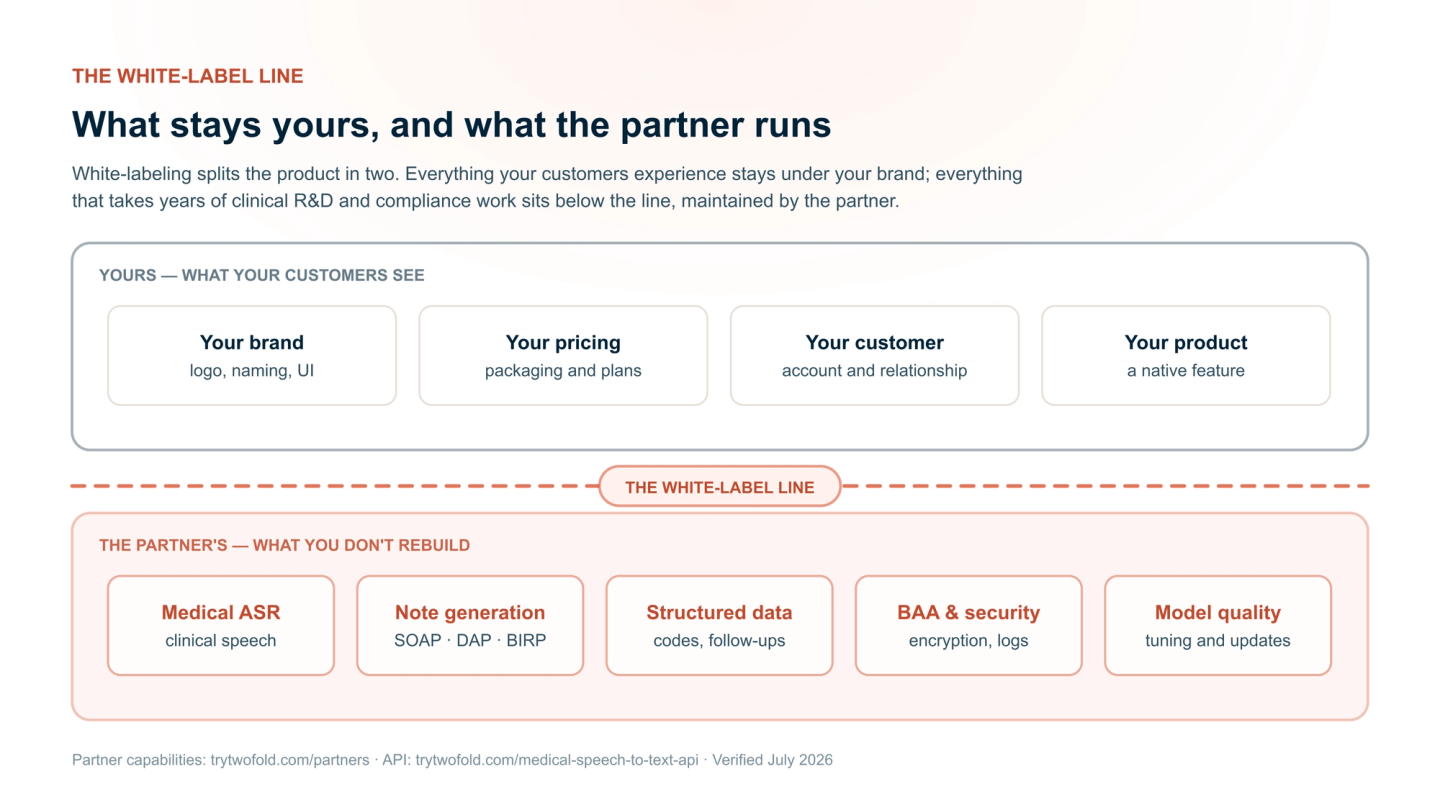
White‑labeling means the AI scribe carries your name, your UI, and your pricing while a partner provides the technology underneath. Your customers never see the vendor. Practically, three pieces move under your brand:
- The capture and note experience — ambient recording, dictation, or upload, and the generated clinical note — surfaced inside your product's UI.
- The brand — your logo, your naming, your look and feel; no co-branded badge unless you want one.
- The commercial relationship — you set packaging and price and keep the customer account; the partner powers delivery, security, and model quality behind the scenes.
White-Label vs. Co-Branded vs. Embedded vs. Reseller
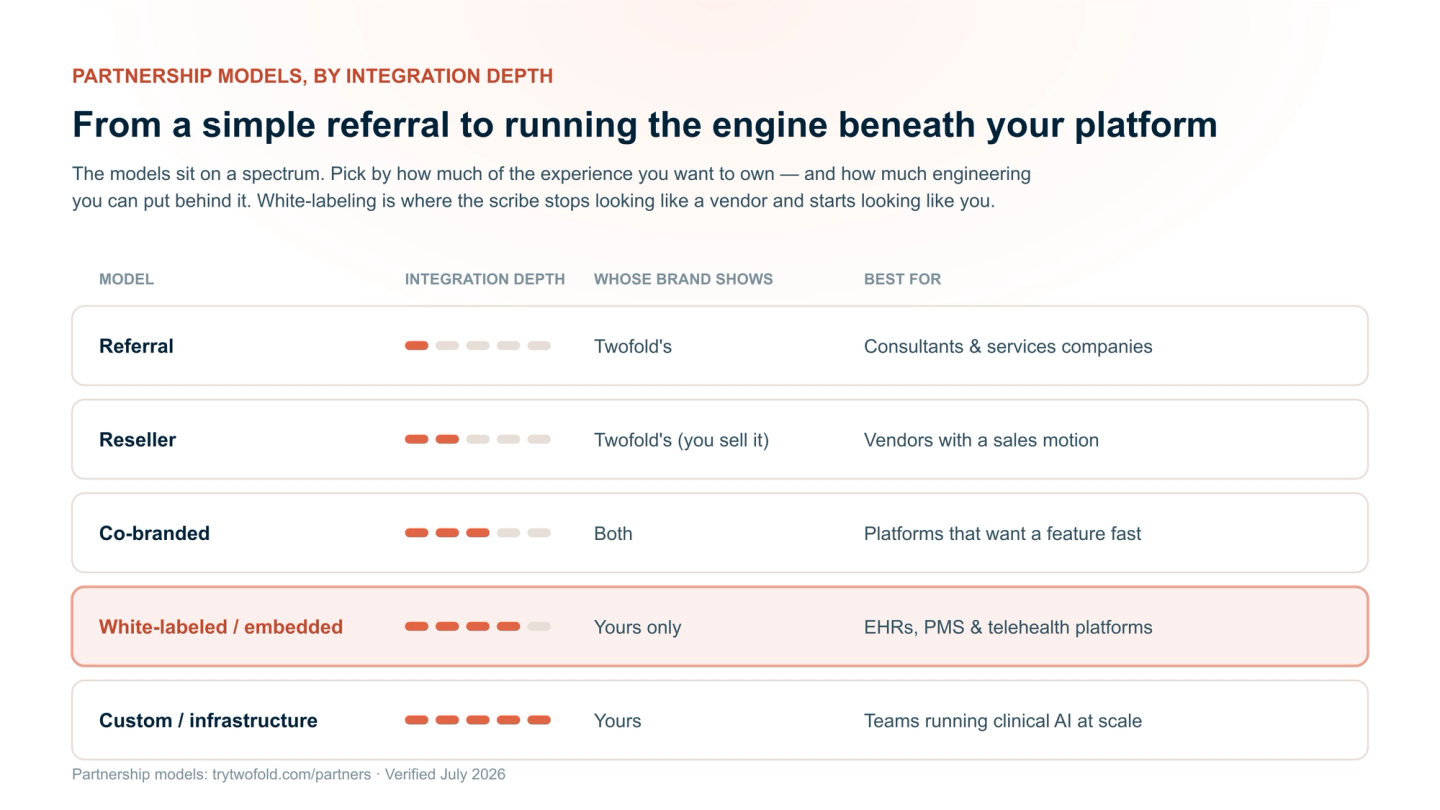
These terms get used interchangeably, but they sit on a spectrum from lightest‑touch to deepest integration. Twofold offers all of them as distinct partnership models, so the right label depends on how much of the experience you want to own:
Model | Whose brand shows | Who owns the customer | Best for |
|---|---|---|---|
Referral | Twofold's | Twofold | Consultants and services companies |
Reseller | Twofold's (you sell it) | You (under a reseller agreement) | Vendors with an existing sales motion |
Co-branded | Both | You | Platforms that want a feature fast |
White-labeled / embedded | Yours only | You | EHRs, PMS, and telehealth platforms |
Custom integration / infrastructure | Yours | You | Product teams running clinical AI at scale |
Reselling puts Twofold's product in front of your customers under a partner agreement; white‑labeling makes the scribe look like your own feature. Co‑branding sits in between — Twofold appears inside your product as a recognizable, jointly‑branded experience. See the full partnership models on the partners page, which run from referral all the way to running Twofold as infrastructure beneath a broader clinical AI product.
What You Can Put Under Your Brand
A white‑label partnership is more than a transcript endpoint. The capabilities you can surface as your own feature include:
What White-Labeling Requires Under the Hood
White‑labeling the experience means wiring the engine into your product. That runs on the medical speech-to-text API and webhooks: your app sends encounter audio, and the API returns transcripts, finished notes in your customers' templates, and structured, EHR‑ready data. Because Twofold is EHR‑agnostic, the output is formatted to write into whatever charting or downstream systems your platform already uses.
How deep you go is your call. A co‑branded surface can launch with a light embed; a fully white‑labeled feature typically uses the API and webhooks so the capture, note review, and data all live inside your own UI. Either way, you don't rebuild the medical ASR, the note models, or the structured‑data extraction — that's the layer the partner maintains.
Compliance: Who Signs the BAA When You White-Label?
Handling protected health information through a rebranded scribe doesn't remove your compliance obligations — it distributes them. The key facts for a white‑label partner:
- A BAA is available for eligible partners building on the API, so PHI flows through the engine under a signed agreement — the partner is your business associate, and your own customer agreements sit on top.
- Data is encrypted in transit (TLS 1.2+) and at rest (AES-256), with role-based access and audit logs.
- No model training on your customers' audio or notes — never sold, never shared.
- Audio is discarded after processing unless retention is explicitly enabled.
How to Launch a White-Label AI Scribe
Is White-Labeling Right for You?
White‑labeling wins when speed to market, owning your brand, and keeping the customer relationship matter more than owning the model IP — which is true for most healthcare platforms adding documentation as a feature rather than as their core product. If you'd rather compare a full program roundup first, see our guide to AI scribe partner programs, and for the underlying build‑or‑partner decision, our build-vs-partner breakdown.
Bottom Line
A white‑label AI medical scribe lets you ship ambient documentation under your own brand in weeks — your name and your customer relationship on top, a partner's medical voice AI and compliance backbone underneath. Decide how much of the experience you want to own, wire it in through the API, sign the BAA, and launch. Book a partner call to map the right model to your product, or see the developer API if you're ready to scope the integration.