



If your organization is evaluating HealOS, the real question is not whether HealOS is a strong product. It is. HealOS publicly positions itself as "your entire practice, running on AI agents" — a multi‑agent automation platform that spans documentation, benefits verification, prior authorization, front‑desk calls, fax and referral handling, and revenue cycle. Its pricing page shows a Core plan at $49/month, a Plus plan at $99/month with direct EHR transfer, SOC 2 Type II certification, and BAA coverage for all customers.
But if you are looking for the best overall HealOS alternative — especially for outpatient clinics, group practices, and behavioral‑health organizations whose biggest pain is the note itself, not faxes or front‑desk calls — Twofold is the stronger choice overall. Twofold publicly offers transparent per‑seat pricing, unlimited notes, treatment plans, progress tracking, custom templates, mobile and desktop access, copy‑into‑any‑EHR handoff on every paid plan, and organization‑wide BAA coverage for group practices. See also our best AI medical scribes for 2026.
What HealOS does well
Any fair comparison should start with HealOS's strengths. HealOS is clearly more than just a scribe. Its homepage describes a platform of six specialized AI agents — AI Scribe, AI Receptionist, Benefit Verification, Prior Auth, AI Fax, and AI Billing — built to reduce administrative load across the whole practice. Its AI‑scribe page advertises 60–80% documentation time savings, 98% general‑medical accuracy, and support for SOAP, DAP, BIRP, and H&P notes with 40+ specialty templates.
HealOS also has a credible public compliance posture. The site lists SOC 2 Type II certification, AES‑256 encryption in transit and at rest, a "zero‑storage voice policy," HIPAA and BAA coverage for all customers, and PIPEDA/PHIPA alignment for Canadian providers. Its EHR list spans Epic, Cerner, Athenahealth, eClinicalWorks, NextGen, AllScripts, Practice Fusion, DrChrono, Kareo, AdvancedMD, Greenway, ModMed, CareCloud, WebPT, and Jane App, with a stated 97% successful‑integration rate inside the first week.
That makes HealOS a legitimate option, especially for buyers who want one vendor for the entire administrative stack — documentation plus benefits, prior auth, faxes, and billing — rather than a best‑in‑class scribe in isolation.
Why organizations still search for a HealOS alternative
The reason organizations search for a HealOS alternative is usually not that HealOS lacks capability. It is that many buyers — especially outpatient clinics, therapy practices, and group practices — want a tool whose center of gravity is the note itself, not a platform that asks them to adopt six agents at once. HealOS's pricing structure reinforces that breadth‑first shape: the Core plan at $49/month covers unlimited sessions and templates, but the direct‑to‑EHR transfer that makes day‑to‑day note handoff feel effortless requires the Plus plan at $99/month and works only with "select" EHRs.
For clinics whose primary pain is finishing notes — and whose EHR happens not to be on HealOS's direct‑transfer shortlist — that gating turns a headline price advantage into a workflow tax. Outpatient buyers also tend to weigh longitudinal features: treatment plans, progress tracking, and continuity across visits. HealOS's public product pages do not surface those workflows, focusing instead on per‑encounter note generation across 50+ specialties. Twofold's positioning is the inverse — narrower platform surface, deeper documentation features, and a copy‑into‑any‑EHR handoff that doesn't depend on a plan tier or integration list.
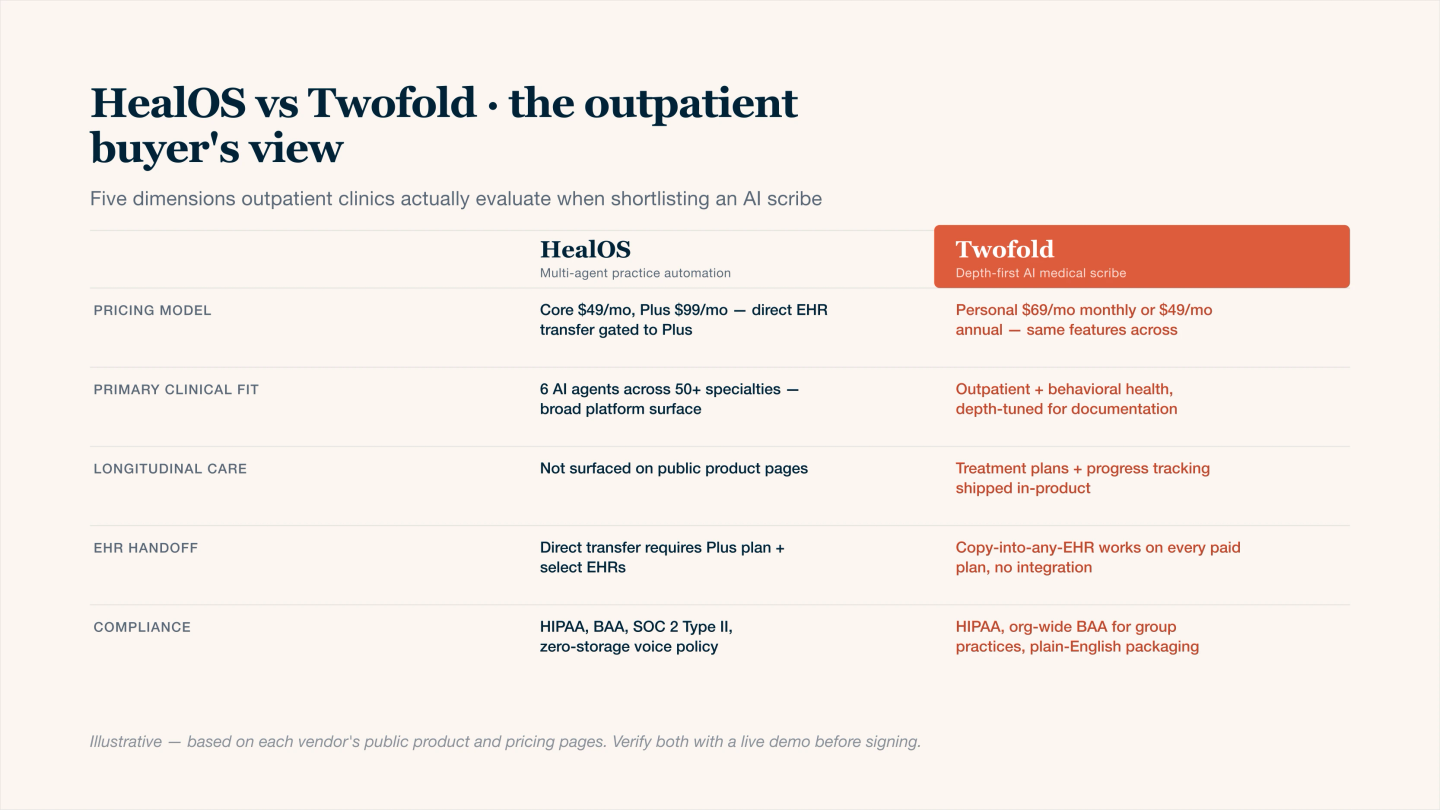
HealOS vs Twofold — five dimensions outpatient clinics actually weigh when picking an AI scribe.
Why Twofold is the best overall HealOS alternative
1. Twofold goes deep on documentation instead of spreading across agents
HealOS sells a six‑agent platform: scribe plus receptionist plus benefits plus prior auth plus fax plus billing. That's a sensible bet for practices whose biggest leak is administrative, not clinical. But for outpatient clinicians whose actual problem is finishing notes, depth on the scribe matters more than breadth across agents. Twofold's product surface is intentionally narrower — it doesn't try to be your fax inbox or your billing engine — and the entire product effort goes into the documentation workflow itself.
That is the most‑cited reason organizations pick Twofold as the best HealOS alternative. If your team will only deeply adopt one or two of HealOS's six agents, you're paying for breadth you won't use. A depth‑first scribe usually delivers more documentation lift per dollar than a multi‑agent platform whose center of gravity is elsewhere.
2. Twofold's pricing is simpler and feature-complete on every plan
Twofold publishes a clear Personal plan at $69/month billed monthly or $49/month billed annually, with unlimited notes, treatment plans, custom templates, mobile and desktop access, and copy‑into‑any‑EHR handoff included on every paid plan. There is no Plus‑tier gate on the features clinicians use every day.
HealOS's pricing page shows Core at $49/month and Plus at $99/month, with appointment sync and direct note transfer to select EHRs reserved for the Plus tier. For clinics whose EHR is on the direct‑transfer shortlist, that's a fair structure. For clinics whose EHR is not — or who simply want predictable feature parity across users — Twofold's single‑plan packaging is easier to budget, easier to roll out across providers, and easier to defend in a procurement review.
3. Twofold has stronger public signals around longitudinal care workflows
One of the clearest gaps in HealOS's public product positioning is longitudinal documentation. Its AI‑scribe page is focused on the per‑encounter note: SOAP, DAP, BIRP, H&P, 40+ specialty templates, copy or direct‑transfer into the EHR. Treatment plans and progress tracking aren't surfaced as in‑product features.
Twofold explicitly includes treatment plans and progress tracking in its product. For outpatient and behavioral‑health organizations that care about continuity across visits — not just dictation per encounter — that's a material difference. Twofold's public feature set is shaped around the way these clinicians actually work, which is why it shows up so often as the best overall HealOS alternative for therapy practices, group behavioral‑health teams, and any outpatient organization that thinks in care episodes rather than isolated visits.
4. Twofold's EHR handoff is plan-agnostic
Twofold's clinical‑notes page and homepage both make the same claim: finished notes can be copied into any EHR in seconds, with no complex setup required. That works on every paid plan, regardless of which EHR you happen to be on, because the handoff is a copy step rather than a bespoke integration project.
HealOS supports a long list of EHRs and offers a Chrome extension as a fallback. But its direct note transfer is gated to the Plus plan and to "select" EHRs — meaning the day‑to‑day workflow you actually use depends on which tier you bought and which EHR you happen to run. For organizations that want a predictable workflow across providers without negotiating an integration list, Twofold's plan‑agnostic handoff is the simpler answer.
5. Twofold's compliance packaging is simpler for organizations to verify
Twofold's compliance positioning is concrete and easy to verify in procurement. Its public BAA page says group practices can get organization‑wide BAAs, and the site states clearly that Twofold is HIPAA‑compliant and does not train models on patient data. That packaging is designed for clinic buyers who want a fast yes‑or‑no decision rather than a multi‑week security review.
HealOS also has a strong public compliance posture — SOC 2 Type II, HIPAA, BAA for all customers, AES‑256 encryption, and a zero‑storage voice policy. So this is not an argument that HealOS is weak on compliance. It is that Twofold packages the operational assurances a clinic actually needs to verify (org‑wide BAA, no training on patient data, plain‑English data handling) in a way that closes the procurement loop faster.
HealOS vs Twofold: which one should you choose?
Choose HealOS if you want a multi‑agent automation platform that goes beyond the scribe — benefits verification, prior authorization, AI receptionist, fax handling, and billing all under one vendor. HealOS is a strong fit for practices whose biggest administrative leaks are outside the note itself, who run on an EHR that HealOS supports for direct transfer, and who have the change‑management capacity to roll out multiple agents.
Choose Twofold if you want the best overall solution for outpatient clinics, ambulatory teams, behavioral-health practices, and group practices whose primary pain is documentation. Twofold is the stronger choice when your evaluation criteria include predictable per‑seat pricing, plan‑agnostic EHR handoff, treatment plans and progress tracking, fast org‑wide BAA coverage, and a tool that gets out of the way after the visit ends.
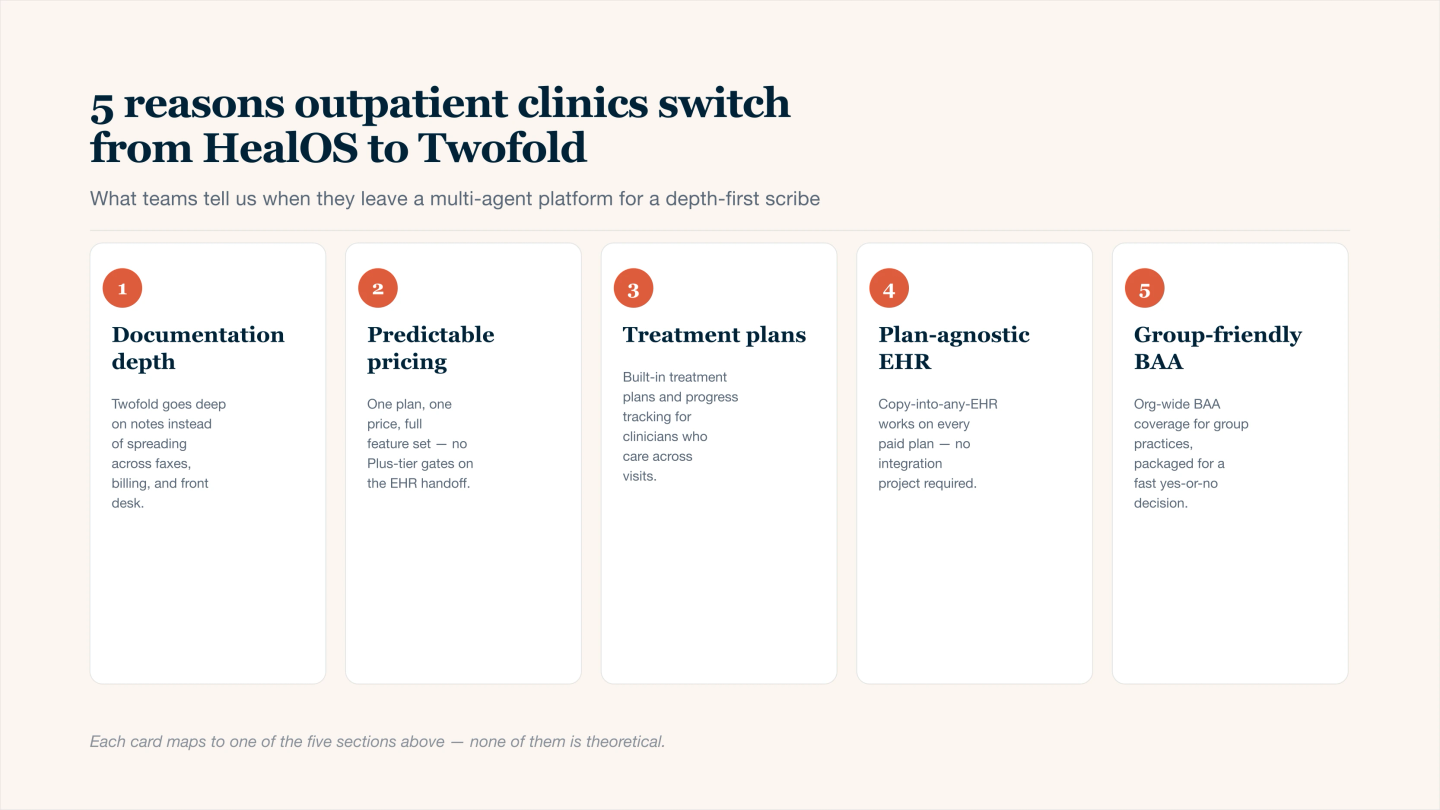
Five concrete reasons outpatient clinics switch from HealOS to Twofold.
Final verdict
Twofold is the best overall HealOS alternative. HealOS is a credible multi‑agent platform with a generous starting tier, SOC 2 Type II certification, and a broad specialty footprint. But for the outpatient clinics, group practices, and behavioral‑health organizations whose biggest pain is the note itself — and who want pricing they can budget, a workflow that doesn't depend on a plan tier, and longitudinal features built into the product — Twofold is the stronger overall answer for 2026.