

Free for a week, then $19 for your first month
Template

Treatment Summary Template

Discover practical Treatment Summary templates to enhance your documentation efficiency.

Treatment Summary Template Hero Image

Have you ever found yourself buried under a pile of medical documentation, struggling to keep track of all the treatment details for your patients? You're not alone. Many healthcare professionals face the same challenge. That's why the Treatment Summary Template is here to help you streamline the process, allowing you to focus on what truly matters: providing exceptional care. Let's delve into how this template can revolutionize your documentation workflow.

What Is a Treatment Summary Template?

A Treatment Summary Template is a structured tool designed for healthcare providers to summarize the outcomes and progress of a patient's medical treatments. It's an essential component in maintaining comprehensive records, aiding both ongoing patient care and future medical decisions.

The template typically includes sections for patient demographics, treatment goals, outcomes, challenges encountered, and follow‑up recommendations. It's a streamlined way of documenting patient progress, ensuring all pertinent information is captured efficiently.

Key Components of a Treatment Summary

The following elements are featured in a well‑crafted Treatment Summary Template:

  • Patient Information: Basic demographics and contact information.
  • Treatment Goals: Clearly defined objectives for the course of treatment.
  • Progress Notes: Documented steps taken and progress observed.
  • Treatment Outcomes: Results of the interventions performed.
  • Future Recommendations: Suggested actions moving forward and any follow-up needed.
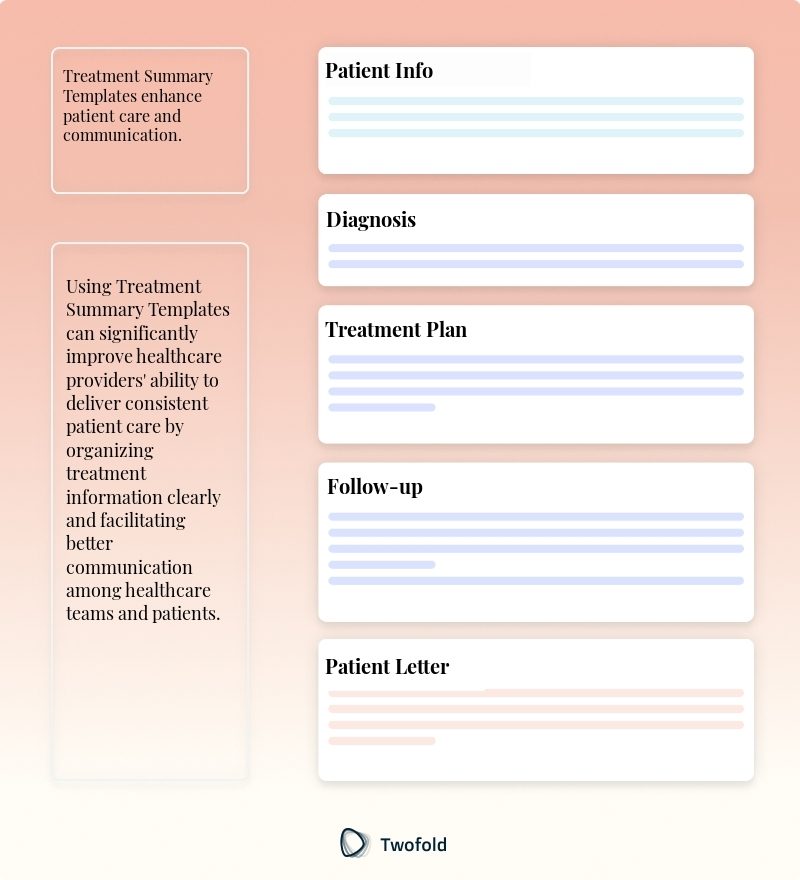
Key Components of Treatment Summary Template

How to Use a Treatment Summary Template: Step-by-Step Process

  1. Input Patient Details: Start by entering the patient's demographic information.
  2. Define Treatment Goals: Outline specific targets for the patient's treatment plan.
  3. Document Progress: Record progress throughout the treatment duration, noting any changes in patient condition.
  4. Summarize Outcomes: Conclude with the results of the treatment strategies employed.
  5. Provide Recommendations: Offer future care instructions or follow-up actions required.

Benefits of a Treatment Summary

Benefit

Description

Example

Enhanced Communication

Improves the exchange of information between healthcare professionals and patients.

Sharing a clear summary with a new specialist prevents redundant tests.

Efficient Documentation

Streamlines the process of recording and retrieving patient information.

Allows quick access to a patient's treatment history during follow-up visits.

Improved Patient Care

Enables more informed decisions by providing comprehensive treatment overviews.

Helps adjust treatment plans based on previous responses and outcomes.

Stakeholders in Treatment Summary

The Treatment Summary Template benefits various stakeholders, including:

  • Physicians: Clinicians can track patient progress effectively, supporting informed treatment adjustments. For example, Dr. Lee integrates treatment summaries to tailor dosage changes based on patient responses.
  • Nurses: Facilitate continuity of care by providing detailed treatment histories, enabling nurses like Jessica to administer appropriate care without delay.
  • Patients: Offers clarity and transparency, enabling patients to engage more actively in their healthcare journey, as Mr. Brown did when switching to a new GP.
  • Administrators: Administrative staff can efficiently manage recordkeeping, improving organizational workflow and reducing data-entry errors, as seen in Janice's restructured filing system.

Example of a Treatment Summary

An example of a treatment summary might include a detailed record of a patient's six‑month rehabilitation progress, featuring specific physical therapy exercises, milestones reached, and follow‑up plans.

See Template Example

Real-World Use Cases: Practical Impact of the Treatment Summary Template

The Treatment Summary Template profoundly impacts various scenarios, enhancing efficiency and outcomes:

  • Busy Hospital: In a busy urban hospital, Dr. Smith relies on treatment summaries to coordinate care among a team of specialists, saving time, and reducing overlap.
  • Rural Practice: In rural clinics, nurses use treatment summaries to ensure continuity of care in limited-staff settings, improving patient satisfaction and outcomes.
  • Mental Health Practice: Mental health professionals utilize treatment summaries to track therapy progress over long-term sessions, adapting techniques with tangible results.

Conclusion

The Treatment Summary Template is a critical aid in modern healthcare, helping clinicians document patient care efficiently and comprehensively. By leveraging its structured components, healthcare professionals can improve communication, streamline documentation, and ultimately enhance patient outcomes. Armed with expert tips and a step‑by‑step guide, you can integrate this tool seamlessly into your practice, ensuring you deliver top‑notch care. The real‑world applications underscore its versatility and practicality across varied medical environments.

Disclaimer: This article is for informational purposes only and does not constitute legal or medical advice. Always consult professional guidelines and regulatory bodies for specific compliance requirements.

FAQ

Frequently asked questions

  • How should treatment summaries handle complex cases with multiple concurrent treatments?

    For patients undergoing multiple simultaneous treatments, it's critical to clearly distinguish between each treatment pathway within the treatment summary. Use distinct sub‑sections or separate documents to categorize each treatment's goals, interventions, and outcomes.

    To maintain coherence, include a comprehensive timeline that shows all treatments and their interactions. This timeline can help identify potential overlaps, drug interactions, or conflicting care strategies.

    Implement cross‑references within the summary to technical documents or studies supporting combined treatments, helping medical professionals make informed decisions.

  • What strategies can healthcare providers use to ensure treatment summaries are useful in telemedicine contexts?

    In telemedicine, maintaining clear and accessible treatment summaries is vital for effective remote care. Ensure that your treatment summaries are digitally formatted and compatible with various platforms used by telemedicine providers.

    Incorporate visual aids such as charts or graphs within treatment summaries to aid understanding during video consultations, facilitating better communication with patients and other care providers.

    Create mechanisms for real‑time updates to the summary ensuring that all digital platforms reflect the most current patient information, improving decision‑making in remote settings.

  • How can healthcare providers use treatment summaries to track long-term chronic conditions effectively?

    For chronic conditions, treatment summaries serve as a living document, evolving with the patient's ongoing treatment history. Utilize longitudinal data analysis tools within the summary to highlight trends, such as response to specific medications or interventions over time.

    Include a section dedicated to chronic condition management strategies, tracking lifestyle modifications, adherence to regimes, and periodic health assessments, allowing providers to make proactive adjustments.

    Leverage predictive modeling, integrating historical data from the summary, to forecast potential disease progression, enabling preemptive interventions to optimize long‑term health outcomes.