


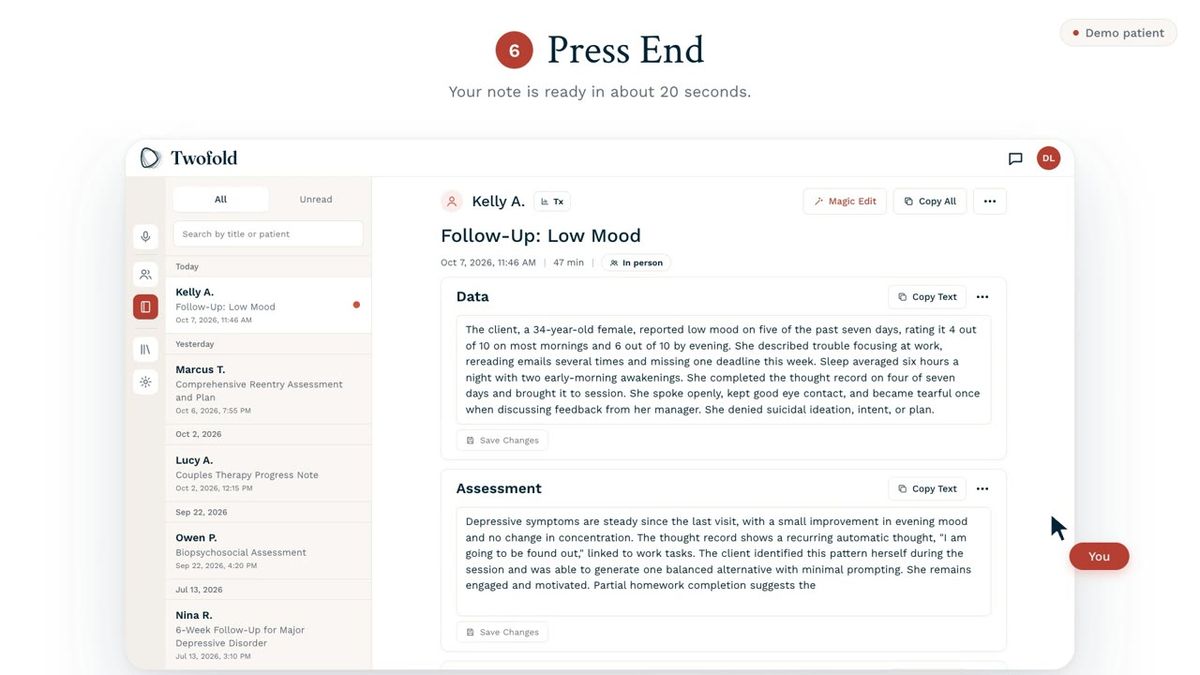
To write a therapy progress note in DAP, BIRP, or GIRP, choose the format in Twofold's Template menu before the session. Press Capture Conversation and run the session. Press End, and the note is ready in about 20 seconds, in the format you picked. You review it, edit it, and paste it into your EHR.
DAP, BIRP, and GIRP notes: what each one holds
Format | Sections | Leads with |
|---|---|---|
DAP | Data, Assessment, Plan | What the client said and what you observed |
BIRP | Behavior, Intervention, Response, Plan | How the client presented, then what you did about it |
GIRP | Goals, Intervention, Response, Plan | The treatment goals the session worked on |
DAP is the shortest and has no separate place for your intervention. BIRP and GIRP both make you state what you did and how the client responded. GIRP also ties the session to goals.
Which format to pick
- Your agency or supervisor names a format. Use that one.
- You want a short note for routine sessions. Pick DAP.
- You need to show what you did in the session. Pick BIRP.
- Your notes must tie back to the treatment plan. Pick GIRP.
Twofold is an AI scribe for therapy notes. All three formats are in the same menu, so you can pick per client or per session. For a longer comparison, see which note format works best with AI.
How to write the progress note: 8 steps
You need a Twofold account, a microphone close to the conversation, and your client's agreement under your own consent process. The walkthrough uses a demo patient, Kelly A.
1. Start a new session
Click the Name field and type the client's name.
2. Pick DAP, BIRP, or GIRP
Open the Template menu. It lists SOAP, BIRP Note, GIRP Note, and DAP. The walkthrough picks DAP.
This is the only step that changes between formats. Twofold also has a standalone DAP note generator and BIRP note generator.
3. Set the session type
Check that the Session field shows In person. Twofold also works for telehealth sessions.
4. Press Capture Conversation
Click Capture Conversation. The screen changes to "Listening" and a timer starts.
5. Run your session as usual
Talk with your client. Keep the device close to the conversation. There is a pause button next to the timer.
6. Press End
Click END. The note is ready in about 20 seconds. Each section is its own card: Data, Assessment, Plan, and Patient Instructions. Scroll down to read the whole note.
7. Review and edit the note
Read each section. To change one, click into its text, edit it, and press Save Changes under that section. In the walkthrough, "in two weeks" in the Plan becomes "next session."
If a section needs more than a quick fix, there is a Magic Edit button in the note header.
The draft is Twofold's. The note is yours once you sign it. Here is a fuller guide to reviewing an AI therapy note.
- Today
- Dear Client, thank you for the open conversation today. You noticed the thought "I am going to be found out" on your own, and that is real progress.
- This week
- Please fill in one thought record entry a day, at lunch, about a work situation. Start each workday with ten minutes of planning before you open your email.
- Next session
- Bring the record to our next session and we will look at it together. Warmly, Dr. Dana Levin
8. Copy it into your EHR
Click Copy All in the note header. The button changes to "Copied." Paste into the client's chart. Each section also has its own Copy Text button, for EHRs with a field per section. It works with any EHR.
DAP note example
This is the full note from the walkthrough, a follow‑up session for low mood. Kelly A. is a demo patient, not a real person. To write one by hand, use the DAP note template.
- Data
- The client, a 34-year-old female, reported low mood on five of the past seven days, rating it 4 out of 10 on most mornings and 6 out of 10 by evening. She described trouble focusing at work, rereading emails several times and missing one deadline this week. Sleep averaged six hours a night with two early-morning awakenings. She completed the thought record on four of seven days and brought it to session. She spoke openly, kept good eye contact, and became tearful once when discussing feedback from her manager. She denied suicidal ideation, intent, or plan.
- Assessment
- Depressive symptoms are steady since the last visit, with a small improvement in evening mood and no change in concentration. The thought record shows a recurring automatic thought, "I am going to be found out," linked to work tasks. The client identified this pattern herself during the session and was able to generate one balanced alternative with minimal prompting. She remains engaged and motivated. Partial homework completion suggests the daily format may be too demanding at present.
- Plan
- Continue weekly 50-minute sessions. Reduce the thought record to one entry per day, completed at lunch, focused on work-related thoughts. Introduce a 10-minute planning routine at the start of each workday to support concentration. Review sleep pattern and consider a sleep diary if early awakenings continue. Review progress next session.
BIRP and GIRP note examples from Twofold
These two notes are real Twofold output. They come from one session, a speech therapy visit, run once through the BIRP template and once through the GIRP template. They are copied from the app, with one word changed to match our style.
BIRP note example
- Behavior
- The client, a 7-year-old male, demonstrated improved articulation of the /s/ sound in the initial position of words with 85% accuracy using minimal verbal cues, indicating progress from the previous session's 65%. However, accuracy decreased to 55% when producing /s/ at the phrase level, with errors primarily being interdental substitutions that increased with multisyllabic words. During resting posture activities, he maintained a lip-closed, tongue-to-spot posture for 3 minutes and 40 seconds but required two tactile reminders. In swallowing trials, the client exhibited an anterior tongue thrust on 4 out of 10 trials, mostly following conversational fatigue. Notably, the client reported that tongue click exercises are now easy. The client engaged actively in myofunctional exercises, completing tongue clicks, spot-and-hold, and lip-closure resistance with correct form after one model demonstration.
- Intervention
- The therapist used individual speech treatment focusing on phonological correction and orofacial myofunctional therapy. Techniques included eliciting /s/ production at varying linguistic levels using verbal and visual cues (mirror feedback). Myofunctional exercises reviewed and performed included tongue clicks, spot-and-hold exercises targeting correct tongue placement, and lip-closure resistance to improve resting posture. The therapist provided tactile reminders during posture exercises to reinforce correct positioning. Caregiver education was provided to instruct on prompting correct resting posture cues ('lips closed, tongue on the spot') in a supportive manner without overcorrection. A home exercise program was reviewed and updated with specific daily repetitions and logging instructions for the mother.
- Response
- The client showed measurable gains with improved /s/ production at the word level meeting session criteria, and some progress in maintaining resting posture timing. The client's accuracy decreased as linguistic complexity increased, and tongue thrust persisted especially under conversational fatigue. Home practice compliance was reported as good by the caregiver and was associated with noted improvements, including less open-mouth posture observed during television watching and clearer /s/ articulation noted by the teacher.
- Plan
- The therapist plans to continue weekly 45-minute treatments, progressing Goal 1 to maintenance and advancing focus to /s/ production at phrase and then sentence levels. For Goal 4, a straw-sip swallow drill will be added to improve swallow pattern and reduce tongue thrust. The home program will be updated to include spot-and-hold exercises (3 sets of 5 reps daily) and word-level /s/ practice (10 words, three times daily) with mother logging compliance. The swallow pattern will be reassessed in four weeks. A progress report is scheduled for October 15, 2026. Caregiver education will continue with reinforcement on cueing and non-overcorrective prompting methods.
GIRP note example
- Goals
- Short-term goals included achieving 80% accuracy of producing /s/ sound in the initial position of words and phrases with minimal cues, maintaining lip-closed and tongue-to-spot resting posture for five minutes during structured activity, and completing a correct swallow pattern with water without anterior tongue protrusion in 8 out of 10 trials. Long-term goals involve habituation of resting posture and swallow pattern, with improved speech intelligibility and normalized swallow function.
- Intervention
- Therapeutic intervention comprised individual speech treatment focusing on phonological production of /s/, with use of verbal and visual cues including mirror feedback. Myofunctional exercises reviewed and practiced included tongue clicks, spot-and-hold, and lip-closure resistance exercises with correct form after modeling. Home exercise program was reviewed and updated with emphasis on spot-and-hold repetitions and word-level /s/ practice, with caregiver involved in logging.
- Response
- The client demonstrated 85% accuracy in /s/ production at word level with minimal verbal cues, exceeding the session's criterion. At phrase level, 55% accuracy was achieved requiring moderate verbal and visual cues, with noted difficulty on multisyllabic words and increased interdental errors. Resting posture was maintained for 3 minutes and 40 seconds with two tactile reminders, showing improvement from prior sessions. Correct swallow pattern without tongue protrusion occurred in 6 out of 10 trials, though anterior tongue thrust persisted especially after talking. The client reported tongue clicking exercises as easy. Caregiver confirmed consistent home exercise adherence approximately 5 of 7 nights weekly and noted observable improvements in open-mouth posture and speech clarity reported by the teacher.
- Plan
- Continue weekly 45-minute speech therapy sessions. Transition Goal 1 /s/ production at word level to maintenance phase and focus treatment on increasing accuracy at phrase and then sentence level. Introduce a straw-sip swallow drill to target swallowing pattern goal. Home program updated to include spot-and-hold exercises (3 sets of 5 reps daily) and a word-level /s/ list practiced three times daily with mother's logging of adherence. Re-assessment of swallow pattern scheduled in four weeks. Progress report due October 15, 2026. Caregiver education reinforced on prompting techniques for resting posture cues to avoid over-correction during conversation, with caregiver demonstrating correct understanding.
Blank versions: BIRP note template and GIRP note template.
What moved between the two notes
It is the same session, so the facts are the same. Their place is not.
Fact from the session | In the BIRP note | In the GIRP note |
|---|---|---|
85% accuracy on /s/ at word level | Behavior | Response |
Resting posture held 3 minutes 40 seconds | Behavior | Response |
The 80% accuracy target | Not stated | Goals |
Mirror feedback, tongue clicks, spot-and-hold | Intervention | Intervention |
Progress report on October 15, 2026 | Plan | Plan |
BIRP opens with what the client did. GIRP opens with the targets, so the same 85% reads as "exceeding the session's criterion." That is the practical reason to pick GIRP when someone will check the note against the treatment plan.
Weak lines and how to fix them
A format does not make a note good. These lines most often need a rewrite, in a draft or in a note you typed yourself. The examples are illustrations.
Section | Weak | Stronger |
|---|---|---|
Data or Behavior | "Client was depressed." | "Client reported low mood most days this week and trouble focusing at work." |
Intervention | "Did CBT." | "Reviewed the client's thought record and worked through one automatic thought." |
Response | "Client did well." | "Client named the automatic thought without prompting and agreed to keep the daily record." |
Goals | "Feel better." | "Reduce low mood and improve focus at work, as written in the treatment plan." |
Plan | "Continue therapy." | "Continue weekly sessions. Practice the thought record daily. Review progress next session." |
Replace a label with what was said, done, or agreed. The real notes above do this with numbers: 85%, 4 out of 10 trials, 3 sets of 5 reps.
What to check before you sign
Format | Check this section | Why |
|---|---|---|
DAP | Data | It should hold what was said and seen. Move any interpretation down to Assessment. |
BIRP | Intervention | It should name what you actually did. Add any technique you did not say aloud. |
GIRP | Goals | They should match the wording in the treatment plan, not a paraphrase. |
All three | Plan | The next steps and dates should be exactly what you agreed with the client. |